
You're standing outside a tattoo shop in Bournemouth with a saved folder of reference images, a rough idea for placement and one uncomfortable question: how do you know the studio is safe, not just stylish? A strong portfolio matters, but it won't tell you how the artist prepares a workstation, what jewellery a piercer uses or whether the premises meet local requirements.
That's why choosing a tattoo studio in Bournemouth should involve more than comparing designs or asking about walk-ins. This guide takes you through the experience at Timebomb, from the Old Christchurch Road setting and custom consultations to artist matching, piercing standards, aftercare and practical booking choices.
Table of Contents
- Welcome to Timebomb Tattoo Studio in Bournemouth
- How a Custom Tattoo Studio Works From Idea to Ink
- Tattoo Styles and Artists You Will Find in Bournemouth
- Hygiene Jewellery and Safety Standards Explained
- Booking Consultations Walk Ins and Aftercare at Timebomb
- Finding Us Facilities and How to Book Your Appointment
Welcome to Timebomb Tattoo Studio in Bournemouth
A first visit often starts with uncertainty. You might have a phone full of screenshots, a small tattoo in mind and no idea whether you need a detailed consultation or can just walk in. You might also be comparing Bournemouth with nearby Poole studios, wondering whether a collector's larger project will receive the same attention as a first tattoo.
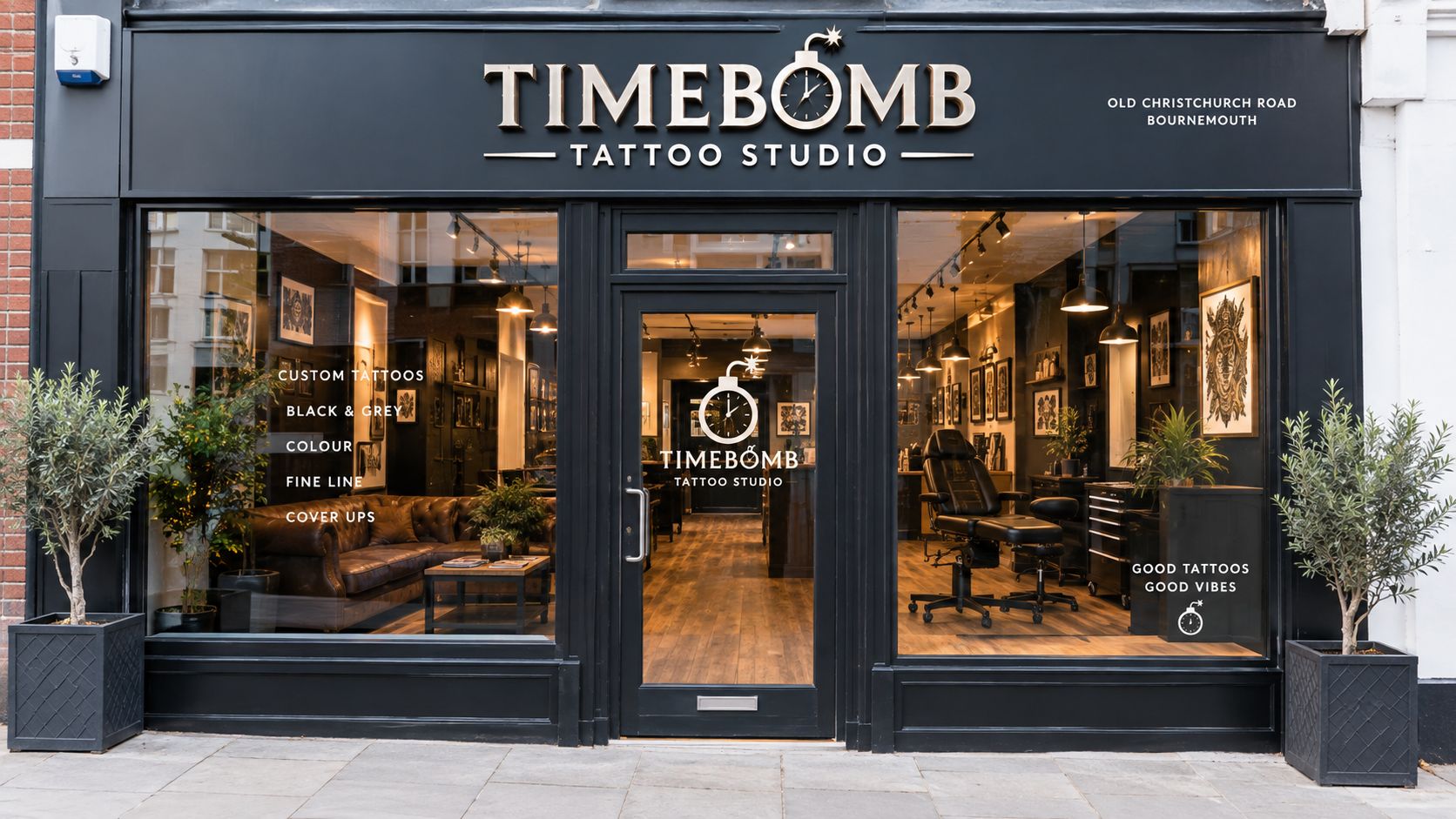
Timebomb Tattoo & Piercing is based on Old Christchurch Road in Bournemouth, serving clients from Bournemouth, Poole and across Dorset. Its approach combines custom tattooing, professional piercing, resident artists and guest artists, with appointments forming the main route and walk-ins accommodated when an artist has space.
What the studio experience feels like
A purpose-designed studio changes the practical experience. Private, curtained tattoo spaces give you more personal space during a session, while an organised workstation helps the artist keep the process focused. For someone booking a first tattoo, that environment can make it easier to ask basic questions without feeling rushed.
The same applies to piercing. You should be able to discuss jewellery, placement, healing and suitability before the procedure, rather than making a decision at the counter with no explanation. A professional studio treats those conversations as part of the service.
A useful test: if you can't explain what will happen before the needle or piercing instrument is used, ask more questions before booking.
The rest of the decision is about fit. A small walk-in piece has different needs from a portrait, sleeve or Japanese back piece. A collector may arrive with a clear style direction, while a first-timer may need help turning an idea into a workable design. Timebomb's appointment-led model supports both situations, while availability determines whether a same-day request is possible.
How a Custom Tattoo Studio Works From Idea to Ink
Think of a custom tattoo as commissioning an illustrator for a design that has to work on a moving, curved surface. You bring the subject, mood and references. The artist brings composition, drawing skill, tattoo knowledge and an understanding of how the design should age on skin.
Start with the conversation
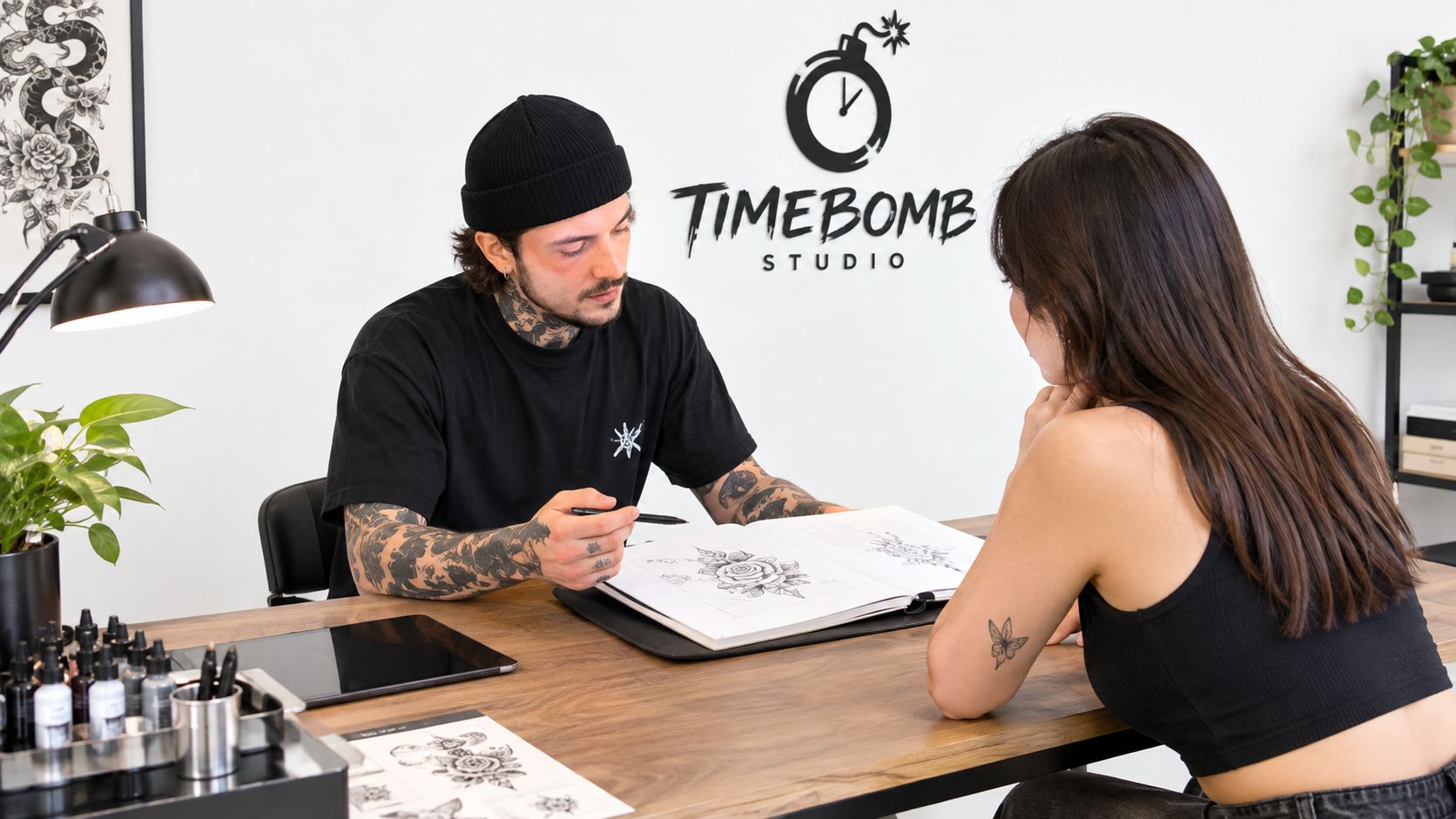
A free consultation is useful when the idea is personal, detailed or difficult to describe. Bring reference images, but don't expect the artist to copy another person's tattoo. Instead, explain what attracts you to each reference, such as the subject, line quality, contrast, composition or colour.
The artist will usually ask about:
- Subject: What should the tattoo show, and what should it avoid?
- Placement: Where will it sit, and how does that area move or change shape?
- Scale: How much room does the design need for its details to remain readable?
- Direction: Which artist's specialism suits the visual language you want?
That discussion reduces uncertainty before a booking is made. It also gives the artist information that a short online message can't provide.
Develop and refine the design
The artist then turns the brief into custom artwork. Sizing matters because a design that looks clear on a screen may become crowded when reduced for the wrist, ankle or another small area. Conversely, a large piece may need more structure so the individual elements work together rather than appearing scattered.
Timebomb's custom-first approach means clients can discuss a design that is developed for their brief, rather than selecting a generic image from a repeated catalogue. For broader reading on tattoo planning and artist choices, explore these tattoo and piercing articles.
Prepare for the appointment
Once the design direction, size and placement are agreed, the artist prepares the stencil and the appointment begins. You'll have another opportunity to discuss positioning before the stencil is applied, which matters because your posture and the body's shape can affect how the finished piece sits.
Walk-ins can suit small or simple tattoos when an artist has availability. Larger, detailed work, including sleeves and portraits, is better planned through an appointment and consultation. The process isn't about making you commit quickly. It's about giving the artist enough information to create something suitable for your skin and your intentions.
Tattoo Styles and Artists You Will Find in Bournemouth
Style names are useful only when they help you choose the right artist. A fine-line idea needs a different approach from a bold Traditional tattoo, and a portrait depends on different decisions again. Start with the visual result you want, then shortlist artists whose portfolios show that work consistently.
Compare the main style families
Traditional and Neo-Traditional designs use confident outlines and clear shapes. Traditional work suits bold symbols, animals and classic motifs, while Neo-Traditional can add more varied line weights, illustrative detail and richer colour.
Blackwork and Dotwork rely on black ink, pattern, texture and controlled density. They can work for graphic motifs, ornamental pieces and larger compositions where negative space becomes part of the design.
Fine Line and micro tattoos use delicate lines and restrained detail. They can suit small symbols, botanical elements and discreet placements, but the artist still needs to judge scale carefully. Tiny detail cannot be reduced indefinitely without becoming difficult to read.
Black and Grey work builds form through shading and tonal contrast. It can suit realistic subjects, large illustrative pieces and designs where colour isn't part of the brief.
Realism and Colour Realism demand careful observation, tonal control and a strong understanding of how a subject translates onto skin. Portraits need particularly thoughtful reference images and placement because small changes in proportion can alter recognition.
Japanese and New School offer distinct visual languages. Japanese-inspired work often benefits from a larger composition with movement and connected elements, while New School can use exaggerated shapes, expressive colour and playful proportions.
Resident and guest artists widen the range of specialisms available. That matters for a sleeve or portrait because the artist's strengths influence the whole result, not just one isolated detail. You can browse a broader tattoo gallery before bringing a shortlist to consultation.
| Style Family | Best For | Typical Scale and Detail |
|---|---|---|
| Traditional and Neo-Traditional | Bold symbols, animals and illustrative subjects | Small to large, with clear outlines and readable shapes |
| Blackwork and Dotwork | Graphic, ornamental and patterned designs | Small to large, with contrast and texture |
| Fine Line and micro tattoos | Delicate symbols, botanicals and discreet pieces | Small, with carefully limited detail |
| Black and Grey | Shading-led images, realism and large compositions | Medium to large, with tonal depth |
| Realism and Colour Realism | Portraits, animals and lifelike subjects | Medium to large, requiring controlled detail |
| Japanese and New School | Connected compositions, expressive subjects and sleeves | Usually medium to large, depending on the concept |
A useful consultation question is simple: “Which artist regularly creates this type of work?” The answer should be based on visible portfolio evidence, not only a general claim that every style is available.
Hygiene Jewellery and Safety Standards Explained
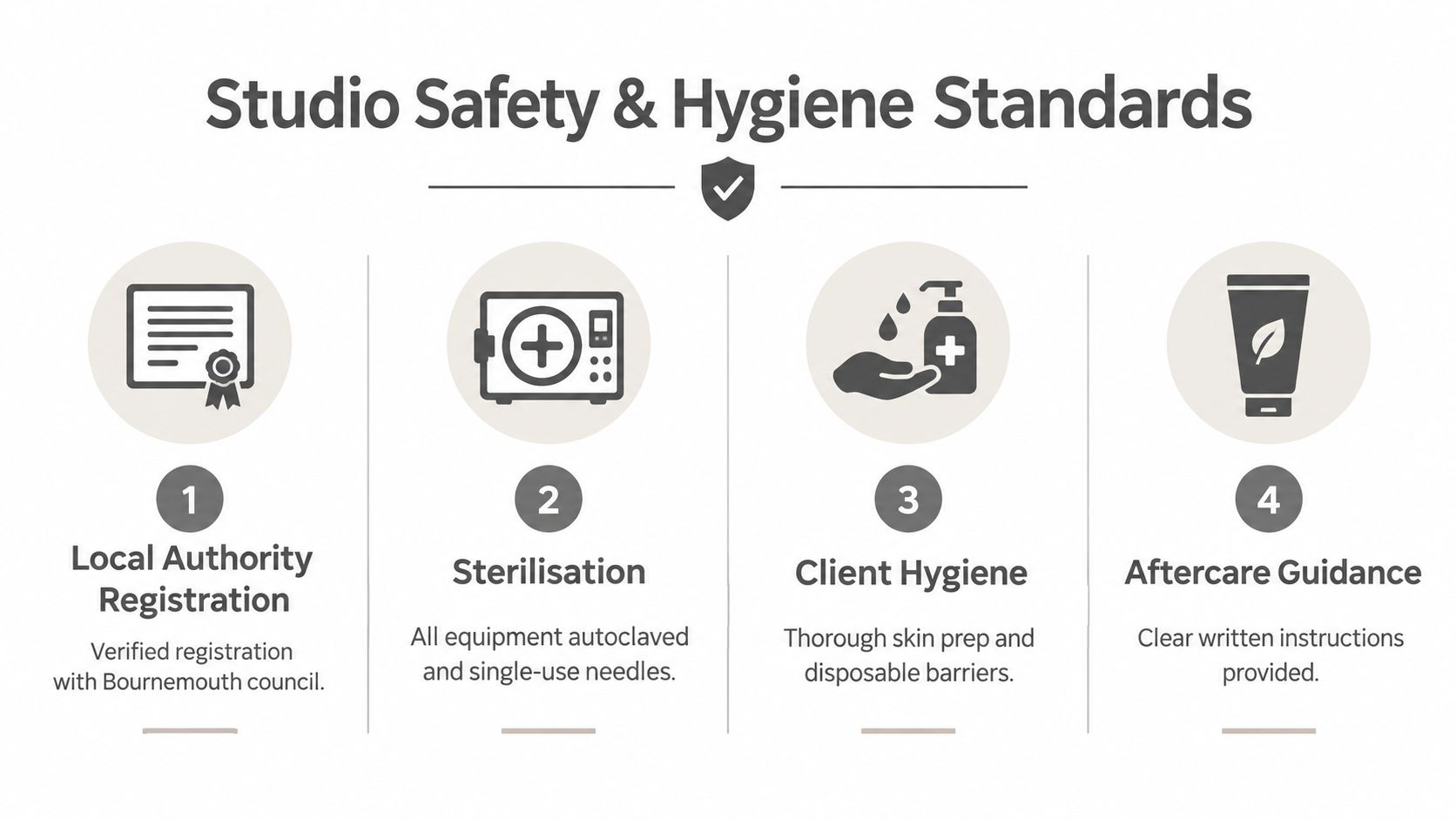
A studio can look polished and still leave important questions unanswered. In Bournemouth, tattooing and body piercing are regulated through the local authority rather than a single national salon licence. BCP Council requires both the person carrying out tattooing or piercing and the premises to be registered before services can legally be offered, and its current registration page lists a £138 fee for registration. The wider UK licensing framework also places tattooing, piercing and electrolysis under local council registration requirements, as outlined in this UK Parliament briefing on skin piercing and tattooing.
The legal background is established rather than new. UK Parliament records describe powers introduced for local authorities outside London under the Local Government (Miscellaneous Provisions) Act 1982, strengthened in 2003 to include body piercing and semi-permanent skin colouring. Registration failures and breaches of local hygiene byelaws can be offences, as explained in the Parliamentary discussion of tattooing and skin piercing regulation.
What you can verify before booking
Local byelaws cover staff hygiene and the cleanliness and safety of premises, furniture and equipment. Government guidance also describes local regulation of tattoo and skin-piercing businesses, including expectations around infection prevention and control. You can review the government guidance on tattooing and body-piercing infection prevention when preparing questions for a studio.
Look for clear answers about:
- Registration: Ask whether the individual practitioner and premises are registered with the relevant council.
- Single-use items: Needles and other disposable consumables should be sterile and used appropriately for one client.
- Sterilisation: Ask how reusable equipment is cleaned and sterilised, and whether the workflow separates clean and used items.
- Workstation preparation: Surfaces, furniture and equipment should be protected and cleaned as part of a consistent process.
- Hand hygiene: Independent council guidance states that hand washing before a skin-piercing procedure should take 2 minutes, while routine hand washing takes 15–30 seconds. Disposable gloves don't replace hand washing. See the UK infection-control guidance for body piercers and tattooists.
- Aftercare: The artist or piercer should explain healing, cleaning and warning signs in language you understand.
Jewellery deserves its own question. Local authority guidance recommends sterile jewellery and identifies implant-grade materials as preferred in piercing contexts. Timebomb's Bournemouth service specifies implant-grade, internally threaded titanium, while the CIEH tattooing and piercing toolkit supports checking jewellery material, sterility and instrument practices.
There isn't a single nationally recognised or accredited training route for tattooing and body piercing. That makes visible hygiene procedures, local registration, artist training and aftercare explanations more useful than relying on a national qualification badge alone.
Booking Consultations Walk Ins and Aftercare at Timebomb
The right booking route depends on the job. A small, straightforward tattoo may be suitable for a walk-in if an artist has space. A portrait, sleeve, realism project or carefully positioned fine-line piece needs more planning, so a consultation is the sensible first step.
Choose your starting point
Book a consultation when you need help shaping the idea. Bring reference images, describe the parts you like and be ready to discuss size and placement. The artist can then advise on composition, suitable scale and which resident or guest artist fits the direction.
Ask about walk-in availability when the tattoo is small, simple and flexible on timing. Availability can change during the day, so contacting the studio first is more practical than assuming an artist can start immediately.
Contact the studio directly by phone, email or online form when you need to explain several details. A written enquiry can include the subject, approximate dimensions, body placement, preferred style and reference images. That gives the studio a clearer basis for suggesting the next step.
Treat aftercare as part of the appointment
A good session doesn't end when you leave the chair. Your artist should explain how to protect the tattoo or piercing while it heals, including what to clean, what to avoid and when to ask for professional advice.
Public-health aftercare guidance emphasises minimal touching and clean hand washing. Piercings should not be over-cleaned, because excessive manipulation can damage healing tissue and increase irritation. Council guidance recommends cleaning piercings no more than twice daily and avoiding restrictive clothing on areas such as the navel, where friction can interfere with healing. These principles are set out in public-health aftercare advice for body art and skin piercing.
Wash your hands before any necessary contact, follow the written instructions and resist the urge to keep checking or twisting jewellery. If something concerns you, contact the studio rather than changing the care routine based on a social-media tip.
Finding Us Facilities and How to Book Your Appointment
Timebomb's Bournemouth studio is at 109 Old Christchurch Road, Bournemouth, BH1 1EP. Its central position makes it a practical option for clients travelling from Bournemouth, Poole and the wider Dorset area, while the Old Christchurch Road setting is easy to identify when you arrive.
The studio uses a purpose-designed environment with private, curtained tattoo spaces. That can be helpful for larger sessions, sensitive placements or anyone who feels more comfortable with additional privacy. The business also operates a sister studio in Croydon, at 22 George Street, Croydon, CR0 1PA, and has operated since 2003, providing a longer trading history behind the two-location setup.
Plan the visit around your booking
For a consultation, arrive with your idea organised but remain open to professional advice. Have your references ready, know the approximate placement and think about how visible or discreet you want the finished work to be. For a piercing, consider the jewellery material and ask how the chosen placement affects healing and daily movement.
Clients looking for more local options can also explore this guide to tattoos near Bournemouth, then compare each studio using the same practical checks: registration, hygiene workflow, artist specialism, jewellery quality and aftercare.
You can enquire by phone, email or online form to discuss a tattoo or piercing. Ask for a free consultation if the project needs design development, or check walk-in availability if you're flexible about timing and the piece is small.
Timebomb Tattoo & Piercing offers custom tattooing, professional body piercing, style-specific artist matching and aftercare guidance in a purpose-designed Bournemouth studio. Visit Timebomb Tattoo & Piercing to book a free consultation, enquire about your next tattoo or piercing, or check whether walk-in availability suits your plans today.