Most small tattoos in the UK are priced at a studio minimum of around £60 to £150. Tiny minimalist work often sits around £60 to £90, while slightly larger small pieces commonly move into £90 to £150.
That answer helps, but it still leaves the part that confuses most first-timers. If the design is tiny, why doesn't the price stay tiny too?
A lot of people ask this while holding a screenshot of a little heart, a date, a short word, or a fine-line flower. They're not trying to bargain. They just want a normal point of reference so they can tell the difference between a fair quote, a rushed quote, and a quote that includes proper studio standards. That's a sensible question.
The tricky bit is that small tattoo pricing isn't really about ink quantity. It's more like paying for an appointment, a prepared workstation, sterile supplies, artist time, and the difficulty of the design you've chosen. A tiny symbol can be quick, but it still needs the same safety steps as a much larger piece.
That's why two tattoos that look almost the same size on paper can land in different price bands. One might be a simple outline. The other might need very precise fine-line work, custom drawing, awkward placement, or lettering that has to stay readable as it heals.
If you're trying to work out how much is a small tattoo before you message a studio, the goal isn't to guess the exact number from size alone. The goal is to understand the logic behind the quote so you can book without second-guessing it. If you want to see the kind of styles that often fall into the “small tattoo” category, a quick browse through this tattoo gallery helps show how varied “small” can be in real studio terms.
Table of Contents
- Introduction What to Expect When Asking About Small Tattoo Prices
- Why Small Tattoos Have a Minimum Price
- What Makes Two Small Tattoos Cost Different Amounts
- Hourly Rate Versus Flat Rate for Small Tattoos
- Typical UK Price Ranges for Small Tattoos and What Pushes You Higher
- How to Get an Accurate Quote and Book With Confidence
- Ready to Book Your Small Tattoo With Timebomb
Introduction What to Expect When Asking About Small Tattoo Prices
A first-time client walks up to the desk with a photo of a tiny heart and asks a fair question: “It's small, so what does something like this usually cost?”
The answer often depends less on the amount of ink and more on what kind of small they mean.
Studios see “small tattoo” used for several very different jobs. A 2 cm star, a short word on the wrist, and a fine-line flower behind the ear may all sound small in everyday language, but they do not ask for the same level of drawing, placement care, or technical control. Size is only one part of the quote.
A helpful way to sort it is by type, not by inches alone:
- Tiny and straightforward. Simple symbols, small outlines, or basic shapes
- Small but precision-heavy. Fine-line details, tiny script, or neat lettering that still has to heal clearly
- Small and custom-drawn. Floral pieces, memorial ideas, geometric designs, or anything that needs original artwork
That distinction matters because tattoo pricing works more like booking a skilled appointment than buying a product by length or weight. Two designs can take up the same amount of skin but sit in different pricing tiers for the same reason two short hair appointments can cost different amounts. One is a basic trim. The other needs more planning and control.
If you want a clearer feel for what studios usually mean by “small,” browsing a gallery of small tattoo styles and placements can help you compare simple, detailed, and custom ideas in real studio terms.
Before asking for a quote, it helps to have four basics ready:
- The design you want
- The placement on your body
- The rough size in centimetres or inches
- The style such as linework, script, shading, or colour
That gives the studio something concrete to price. It also saves you from comparing one quote for a tiny outline with another quote for detailed micro lettering and assuming they should match.
Why Small Tattoos Have a Minimum Price
You message a studio asking for a tiny star on your wrist. It looks like a five-minute job, so the quote can feel surprisingly high at first glance.
The part that catches people out is simple. You are not only paying for the few millimetres of ink on the skin. You are paying for the appointment to exist safely and properly in the first place.
Tattoo pricing works a lot like a taxi fare. A short ride still has a starting charge because the car, driver, fuel, and time are already committed before the distance really changes the total. A small tattoo works the same way. Before the artist makes the first line, the studio has already used time, supplies, and a prepared workstation.
What the minimum actually covers
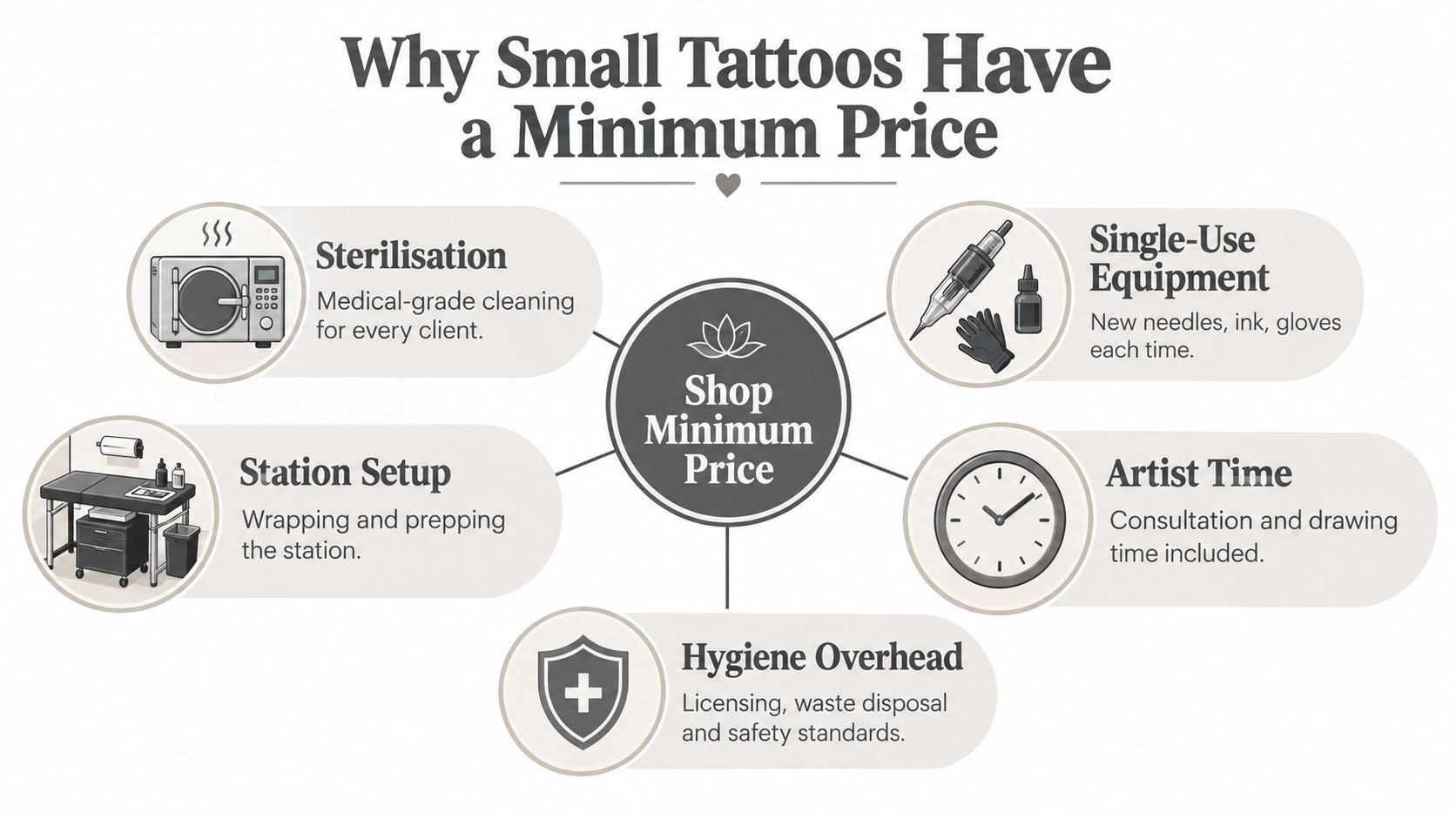
When a studio sets a minimum price, it usually has to cover the same base job every client requires, whether the design is a tiny symbol or something a bit larger.
- Sterilisation and hygiene: The same cleaning and barrier protection standards apply to every appointment.
- Single-use supplies: Fresh needles, ink caps, gloves, razors, wipes, stencil materials, protective wrap, and aftercare items all come out for the session.
- Station setup and breakdown: The area has to be cleaned, wrapped, laid out, then cleared and disposed of properly afterwards.
- Artist appointment time: Messages, consultation, sizing, stencil prep, placement checks, and the tattoo itself are all part of the job.
- Studio running costs: Rent, licences, clinical waste collection, cleaning products, machine maintenance, and utilities continue regardless of tattoo size.
A good way to picture it is setting up a kitchen to make one cupcake. You still heat the oven, get out the tools, measure ingredients, and wash up afterwards. Making one instead of twelve changes part of the job, but it does not remove the starting work.
Why centimetres do not tell the full story
A ruler only shows footprint. It does not show setup.
That is why a tiny tattoo can still carry a minimum charge even if the actual tattooing time is short. The appointment may include replying to the brief, printing and adjusting the stencil, shaving and cleaning the area, checking placement from different angles, completing the tattoo, cleaning down, and giving aftercare advice. The inked part is only one slice of the session.
As noted earlier, small tattoo quotes often reflect those fixed studio costs more than the amount of ink used. That is the main reason prices can jump in clear tiers rather than rise neatly by centimetre.
Practical rule: If a very small tattoo seems expensive for its size, the quote is often covering setup, safety, and booked artist time.
A short explainer can help make that logic easier to picture.
Why the minimum protects quality
Minimum pricing also protects the result. Tiny tattoos leave very little room for shaky placement, rushed stencil work, or careless line control.
If a studio priced every miniature design as if it were only paying for a drop of ink, the pressure would fall on speed. That is a poor trade for something permanent. A fair minimum gives the artist enough room to slow down, check spacing, and tattoo cleanly. For small work, that care matters more than people expect.
What Makes Two Small Tattoos Cost Different Amounts
Two tattoos can be the same size on a ruler and still sit in different price bands. A lot of confusion starts here, especially for first-timers comparing screenshots online.
The main reason is simple. Size tells you the footprint. It doesn't tell you the workload.
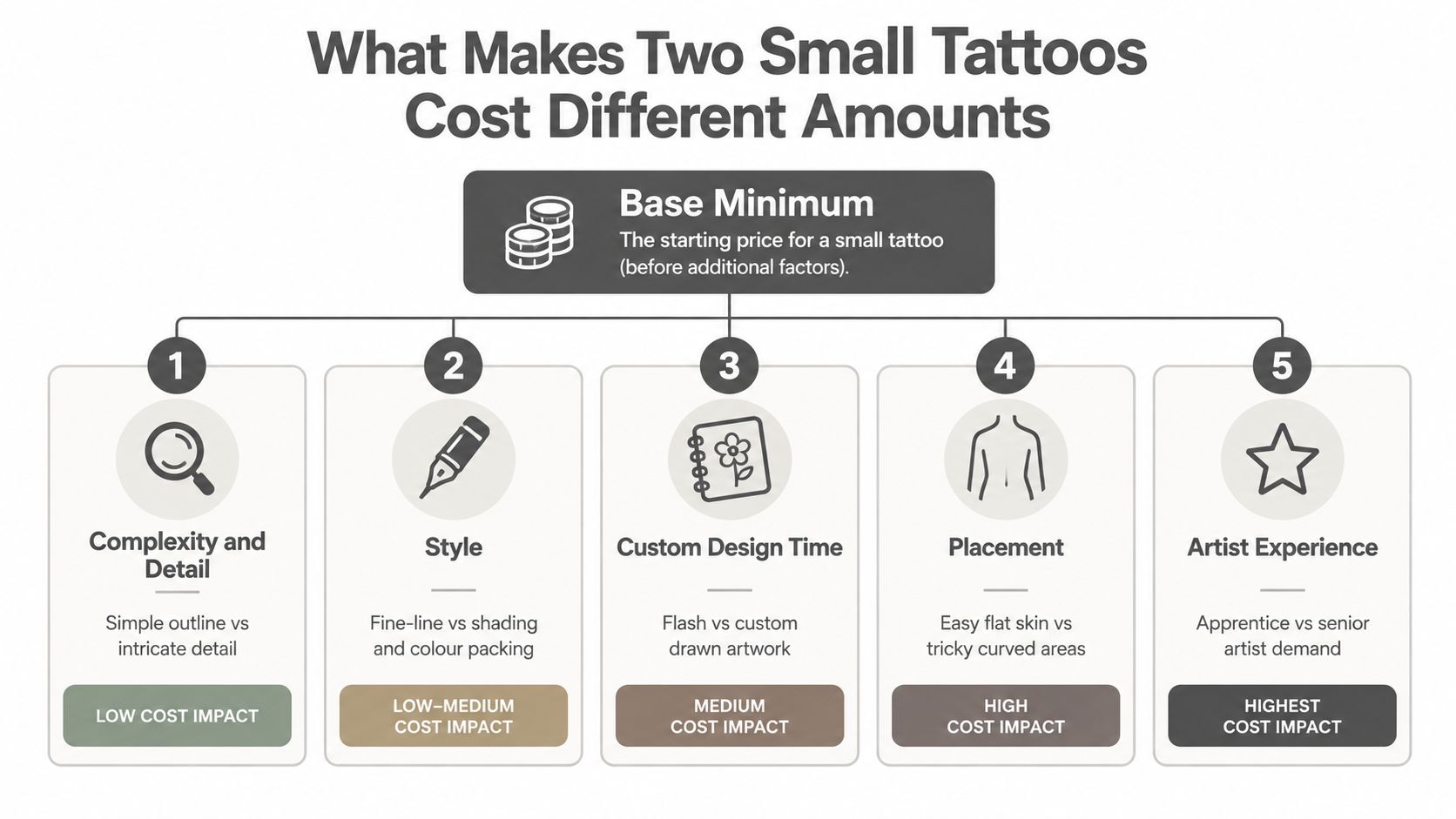
The five biggest price drivers
A recent UK pricing guide separates small tattoo pricing by execution type rather than just dimensions, showing bands for micro tattoos, tiny text, simple symbols, shading, and small geometric or floral work ranging from about £45 to £180 (UK small tattoo pricing bands by style). That spread makes more sense when you look at what changes the job.
Complexity and detail
A plain outline heart and a miniature floral stem might fit in the same space, but one has far more decision points. Extra petals, line turns, texture, and balance all add time and concentration.
Style
Fine-line work can look minimal, but it often demands more control than a bolder simple mark. Tiny text has to stay legible. Shading adds passes. Colour packing changes the process again.
Custom design time
Some designs come straight from existing flash or a very simple reference. Others need drawing, editing, resizing, and placement adjustments before the appointment even starts.
Placement
Flat, easy-to-reach skin is usually more straightforward than curved, mobile, or awkward areas. Wrists, fingers, ribs, and other tricky placements can require more care to position and execute well.
Artist experience and specialism
Clients often underestimate this one. A small tattoo in a specialist style, especially neat script, micro detail, or elegant fine-line work, may be priced differently because the artist is being chosen for that exact skill.
A simple same-size comparison
Here's a clearer way to think about it.
| Small tattoo idea | Same size on skin | Why the quote may differ |
|---|---|---|
| Tiny star outline | Yes | Simple stencil, low detail |
| One word in script | Yes | Letter spacing and readability matter |
| Fine-line flower | Yes | More linework and precision |
| Small geometric design | Yes | Symmetry and clean angles take care |
| Mini shaded symbol | Yes | Shading adds time and technique |
A tattoo can be small in area but demanding in execution. That's why “same size” doesn't mean “same price”.
Why this matters when you're comparing quotes
If one studio prices a tiny symbol differently from a tiny script piece, that doesn't automatically mean one is expensive and one is cheap. It may mean they're categorising the work more accurately.
The better question is: what kind of small tattoo is this? Once you answer that, the pricing starts to look much less random.
Hourly Rate Versus Flat Rate for Small Tattoos
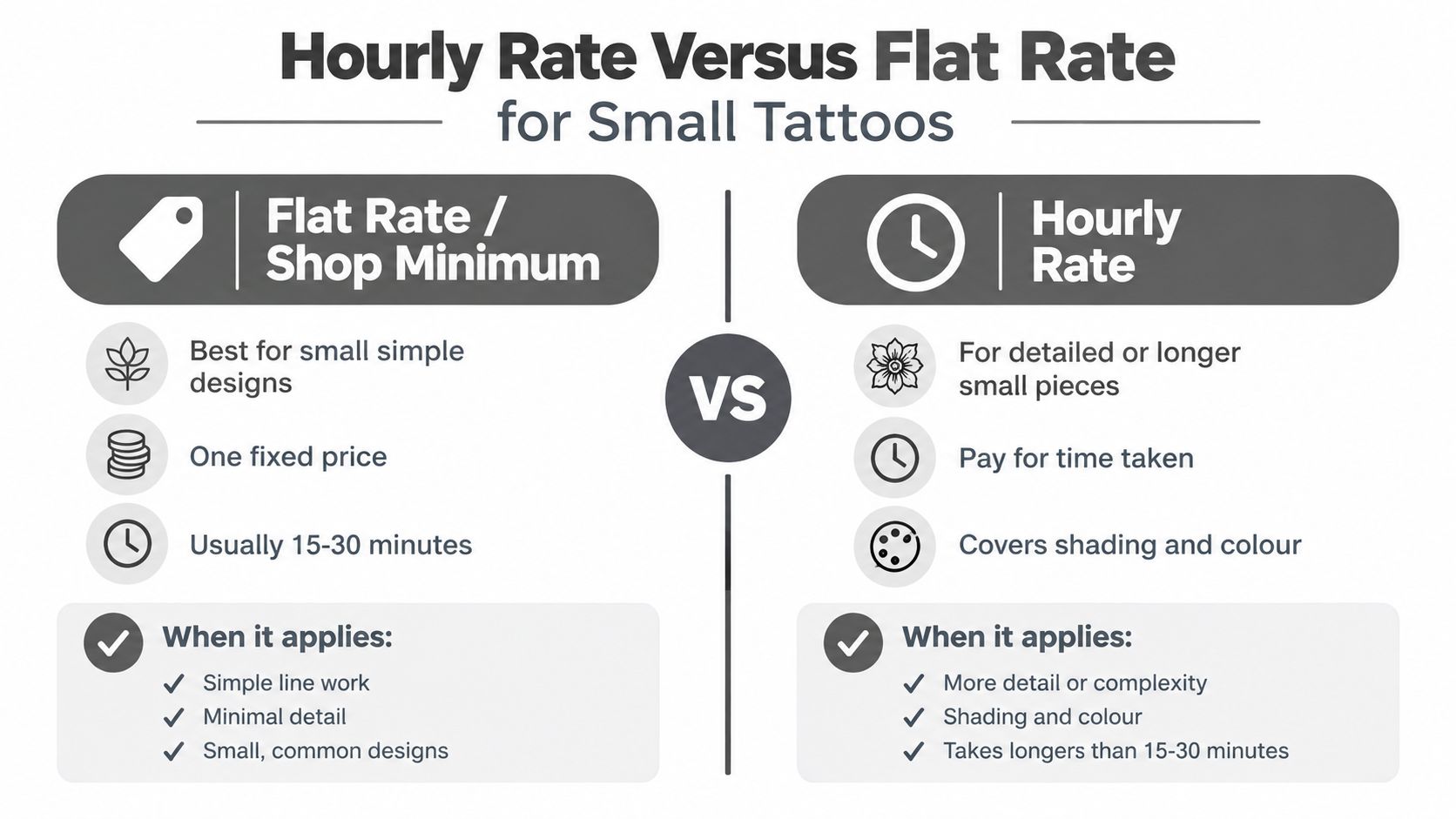
Some small tattoos are quoted as one fixed price. Others are quoted by time. Neither model is automatically better. They just suit different kinds of work.
If you've ever asked how much is a small tattoo and got a clean number from one studio but a time-based answer from another, that's usually a billing structure difference rather than a contradiction.
When a flat rate makes sense
A flat rate usually suits work that's easy to scope in advance. The artist can look at the design, placement, and size and feel confident giving one clear figure.
This often works well for:
- Simple symbols: Clean, straightforward pieces with limited detail
- Short text: If the font and placement are uncomplicated
- Small flash designs: Pre-drawn designs with predictable timing
Clients often like flat pricing because it removes uncertainty. You know what you're paying before the session starts.
When hourly pricing can appear
A time-based quote tends to show up when the design may take longer to execute than its size suggests. The footprint is still small, but the process isn't.
That can happen with:
- Intricate fine-line work that needs a slower hand
- Detailed shading in a compact space
- Custom pieces that may evolve during preparation
- Difficult placements where setup and positioning take longer
If a small tattoo is complex enough to vary in timing, an hourly structure can be the more honest quote.
Questions worth asking before you book
A good consultation clears this up quickly. You don't need industry jargon. You just need direct questions.
- Is this a fixed-price piece or time-based?
- Does the quote include design prep and stencil time?
- Would changing the placement affect the quote?
- If I simplify the design, would it stay in the flat-rate range?
Those questions help you compare like for like. They also prevent the common misunderstanding where a client hears “small tattoo” and assumes “one universal small tattoo price”.
Typical UK Price Ranges for Small Tattoos and What Pushes You Higher
A tiny tattoo can still fall into very different price brackets. The reason is simple. Studios are pricing an appointment, not just measuring a drawing.
A small heart on an easy-to-reach forearm is one kind of job. Tiny script on a finger in central London is another. Both are small on the skin, but the second often takes more precision, more setup, and sits inside a higher-cost studio model.
Small Tattoo Price Bands by Type and Location
| Design Type and Size | Typical UK Price Band | Notes on What Affects Price |
|---|---|---|
| Earlier small tattoo bands | As above | Use the earlier ranges as your baseline, then adjust for complexity and city |
| Small 2 to 3 inch tattoo in London | Roughly £120 to £280 | Higher studio costs in major cities can lift the whole bracket, even for simple designs |
For a London-specific benchmark, a 2026 pricing guide lists small 2 to 3 inch pieces at roughly £120 to £280 and notes that minimum charges in London often start around £60 to £100 (London tattoo prices guide for 2026).
What usually pushes a small tattoo upward
Price jumps tend to come from three pressure points working together.
Complexity tier. A tiny outline is usually the entry version of a small tattoo. Add fine-line detail, tiny text, geometric symmetry, or soft shading, and the artist has to work slower and more carefully.
Placement difficulty. Areas that are curved, bony, or awkward to position can stretch a short appointment. The tattoo is still small, but the job gets fiddlier.
Location. A studio in a major city often has a higher pricing floor before the needle even starts. Rent, staffing, and operating costs affect the minimum, and that higher floor carries through to small pieces too.
That is why two designs with the same width in centimetres can land in different quote ranges.
A quick way to place your idea
Try sorting your tattoo like a studio would:
- Baseline small piece: clean symbol, simple outline, easy placement
- Precision small piece: tiny script, fine-line work, neat micro design
- Detailed small piece: shading, texture, layered floral or geometric work
- City-priced small piece: any of the above in a higher-cost area such as London
A useful rule is to estimate by complexity first, then by location. Size still matters, but once a tattoo is already small, the bigger price jumps often come from how carefully it must be executed and where the appointment is being booked.
How to Get an Accurate Quote and Book With Confidence
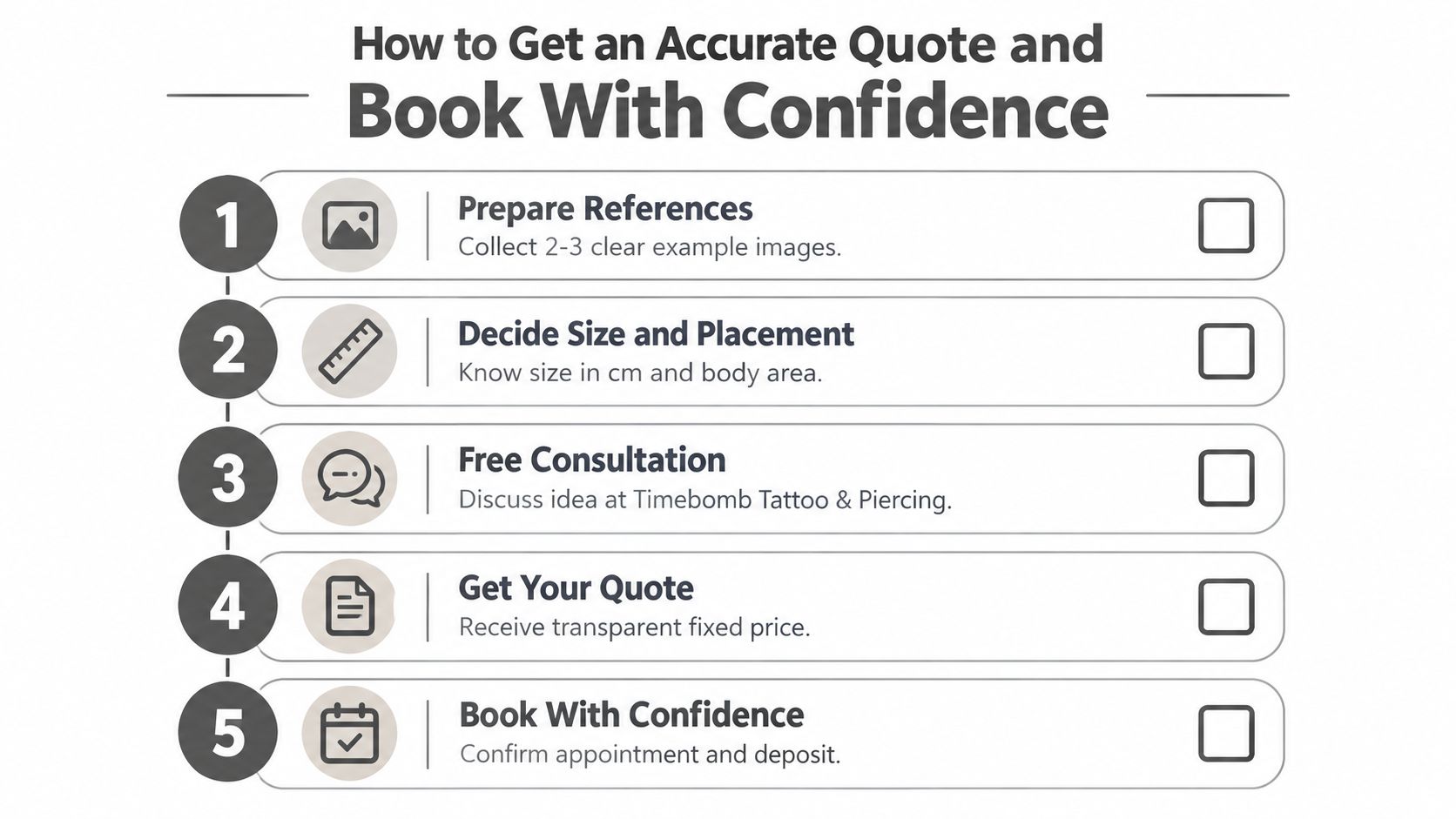
The fastest way to get a reliable quote is to stop describing the tattoo as “small” and start describing it as a project. Even a tiny design becomes much easier to price when the artist can see exactly what you mean.
That doesn't mean you need to arrive with a perfect brief. It just means you'll get a better answer if you bring a few practical details with you.
What to prepare before asking
Bring these four things if you can:
- Reference images: A couple of examples help show style, not just subject
- Approximate size: Give a rough measurement rather than saying “small”
- Placement idea: Wrist, ankle, forearm, rib, collarbone, and finger all change the job
- Must-haves and no-goes: For example, “fine-line only” or “no shading”
A booking guide for Bournemouth clients can also help if you want to see how studios handle enquiries and appointments for different types of pieces. This tattoo booking information for Bournemouth is a useful practical reference.
How consultations reduce guesswork
A consultation is where vague ideas turn into quoteable work. The artist or studio can clarify scale, placement, style, and whether your idea suits a fixed price or a longer booking.
One option is Timebomb Tattoo & Piercing, which offers free consultations for discussing ideas, size, placement, and reference images before booking. That kind of conversation is often what turns “How much is a small tattoo?” into an actual figure rather than a broad range.
Questions first-timers should ask
Try these if you want clear answers without overcomplicating it:
- Will this design need custom drawing?
- Is this placement suitable for the detail level I want?
- Would this work better slightly larger?
- Is this likely to be bookable as a walk-in, or should I book ahead?
- What aftercare do you recommend for this placement?
One legal point you should know in the UK
For permanent tattooing in the UK, the legal minimum age is 18 under the Tattooing of Minors Act 1969, with enforcement and fines noted in UK guidance (UK tattoo age law and pricing guidance). If you're booking your first piece, it's worth knowing this before you enquire.
Bring clear references, know roughly where you want the tattoo, and ask for advice on whether the design should be adjusted. That's how you get the most accurate quote.
Ready to Book Your Small Tattoo With Timebomb
A small tattoo is one of the easiest things to underestimate. It looks simple on a phone screen. Then the questions start. How fine are the lines? Will the text stay readable? Does the placement make the job trickier? Is the quote based on a minimum, a fixed price, or time?
That's why the most useful way to think about pricing is this. You're not only paying for size. You're paying for setup, skill, and the kind of design you've chosen. Once you understand that, small tattoo quotes stop feeling arbitrary.
If you're in Dorset or South London, it also helps to speak to a studio that can look at your actual idea rather than guessing from one sentence. A simple symbol, a neat piece of script, and a tiny custom floral may all count as “small”, but they aren't the same booking.
For readers near the south coast, this Bournemouth tattoo studio page gives a good starting point for checking location details and enquiry options.
If you're ready to move from browsing to booking, it helps to have a few contact routes in mind:
- Phone: Useful if you want to ask about walk-in availability or talk through a simple idea quickly
- Email: Best if you want to send reference images, placement notes, and sizing details
- Online form: Good for structured enquiries when you want to include all the basics in one message
- In person: Practical if you want placement advice and you're local to the studio
Timebomb Tattoo & Piercing has two studio locations for tattoos and piercings:
- Bournemouth: 109 Old Christchurch Road, Bournemouth, BH1 1EP
- Croydon: 22 George Street, Croydon, CR0 1PA
Walk-ins can sometimes work for small, straightforward pieces when an artist has space. More detailed work is usually better booked in advance so the design, artist match, and timing are right from the start.
If you've been stuck at the “I only want something tiny” stage, the next step is simple. Send the design, size, and placement. Then let the studio turn that into a proper quote you can trust.
If you're ready to stop guessing and get a real price for your idea, Timebomb Tattoo & Piercing offers custom tattooing, professional piercing, and free consultations at its Bournemouth and Croydon studios. You can get in touch by phone, email, online form, or by visiting the studio to discuss your design, placement, and booking options for a small tattoo or piercing.