
A full tattoo sleeve in the UK is commonly budgeted at £1,500–£5,000, while a half sleeve generally falls around £600–£1,500. The final cost depends on the artist's rate, the hours required, the design's complexity, the amount of skin covered and the number of sessions.
That headline range is useful, but it doesn't explain why two sleeves with similar dimensions can receive very different quotes. A sleeve is a production project. You're paying for design decisions, tattooing time, sterile preparation, professional equipment, studio overheads and the artist's ability to place a lasting composition on a moving surface.
Table of Contents
- What a Tattoo Sleeve Costs in the UK
- The Main Factors That Shape Your Sleeve Quote
- How Style and Complexity Change the Price
- Sessions, Hours and Deposit Expectations
- The Hidden Studio Costs Behind Every Quote
- Sample Sleeve Budgets for Real Scenarios
- Planning Your Sleeve and Booking Your Artist
What a Tattoo Sleeve Costs in the UK
A full sleeve commonly costs £1,500–£5,000 in the UK, while a half sleeve is generally around £600–£1,500, according to UK tattoo cost benchmarks. Those figures are planning ranges, not guaranteed quotes.
The basic calculation is straightforward:
Hours worked × hourly rate = tattooing labour
The artist then considers the factors that make those hours shorter or longer. Detail density, colour saturation, background work, body coverage, placement and the amount of custom drawing can all change the estimate. A simple line-led design and a photorealistic composition might cover a similar area, but they don't demand the same number of passes or the same technical pace.
A half sleeve usually covers either the upper arm, from shoulder towards elbow, or the lower arm, from elbow towards wrist. A full sleeve runs from shoulder to wrist and may connect visually with the hand, chest or shoulder area, depending on the design. Confirm the intended coverage before comparing quotes, because “sleeve” can mean very different things between studios.
| Sleeve Type | Low (£) | Mid (£) | High (£) | Main Driver |
|---|---|---|---|---|
| Half sleeve | 600 | Not stated | 1,500 | Skin coverage and design detail |
| Full sleeve | 1,500 | Not stated | 5,000 | Hours, sessions and complexity |
A full sleeve typically involves 20–40 or more hours of tattooing, usually split across multiple appointments, while a half sleeve is often estimated at 6–12 hours. At an indicative UK hourly rate of £80–£200, the arithmetic broadly explains the published ranges. Highly detailed realism, colour realism, portraits, Japanese work and dense blackwork can push a quotation higher.
Before you compare artists, decide whether you want half-arm coverage or a shoulder-to-wrist project. Then judge the quote against four practical drivers: artist rate, time, complexity and location. For smaller tattoo budgeting, this guide to how much a small tattoo costs provides a useful comparison.
The Main Factors That Shape Your Sleeve Quote
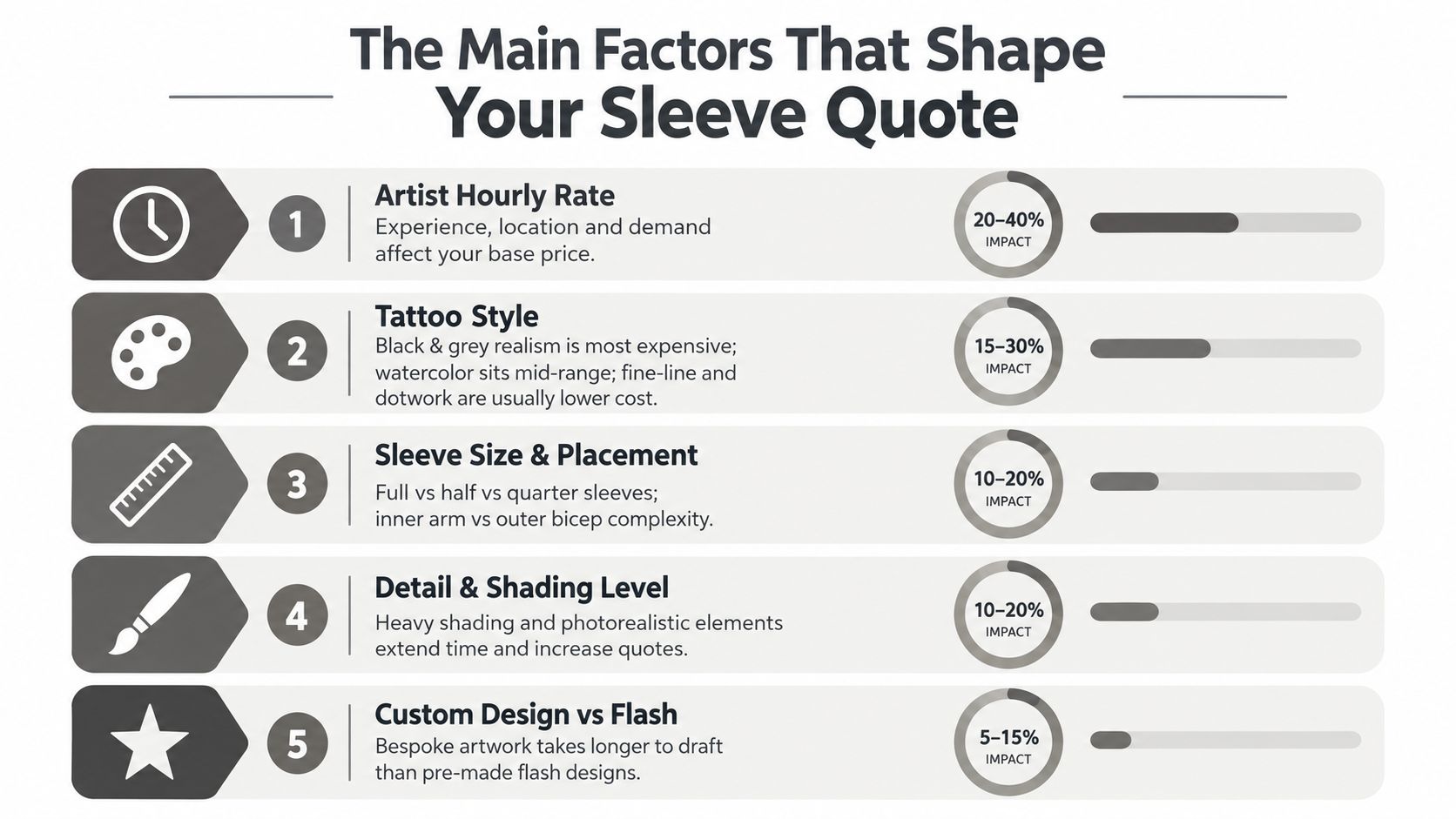
A sleeve quote is a stack of variables, not a price pulled from a menu. The hourly rate matters, but it only becomes meaningful when you understand how quickly the artist works, how much drawing the concept requires and how densely the skin will be worked.
Artist rate and working time
UK hourly rates commonly sit around £80–£200, although seniority, specialism, demand and location can move the figure higher. Another UK pricing dataset places the broader hourly range at roughly £80–£250 and notes that specialist work may sit towards the upper end, particularly in London. UK hourly tattoo pricing and sleeve estimates explain why experience and demand affect the labour rate.
A cheaper hourly rate doesn't automatically mean a cheaper sleeve. An artist who works slowly may take more billable hours than a faster specialist. A junior artist may also offer a narrower style range, which matters if your idea depends on smooth realism, Japanese composition or controlled blackwork.
Complexity and coverage
Large focal elements, smooth gradients, saturated colour, repeated textures and custom backgrounds all add work. So does difficult placement. The inner arm, elbow and areas where the skin changes direction need careful composition and application.
A sleeve made from pre-existing flash designs may require less planning than a fully custom narrative. A bespoke sleeve needs reference selection, layout, transitions and decisions about how each element will age beside the next one.
Colour and location
Colour can require additional layering and saturation passes. Black and grey isn't automatically inexpensive either. A detailed black and grey portrait can take longer than a simpler colour design.
Location affects the rate because studios carry different operating costs and artists face different levels of demand. Don't compare a specialist London quote with a Bournemouth quote as though the same hourly economics apply. Compare portfolios, working methods, hygiene standards and the estimated hours together.
Practical rule: Ask what would reduce the quote without damaging the design. Choosing a less saturated palette or reducing background density may help, but removing the wrong detail can destroy the composition.
How Style and Complexity Change the Price
Style is the biggest decision you control before booking. It determines the type of mark-making, the number of passes, the amount of shading and the level of planning required.
| Style | Full Sleeve Hours | Session Count | Typical UK Band (£) | Why It Costs What It Costs |
|---|---|---|---|---|
| Colour realism | Varies, often towards the higher end | Multiple sessions | Upper end of the range | Smooth gradients, skin-tone blending and repeated colour passes |
| Japanese | Varies by composition | Multiple sessions | Broadly variable | Flowing motifs, wind bars, water and saturated backgrounds |
| Fine line and minimalist | Varies by density | Multiple sessions | Broadly variable | Delicate lines demand control and careful placement |
| Dense blackwork | Varies by coverage | Multiple sessions | Broadly variable | Solid fills, geometric planning and consistent saturation |
Colour realism usually commands the strongest budget because portraits, smooth transitions and skin-tone blending leave little room for rushed application. The artist has to build the image gradually and protect clarity between adjoining elements.
Japanese sleeves work best when the composition flows around the arm. Wind bars, water and background structures can make the piece feel complete, but dense backgrounds and saturated colour add application time. The design needs to be planned as one composition rather than assembled as unrelated motifs.
Fine line work can look deceptively quick. Thin lines don't excuse poor preparation, and a delicate sleeve needs controlled placement to avoid visual clutter. Minimalism can reduce the amount of ink, but it doesn't remove the need for an experienced hand.
Dense blackwork covers skin decisively, yet solid areas and geometric structures need careful planning. Uneven saturation, weak transitions or poorly considered negative space can become obvious once the arm moves.
Use the tattoo style guide to compare visual directions before requesting a quote. The sensible approach is to show the artist your references, state the desired coverage and ask which elements are likely to consume the most time.
Don't choose a style because you assume it will be cheap. Choose the style you can afford to complete properly. A half-finished sleeve is poor value regardless of the hourly rate.
Sessions, Hours and Deposit Expectations
A full sleeve is rarely completed in one sitting. Published UK guidance places many full sleeves at 20–40 or more billable hours, divided across appointments rather than treated as a single purchase. Healing intervals also matter, because the skin needs to recover before the artist adds more work to adjoining or overlapping areas.
A practical booking conversation should establish:
- Estimated hours or sessions. Ask whether the figure covers tattooing only or includes design time.
- Billing method. Most large projects are billed hourly, although some senior artists offer a fixed day rate.
- Deposit terms. Confirm the amount, whether it comes off the final invoice and the rules for cancellations or date changes.
- Touch-up policy. Ask what happens if a small area needs attention after healing and what the studio considers normal ageing.
- Appointment spacing. Let the artist decide when the skin is ready for the next stage.
| Element | Typical Range |
|---|---|
| Full sleeve tattooing time | 20–40 or more hours |
| Half sleeve tattooing time | 6–12 hours |
| Billing basis | Hourly rate or agreed day rate |
| Deposit | Confirm directly with the studio |
| Final quotation | Based on design, placement, coverage and sessions |
For a simple arithmetic benchmark, 20 hours at £80 equals £1,600, while 40 hours at £125 equals £5,000. Those examples show why a quote can remain within the broad national range while the working time differs substantially.
Don't book on a vague promise that the artist will “get it done” in an unspecified number of visits. Request a written estimate, understand the cancellation window and keep the deposit terms with your booking confirmation.
The Hidden Studio Costs Behind Every Quote
A professional tattoo rate pays for more than needle time. Every appointment involves preparation, barriers, hand hygiene, gloves, sharps disposal, equipment management, cleaning and breakdown. Those tasks repeat across every session of a sleeve.
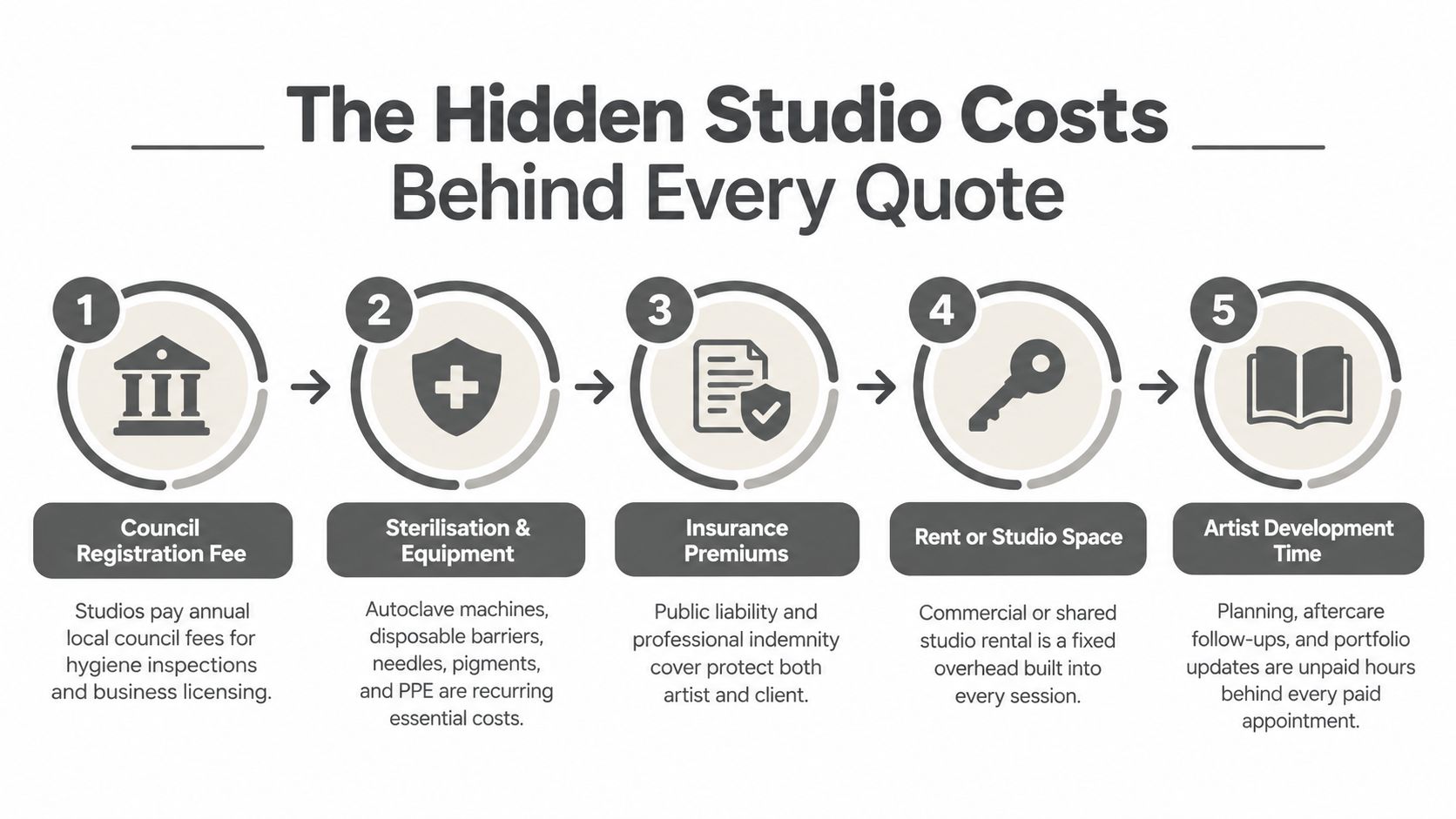
In England and Wales, tattooists must register with the relevant local council and comply with local byelaws covering hygiene and the cleanliness and safety of premises, furniture and equipment. Council guidance links contaminated equipment and poor-quality ink with risks including infection, scarring, hepatitis and HIV exposure. Tattoo registration and hygiene guidance from Stafford Borough Council explains why these controls matter.
The rate also helps cover:
- Single-use supplies: Needles, cartridges, ink cups, gloves, aprons and disposable barriers are used for safe appointments.
- Sterilisation workflows: Equipment and surfaces require documented preparation, cleaning and sterilisation procedures.
- Premises: Rent, treatment furniture, lighting, insurance and maintenance all sit behind the session.
- Planning time: Custom drawing, reference research, placement planning and aftercare communication happen outside the hours you see on the clock.
- Piercing equipment: If a client books piercing as well, implant-grade jewellery and sterile handling form part of that service.
A reputable studio should be able to explain its registration, hygiene process and aftercare approach without defensiveness. Be cautious about artists working from unregistered premises, reused cartridges, missing sterilisation records or quotes that seem radically disconnected from local professional pricing.
A low quote is only a bargain if the artist is delivering the same standard of design, hygiene and accountability. Often, you're comparing different products.
Sample Sleeve Budgets for Real Scenarios
The safest way to benchmark a quote is to separate hours, rate, deposit, design work and contingencies. Don't compare only the final number. Compare what the number includes.
A Bournemouth client considering a half sleeve of black and grey roses should ask whether consultation and custom drawing are included, how many tattooing hours the artist expects and whether the design fee is separate. Roses can be relatively straightforward as motifs, but realism, dense shading and a fully connected background can change the labour substantially.
A Croydon client commissioning a full Japanese colour sleeve should expect the quotation to account for composition, background flow, colour packing and multiple appointments. A senior specialist may offer a day rate rather than a simple hourly calculation. The client should also decide whether travel, time off work and optional gratuity belong in the personal budget.
A Dorset collector extending existing work faces a different problem. Integration can take longer than tattooing an isolated sleeve because the artist must match scale, line weight, saturation, ageing and transitions. The consultation should identify which areas need new work and which existing sections limit the design.
| Scenario | Style | Hours | Hourly Rate | Deposit | Total |
|---|---|---|---|---|---|
| Bournemouth half sleeve | Black and grey roses | Confirm after consultation | Confirm with artist | Confirm booking terms | Written estimate required |
| Croydon full sleeve | Japanese colour | Confirm after consultation | Confirm with artist or day rate | Confirm booking terms | Written estimate required |
| Dorset addition | Blackwork integrated with existing tattoos | Confirm after consultation | May vary for integration work | Confirm booking terms | Written estimate required |
Don't force a studio to honour a figure copied from another city. A useful quote states the expected hours or sessions, design inclusions, deposit rules, touch-up policy and the assumptions behind the estimate.
The national benchmark remains useful for orientation, but a specialist should assess your actual arm, skin coverage, references and existing work before giving a responsible price. A consultation isn't an obstacle to a quote. It's the point where an unreliable guess becomes a workable plan.
Planning Your Sleeve and Booking Your Artist
Start with references, not a price demand. Collect images that show the mood, subject matter, shading and colour approach you like, then take clear placement photographs from several angles. The artist needs to understand the arm's shape and how the design will move around it.
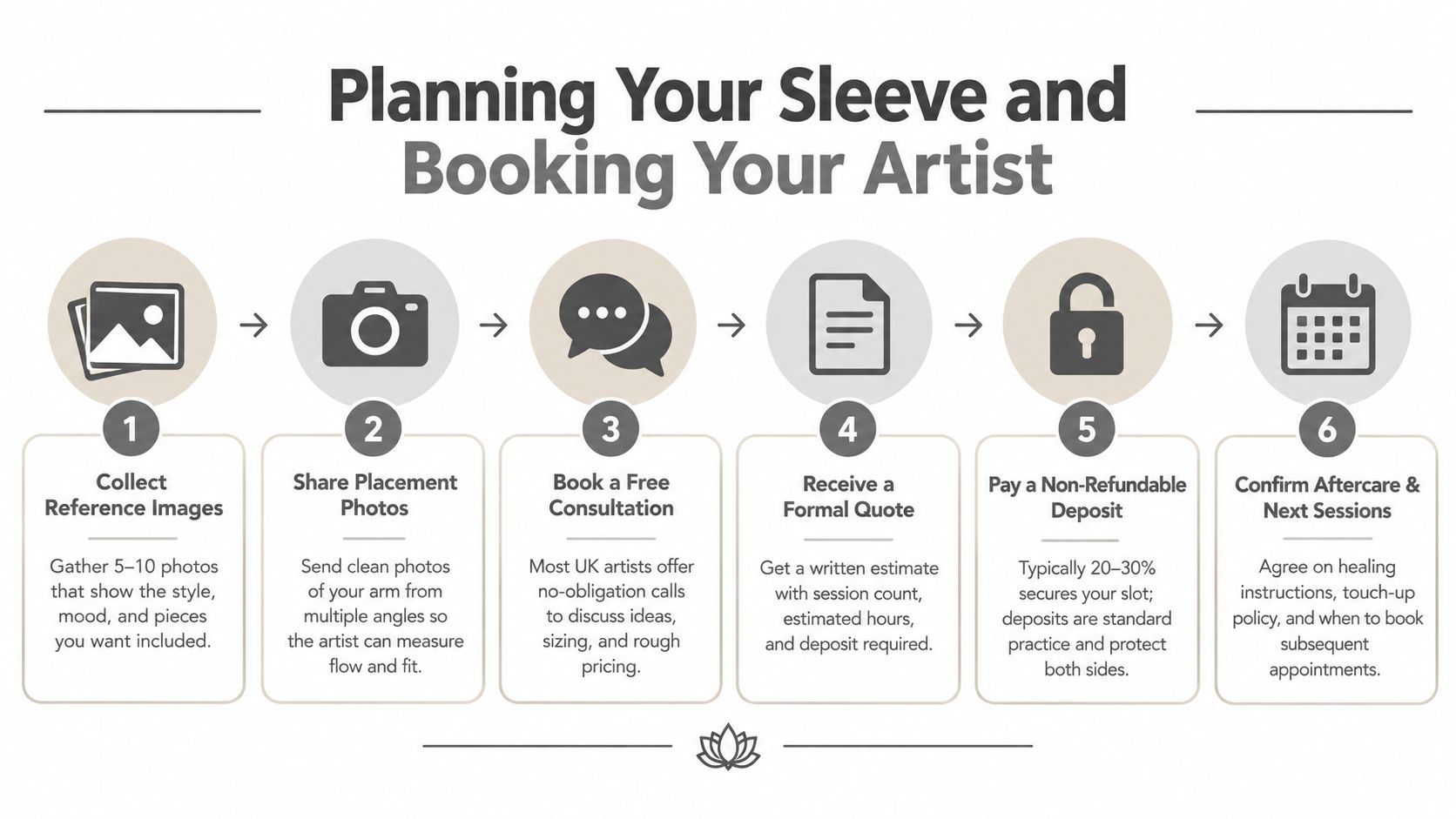
Use this booking sequence:
- Send the brief: Include references, preferred style, approximate coverage and any existing tattoos.
- Attend a consultation: Discuss size, placement, composition, realistic working time and the artist's suitability.
- Choose the quote format: Confirm whether you're receiving an hourly estimate, a fixed project price or a day rate.
- Read the deposit terms: Check cancellation rules, rescheduling requirements and whether the deposit is applied to the balance.
- Book healing gaps: Let the artist schedule the next appointment when the skin has recovered.
- Prepare for the session: Eat beforehand, bring a loose or short-sleeved top and avoid sun exposure on the area.
The custom tattoo service should be judged by the artist's portfolio and consultation quality, not by a headline rate alone. Look for healed examples where possible, especially if you want realism, fine line, Japanese colour or dense blackwork.
The studio should also provide clear aftercare guidance and explain how follow-up appointments work. Ask whether touch-ups are included, how long the policy lasts and what happens if the work needs attention after the initial healing period.
Bring every practical question to the consultation. A good artist would rather adjust the scope before booking than discover halfway through the project that the budget, placement or design direction doesn't work.
Timebomb Tattoo & Piercing offers free consultations, custom tattooing across styles and professional piercing at its Bournemouth and Croydon studios, with enquiries available by phone, email or online form. To discuss your sleeve, request a quote built around your design or arrange an appointment, visit Timebomb Tattoo & Piercing and send your references before booking.