
Black and grey is the leading tattoo style among UK people actively looking to get tattooed, chosen by 26.7% of respondents, yet 38.5% of tattoo-intending respondents are still unsure which style they want. You may be sitting with a saved folder of ideas, several conflicting opinions, and no clear answer about what will suit your skin, placement, or future self.
That uncertainty is normal. A tattoo style isn't a filter applied to an image. It affects the way an artist uses line weight, contrast, colour, shading, negative space, and composition. It also affects how the tattoo may heal, soften, and change as your skin ages.
The right choice balances what you love today with what will remain readable years from now. Think of your consultation as a design conversation, not an examination. You bring the meaning and visual references, while the artist helps translate them into a form that works on a living, moving surface.
Table of Contents
- Navigating the World of Tattoo Artistry
- The Evolution of British Tattoo Culture
- Essential Characteristics of Major Tattoo Styles
- Long-Term Durability and Skin Aging
- Matching Your Vision to the Right Artist
- The Consultation Process and Bespoke Design
- Hygiene Standards and Studio Facilities
- Booking Your Appointment and Next Steps
Navigating the World of Tattoo Artistry
Most clients don't arrive with a perfectly formed brief. They arrive with a subject, a feeling, or a collection of images. Someone may want a raven, a family symbol, or a floral design, but still be unsure whether it should become fine line, blackwork, realism, or something more traditional.
The first useful distinction is between subject and style. A rose can appear as a bold Traditional emblem, a delicate Fine Line study, a shaded black and grey piece, or part of a large Japanese composition. The object hasn't changed, but the visual language has.
Start with the decision behind the image
Ask yourself what you want the tattoo to communicate at a glance:
- Clarity: Do you want a strong silhouette that reads quickly from a distance?
- Atmosphere: Would soft shading, limited colour, or dramatic contrast express the mood better?
- Detail: Are you drawn to texture and realism, or would detail distract from the main idea?
- Discretion: Should the tattoo remain subtle, or do you want it to become a prominent part of your body art?
These answers give an artist something more useful than a style label alone. “I want a black and grey wolf with a quiet, realistic mood” provides direction. “I want something cool” leaves the important decisions unresolved.
Practical rule: Choose the style that supports your idea, your anatomy, and your patience with aftercare, not only the style that looks exciting in a fresh photograph.
A good artist won't force you into a category. They may explain that your reference suits a different approach, simplify an over-detailed concept, or recommend a larger placement so the design has room to breathe. That isn't a rejection of your idea. It's the beginning of making it work on skin.
The Evolution of British Tattoo Culture
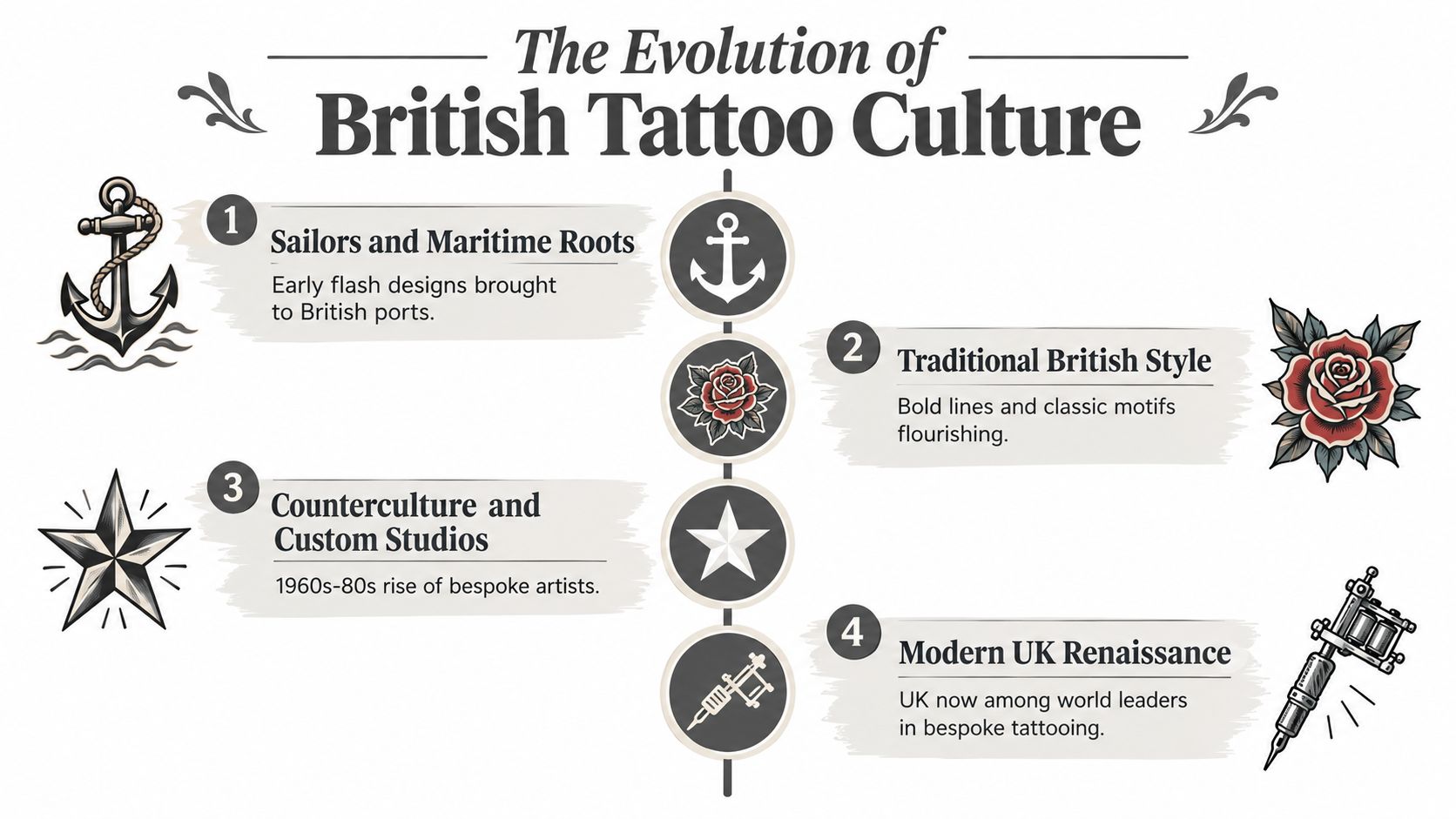
British tattooing grew from novelty into an established custom art form over a long cultural journey. Modern tattoo commerce in Britain is traced to the late 17th century, when pilgrims returned with souvenir tattoos from abroad. At that point, tattoos were often treated as exotic reminders of travel rather than as highly individualised artwork, as described in this history of British tattooing.
A widely cited timeline places the first professional tattoo studio in Britain at 1870. By 1900, tattooing had spread through many parts of British society. That shift created space for tattooing to move beyond fixed novelty designs and towards personal commissions, specialist techniques, and studio-based craftsmanship.
From shared motifs to individual language
Traditional motifs still matter because they offer immediate readability. Roses, anchors, animals, lettering, and maritime symbols can carry a familiar visual weight, especially when built with strong outlines and deliberate colour. Japanese tattooing, realism, blackwork, fine line, and other approaches broadened the vocabulary available to British clients.
That history helps explain why a modern UK studio can move between Traditional, Japanese, Realism, Blackwork, and Fine Line without treating one style as the only authentic choice. British clients inherited a culture that kept developing through travel, trade, counterculture, technology, and custom design.
The range can feel overwhelming, but it also gives you better options. Your tattoo doesn't have to follow a single national template. It can be selected according to your story, body shape, preferred contrast, and expectations for the future.
The visual timeline below offers another way to place that progression in context.
Essential Characteristics of Major Tattoo Styles
A style becomes easier to choose when you stop judging it only by subject matter and look at its construction. Pay attention to outline weight, ink saturation, colour range, shading method, and empty space.
| Style | What you usually see | What to discuss with the artist |
|---|---|---|
| Traditional or Old School | Bold outlines, clear shapes, classic motifs, and a controlled palette | Whether the design needs strong separation between elements |
| Neo-Traditional | Bold structure with varied lines, richer colour, dimensional shading, and illustrative detail | How much detail the skin and placement can support |
| Japanese | Flowing compositions, substantial coverage, and connected imagery such as dragons, koi, flowers, or waves | How the design will follow the body's contours as a larger project |
| Blackwork and Dotwork | Dense black areas, geometric forms, graphic contrast, and patterned texture | Where negative space will preserve readability |
| Fine Line | Delicate outlines, restrained shading, and a light visual footprint | Whether the size and placement give fine details enough room |
| Realism | Carefully modelled light, texture, anatomy, and depth | How the artist handles contrast rather than simply copying a photograph |
Traditional relies on visual economy. Its outlines and simplified forms make the image readable without needing every texture represented. Neo-Traditional keeps that structural confidence but can introduce broader colour choices, varied line weights, and more illustrative shading, which is why it suits clients who want a classic foundation with extra depth. This guide to Neo-Traditional tattoo style explains that relationship in greater detail.
Japanese tattooing is often understood as a composition rather than an isolated sticker. Background movement, body flow, and the relationship between major motifs matter as much as the central subject. If this direction appeals to you, compare examples of Japanese tattoo styles before deciding whether you want a standalone image or a connected project.
Blackwork can be stark and graphic, while Dotwork creates tone and texture through repeated points. Fine Line depends on restraint and clean placement. Realism depends on controlled contrast, accurate proportions, and an artist who understands how to simplify a reference without losing its identity.
At the consultation, don't just say “I like this style”. Point to the exact feature you like, such as the heavy outline, muted shading, open skin, or saturated colour.
Long-Term Durability and Skin Aging
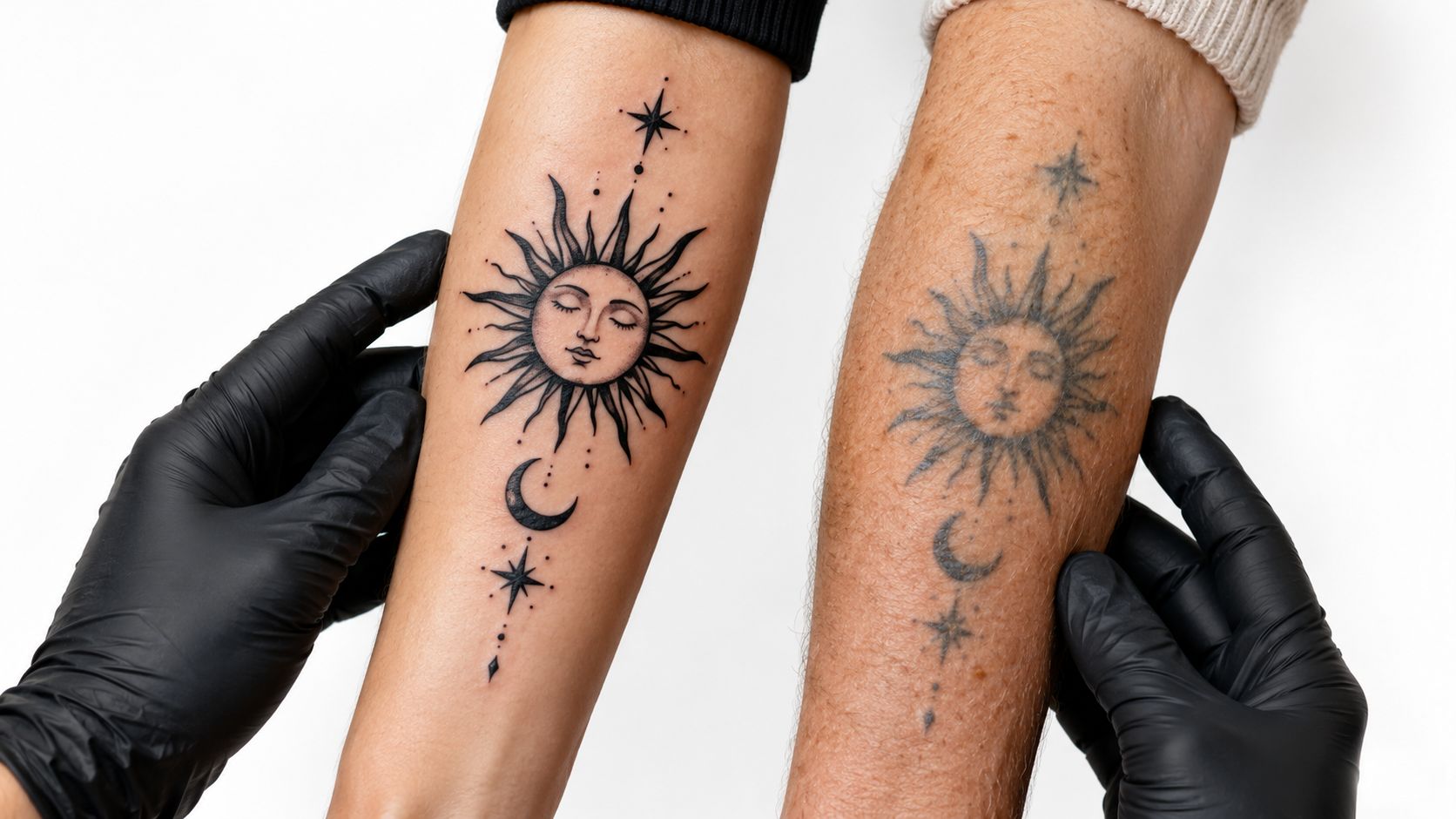
At the consultation table, a fresh tattoo can make almost any style appear sharper than it will after healing. Ask the longer-term question: “Will the structure still read when the skin and ink have changed?” Ink settles, skin stretches and moves, and sunlight gradually affects colour and contrast. The strongest design is one that remains clear years from now, not one that only succeeds in a fresh photograph.
Recent 2026 trend coverage from Burned Hearts describes micro-realism as popular but risky, particularly when an artist packs too much detail into a small area. It warns that dense detail can blur after 7 to 10 years, while balanced contrast and negative space may help a design stay clearer for longer. Read the full discussion of tattoo durability and body art, and compare it with this guide to tattoos and body art before treating a current trend as a long-term guarantee.
Detail needs room to survive
Fine Line and micro-realism can look beautiful when the scale, placement, and design work together. They become less forgiving when tiny details sit too close together, when the tattoo is placed where skin moves or rubs often, or when the client expects fresh precision to remain unchanged.
Larger black and grey work, strong Blackwork, and structured Neo-Traditional designs often give the artist more room to create contrast and separation. That does not make them right for every client. Their visual systems offer more resilience when the artist protects negative space and avoids crowding.
The most fashionable tattoo isn't automatically the most durable tattoo.
Sun exposure, friction, placement, skin condition, and aftercare all shape the result. An experienced artist should explain when a design may need simplifying, enlarging, or repositioning. Delicate work remains an option. The decision is about understanding what its fine detail may require from your skin and future upkeep.
Ask: “Which parts of this design are most likely to soften first, and how would you adapt them?” The answer shows whether the artist is planning for healed skin rather than only the first photograph.
Matching Your Vision to the Right Artist
An artist's portfolio should answer a practical question: Can this person repeatedly produce the technical qualities my tattoo needs? Liking one image isn't enough. You need evidence that the artist understands the style across different subjects, body areas, and compositions.
Start with the portfolio, then inspect it like an apprentice rather than a shopper.
Look for technical consistency
Check whether the lines remain intentional around curves and joints. In Fine Line work, look for delicacy without hesitation or uneven breaks. In Traditional and Blackwork, examine whether bold outlines and solid black areas are evenly saturated. In Realism, study the transition between light and dark, not just the subject's resemblance to a photograph.
Use this sequence:
- Identify the recurring style. Does the artist naturally create the visual language you want, or would you be asking them to leave their speciality?
- Study several examples. One strong tattoo may be an exception. A coherent body of work demonstrates repeatable skill.
- Check composition. Look for designs that fit the anatomy instead of appearing pasted onto it.
- Ask about healed work. Fresh ink shows immediate impact. Healed examples reveal how the artist manages line spacing, contrast, and saturation.
- Discuss the difficult parts. Ask how they would handle small details, pale tones, dense shading, or a placement that bends and moves.
A Fine Line specialist may not be the right choice for a large Japanese back piece, just as a Traditional artist may not be the natural fit for a soft photorealistic portrait. That isn't a judgement on either artist. Tattooing has different technical demands, and a portfolio makes those demands visible.
Portfolio test: If you can't find work close to your proposed style, subject, and scale, keep researching before you pay a deposit.
The right artist will also explain limitations without making you feel foolish. Clear advice about size, placement, and detail protects the final tattoo.
The Consultation Process and Bespoke Design
A consultation turns a vague idea into a tattoo that can be placed, sized, and completed. Bring reference images, but don't expect one image to become a direct copy. References help communicate mood, subject, pose, texture, and colour. The artist still has to build a composition for your anatomy.
Begin with the elements that can't be changed later. Discuss the body area, approximate scale, visibility, work clothing, movement, and whether the design may eventually connect to another tattoo. A forearm, shoulder, rib area, and calf each impose different practical conditions.

What a productive meeting should settle
- The visual direction: Agree whether the piece is Traditional, Black and Grey, Fine Line, Japanese, Realism, or another approach.
- The physical plan: Confirm placement, scale, orientation, and how the design follows the body's contours.
- The working process: Establish whether the project needs one appointment, several sessions, or time for a larger composition to develop.
- The practical expectations: Discuss pricing, deposits, preparation, timing, and aftercare before the appointment.
A bespoke tattoo should solve a specific design problem for one person's body. Some studios take a custom-first position and won't tattoo the same piece twice, allowing the artist to adapt the work rather than treating every client as a place to reproduce a template. That approach can be especially valuable when the design needs to flow around anatomy or sit beside existing work.
You should leave the consultation understanding what happens next. You don't need every line finalised at the first conversation, but you do need confidence that the artist has heard your priorities and can explain the route from concept to skin. For clients looking for a custom tattoo design, a free consultation can remove uncertainty before a booking is confirmed.
Hygiene Standards and Studio Facilities
Artistic skill and hygiene belong in the same decision. A beautiful portfolio doesn't compensate for poor preparation, unclear sterilisation procedures, or careless handling of equipment and jewellery.
Before your appointment, ask how the studio prepares the work area, handles single-use materials, cleans equipment, and sterilises reusable instruments. For piercing, ask about implant-grade, internally threaded titanium jewellery. The threading sits inside the jewellery rather than scraping through the piercing channel during insertion, while appropriate material quality supports safer professional practice.
What to observe when you arrive
Look for a clean, organised environment where the artist sets up a sterile field rather than rushing directly from one client to the next. Private, curtained tattoo areas can provide privacy, and multiple booths can help a studio separate clients and manage its workflow. Purpose-designed facilities should feel calm, ventilated, and easy to keep clean.
A professional studio should also explain aftercare in language you understand. UK local-authority guidance says tattoos should be washed gently at least twice daily, patted dry, not re-covered, and kept away from soaking, tight clothing, sunbeds, and excess sweating for at least 10 days. The same tattooing guidance from Derby City Council requires written and verbal aftercare advice and notes that larger-area tattoos may need a sterile, non-adhesive dressing for the journey home.
Dense Blackwork, Japanese compositions, and heavily saturated Traditional work may need particularly careful healing management because they involve broader coverage or more concentrated pigment. Your artist should match the advice to the tattoo's placement, size, and exposure rather than handing every client identical instructions.
Booking Your Appointment and Next Steps
Your next step depends on the tattoo you want. A small, straightforward piece may fit a walk-in appointment when an artist has space. A sleeve, portrait, Japanese composition, or detailed realism project needs a scheduled appointment so the right artist has enough time to prepare and work without rushing.
Contact the studio by phone, email, or online form and include the information an artist needs to assess the idea:
- Your concept: Explain the subject, meaning, preferred style, and any reference images.
- Your placement: Name the body area and share a clear photograph if the studio requests one.
- Your approximate size: Use centimetres or a comparison with your hand, but expect the artist to refine it.
- Your timing: Say whether you're flexible, need a particular date, or are asking about a walk-in.
- Your questions: Ask about consultation availability, deposits, preparation, and aftercare.
A free consultation can help you decide between styles before you commit. It also gives the artist an opportunity to match your idea with an artist whose portfolio suits the required technique. Walk-ins can be convenient for smaller designs, but availability changes with the day's schedule, so calling first is sensible.
After the appointment, the relationship continues through healing. Follow the written guidance, keep the tattoo clean, avoid soaking and friction during the advised period, and contact the studio if you're unsure about an unexpected reaction.
Timebomb Tattoo & Piercing offers custom tattooing across styles from Traditional and Blackwork to Fine Line, Realism, Japanese, and micro tattoos, alongside professional piercing at studios in Bournemouth and Croydon. Visit Timebomb Tattoo & Piercing to request a free consultation, ask about phone, email, or online booking, or check whether a walk-in appointment is available.