
You've probably done some version of this already. You open a few tabs, search for body art tattoo, then bounce between tattoos, piercings, temporary designs, aftercare advice, and photos that all look good until you try to imagine them on your own body.
That's where many get stuck.
It isn't usually a lack of inspiration. It's a lack of clarity. You might love the look of a forearm tattoo but wonder how permanent that decision feels in real life. You might like the idea of a piercing because it seems less final, but you're not sure about healing or jewellery changes. Or you might want something expressive now without signing up for something you'll still be managing years from today.
In the UK, tattoos are no longer niche. A YouGov survey of British adults found that 26% had at least one tattoo and 11% had a visible tattoo. In the same survey, tattoo ownership was especially common among working-age adults, with around 34% to 38% of people aged 25 to 54 saying they had one. That tells you something useful straight away. Tattooing sits firmly in ordinary life now, not at the edge of it.

If you're looking at tattoo studios in Bournemouth, or anywhere else, the better question isn't just “what looks good?” It's “what level of commitment fits me?”
That's the key idea running through everything below. Think of body art as a spectrum. At one end, you've got options you can wear for a short time and wash away. In the middle, you've got piercings, which change the body but can often be reversed. At the far end, you've got tattoos, where the artwork becomes part of your skin for the long haul.
Table of Contents
- Introduction to Body Art and Tattoos Today
- What Body Art Means and Where Tattoos Fit
- Tattoos Piercings and Temporary Art Compared
- Popular Tattoo Styles and How to Choose One
- Healing and Aftercare Essentials for Tattoos and Piercings
- Common Misconceptions About Safety Regret and Removal
- Book Your Body Art Tattoo or Piercing With Confidence
Introduction to Body Art and Tattoos Today
Why people feel torn between options
A first-timer usually isn't choosing between “good” and “bad”. They're choosing between different kinds of commitment.
A small wrist tattoo might feel manageable until you realise it's visible at work. A nostril piercing might seem simpler until you remember it still needs careful healing. A temporary design can help you test a look, but it won't give you the same sense of ownership as permanent art. Those are different decisions, even when the visual style overlaps.
That's why broad searches can feel messy. “Body art tattoo” sounds like one topic, but it covers several paths that behave differently in the world.
Body art isn't one lane. It's a set of choices about permanence, pain, healing, visibility, and how much future-you needs to live with today's decision.
A practical way to think about it
If a client sat in front of me unsure where to start, I wouldn't begin with trends. I'd begin with routine.
- Lifestyle first. Can you care for a healing area properly?
- Visibility second. Do you want to see it every day, or hide it when needed?
- Commitment third. Are you testing self-expression, or marking something permanent?
- Then style. Once the first three are clear, the design gets easier.
That order saves people from making emotional decisions with practical consequences attached.
What Body Art Means and Where Tattoos Fit
Body art is the umbrella. Tattoos are one branch under it.
People often use “body art” and “tattoo” as if they mean the same thing, but they don't. Body art covers intentional decoration or modification of the body. Tattoos sit alongside piercing, scarification, branding, and temporary forms such as henna or transfer designs.
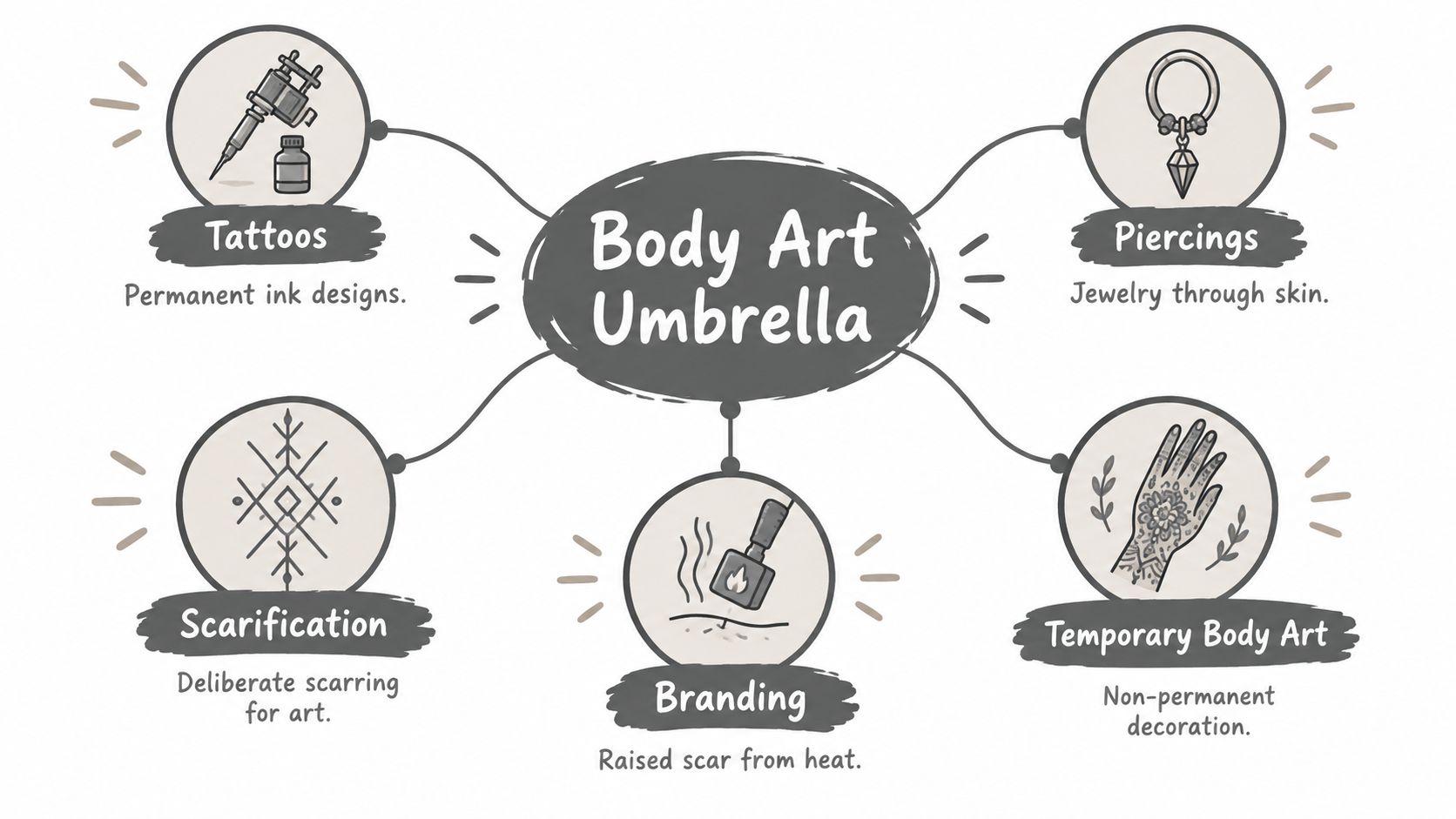
Plain definition: Body art is any deliberate way of changing or decorating the body for expression, identity, culture, memory, or style.
The permanence spectrum
The easiest way to understand the category is to picture a spectrum.
At one end, you have temporary body art. That includes things that sit on the surface of the skin and fade or wash away. It gives you visual impact without long-term commitment.
In the middle, you have piercing. A piercing creates a channel through tissue so jewellery can be worn. It's more committed than temporary art because the body has to heal around the piercing, but it still isn't the same kind of permanence as tattooing.
At the far end, you have tattooing. Ink is placed into the skin so the design stays. Styles, placement, colour, and execution all vary, but the basic point remains the same. You're making a lasting change.
Why the method matters
The method changes everything.
A temporary design asks very little from the body. A piercing asks for healing and jewellery care. A tattoo asks for skin healing now and design acceptance later. That's why hygiene, practitioner skill, and aftercare standards can't be treated as interchangeable across all forms of body art.
Tattooing also has a long professional history in Britain. In 1894, London tattooist Sutherland Macdonald became the first person listed in the Post Office Directory under tattooists, and he remained the only entry in that category for the next four years, as noted in this account of Britain's first professional tattoo artist. That moment matters because it marks tattooing as a recognised trade, not just an improvised practice.
A better question than “tattoo or body art”
Instead of asking whether a tattoo “counts” as body art, ask where your idea belongs on the spectrum.
- Short-term expression often points to temporary art.
- Adornment with some flexibility often points to piercing.
- A lasting visual statement points to tattooing.
That shift sounds small, but it clears up a lot of confusion. You stop shopping only by image and start choosing by fit.
Tattoos Piercings and Temporary Art Compared
A good decision gets easier when you compare the options side by side. Not as a trend board, but as lived experience.
Some people choose a tattoo because they want a fixed image that becomes part of them. Some choose a piercing because they like the look of changeable jewellery. Others try temporary body art first because they want to test placement, attention, or confidence before making a bigger commitment.
Body Art Options at a Glance
| Feature | Tattoo | Piercing | Temporary Art |
|---|---|---|---|
| How it's made | Ink is placed into the skin with tattoo equipment | Jewellery is inserted through a fresh piercing | Design sits on or stains the surface of the skin |
| Commitment level | High | Medium | Low |
| Pain pattern | Usually a steady scratching or vibrating sensation | Usually a short, sharp moment followed by soreness | Minimal or none |
| Healing focus | Protect the skin while it closes and settles | Protect the channel and jewellery area | Very little aftercare beyond preserving appearance |
| Longevity | Long-term | Lasts while you keep the piercing and it remains healthy | Short-term |
| Reversibility | Removal is possible but not simple | Jewellery can often be removed, though marks may remain | Washes off or fades |
| Style flexibility | Fixed artwork | Jewellery can be changed after healing | Easy to switch designs often |
| Visibility choice | Depends on placement | Depends on placement and jewellery | Easy to wear only when wanted |
How the experience differs
Tattoos tend to be about design ownership. You choose line, size, placement, and style in a very intentional way. Even a small tattoo often needs more thought than people expect, because a permanent piece still has to age well on skin.
Piercings behave differently. The initial act is fast, but the commitment sits in the healing. You don't just “get” a piercing. You live with it while the tissue settles, while jewellery stays in place, and while you avoid knocking or changing it too soon.
Temporary art is often underestimated. It can be useful if you're undecided about scale or visibility. Wearing a design on the hand, forearm, neck, or ankle for a short period can tell you quickly whether you enjoy the attention that placement brings.
Practical rule: Choose the option whose aftercare and long-term reality you can honestly handle, not just the one that looks best in a photo.
Lifestyle questions that usually decide it
Ask yourself these before booking anything.
- Work and visibility. Will visible body art create stress you don't want?
- Routine and healing. Can you keep the area clean and avoid friction, swimming, or heavy disruption while it heals?
- Changeability. Do you want to swap jewellery, keep one image, or change your look often?
- Regret tolerance. If your taste shifts later, which option will feel easiest to live with?
That last question matters more than people think. A good body art tattoo choice isn't the most dramatic option. It's the one that still makes sense once the excitement settles.
Popular Tattoo Styles and How to Choose One
Style is where people usually begin, but it shouldn't be where they stop. A design can be beautiful in the wrong style for the body part, too small for the level of detail, or better suited to another artist entirely.
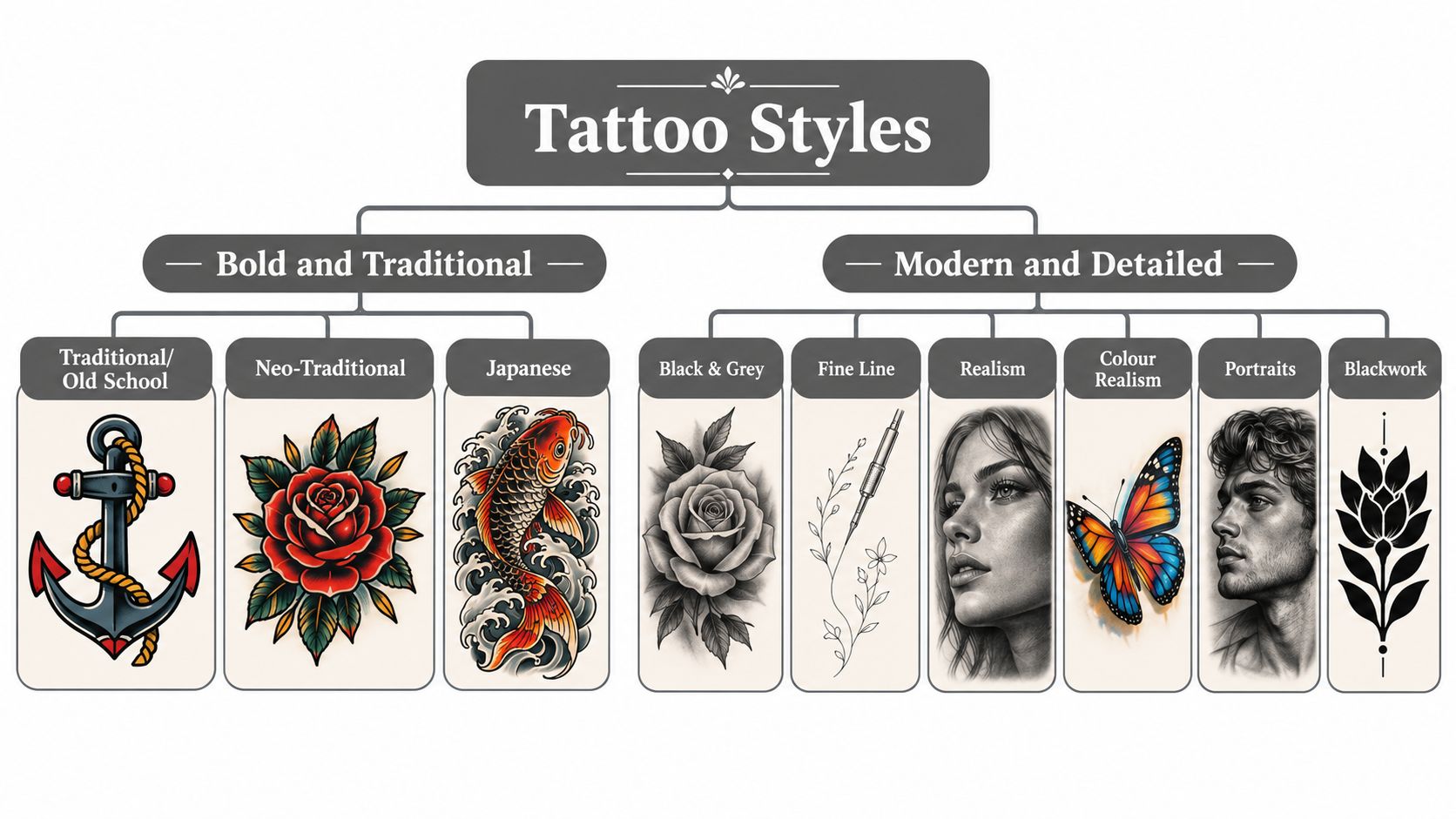
Bold and traditional families
Traditional or Old School uses bold outlines, strong shapes, and classic imagery such as roses, daggers, swallows, and anchors. It suits people who want a tattoo that reads clearly from a distance and tends to hold its visual strength well.
Neo-Traditional keeps that solid structure but adds more ornament, colour variation, and detail. If you like decorative pieces with stronger flow and richer visual depth, this often feels like the next step.
Japanese work often relies on movement across larger areas. Koi, dragons, waves, masks, peonies, and wind bars aren't just separate images. They're usually designed to work together across the body.
Modern and detailed styles
Black & Grey leans on shading instead of bold colour. It can feel soft, dramatic, realistic, or atmospheric depending on the subject.
Fine Line uses delicate linework and light visual weight. It's popular for script, florals, symbols, and discreet placements, but it needs thoughtful sizing because details that are too tiny can blur into each other over time.
Realism aims for lifelike depth and texture. Colour Realism takes that further with full-colour rendering. Portraits sit inside this detailed world too, but they're especially unforgiving. A small mistake in proportion changes the whole face.
A gallery helps here because style names can feel abstract until you see real healed and fresh examples. Browsing a tattoo gallery with different styles and placements makes it easier to notice what you repeatedly come back to.
Here's a useful visual reference before you decide what to save for your consultation.
Graphic and high-contrast directions
Blackwork uses bold black shapes, pattern, or heavy contrast. It can be minimal or intense.
Dotwork builds images through tiny points rather than smooth shading. It often suits geometric or ornamental ideas.
New School pushes exaggeration, movement, and bright personality. It isn't subtle, and that's the point.
Micro tattoos or very small tattoos can look elegant, but they demand restraint. A tiny tattoo works best when the idea is simple enough to stay readable.
A strong tattoo style doesn't just match your taste. It matches the body part, the size, and the way skin carries detail.
How to choose without overthinking
Try this filter instead of scrolling endlessly.
- Choose mood first. Bold, delicate, realistic, graphic, or decorative.
- Match it to placement. A rib piece behaves differently from a calf or forearm piece.
- Be honest about size. More detail usually needs more space.
- Find the right specialist. An artist who shines in Japanese work isn't automatically the best fit for fine line script.
- Bring references for direction, not imitation. Good custom work uses references as a brief, not a tracing exercise.
Studios with a custom-first approach often won't repeat the same tattoo twice. That's a good thing. It means your references guide the conversation, but the finished design is built for you.
Healing and Aftercare Essentials for Tattoos and Piercings
The exciting part is the appointment. The important part starts when you leave.
Healing is where good work is protected. If you treat aftercare like an afterthought, even a strong tattoo or piercing can have a rough start. If you treat it like basic maintenance, most of the process becomes much easier to manage.
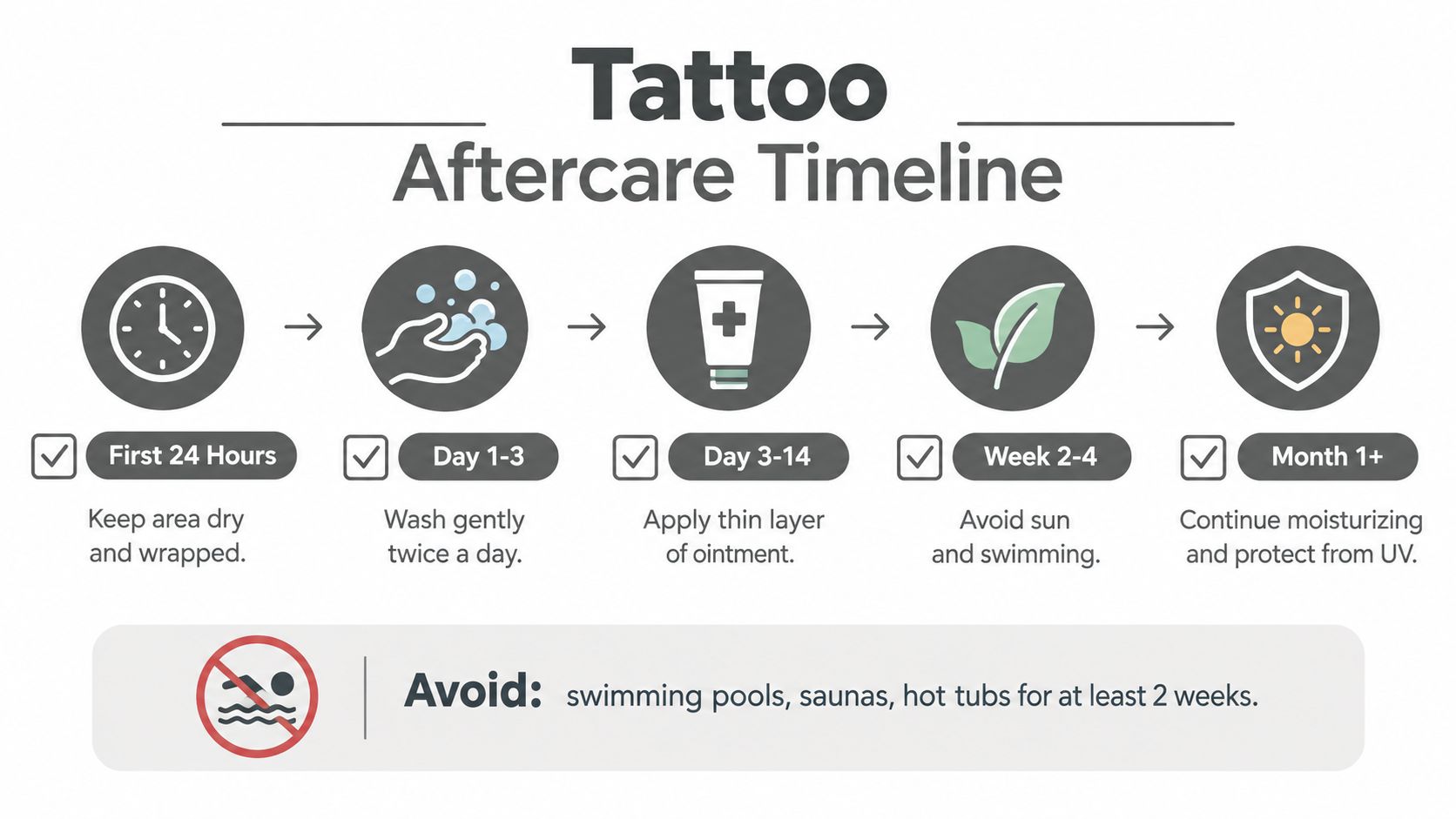
The first 24 hours
For tattoo-like micropigmentation, NHS aftercare guidance recommends keeping the area dry for the first 24 hours, then washing with mild soap after the initial dressing period, avoiding picking crusts, and watching for signs such as redness, heat, swelling, increased pain, or discharge that may indicate infection, as summarised in BBC reporting on NHS aftercare guidance. Those principles are a solid baseline for anyone healing a fresh tattoo.
That first day is not the time to test products, touch the area repeatedly, or show it off to everyone who asks. Clean hands and calm handling matter more than complicated routines.
The first week
People usually get impatient.
NHS guidance also advises avoiding swimming pools, saunas, hot tubs, and heavy exercise for about a week in the same aftercare summary. The reason is simple. Heat, sweat, soaking, and friction don't help healing skin stay settled.
A straightforward routine tends to work best:
- Wash gently with mild soap once the dressing stage is over.
- Keep it clean rather than constantly coated in product.
- Leave crusts alone because picking can pull colour and disrupt even healing.
- Use clean gauze or sterile materials if there's light weeping and your artist advises it.
What sterile technique should look like
Clients don't need to become regulators, but they should know the basics.
UK local authority conditions require sterile single-use disposable needles, sterile pigment in single-use pots or pre-packed single-use vials, and disposable non-latex gloves changed for each client, according to tattooing and skin piercing licence conditions from Angus Council.
For reusable equipment and jewellery, other UK guidance says tools should only be reused after cleaning and steam sterilisation, and piercing jewellery should be sterile before use, as set out in local-authority skin piercing guidance. A separate Cambridge skin-piercing code of practice adds that items penetrating broken skin or mucous membranes must be sterilised in an autoclave or purchased sterile as single-use disposables, and that steam sterilisation is the only reliable method.
That sounds technical, but the takeaway is simple. Sterility is not a vibe. It's a process.
One example of a studio setup that states sterile techniques and, in Bournemouth, implant-grade internally threaded titanium jewellery is Timebomb Tattoo & Piercing. Whether you book there or elsewhere, those are the kinds of practical details worth checking.
Fresh work needs boring care. That's usually the care that heals best.
Normal healing and warning signs
Mild tenderness, some warmth early on, and light crusting can be part of normal healing. What you're watching for is change in the wrong direction.
Seek medical review if you notice:
- Increasing redness rather than gradual settling
- Heat and swelling that worsen instead of ease
- Growing pain
- Discharge that suggests infection
Those signs deserve attention. Waiting and hoping usually isn't a smart plan.
Common Misconceptions About Safety Regret and Removal
The most common myth is that a good studio removes all risk. It doesn't. A good studio reduces avoidable risk and helps you make better decisions before anything touches your skin.
One of the more useful UK figures on this comes from government analysis of tattoo inks and permanent make-up, which estimates that around 1.8% of people with tattoos develop an adverse reaction severe enough to require a doctor's consultation, as referenced in NHS aftercare information discussing tattoo reactions. That matters because reactions aren't always immediate. Delayed inflammatory or allergic responses can happen later, which is why consultation questions about eczema, dermatitis, or metal allergy aren't just box-ticking.
Regret is more practical than people think
People often assume regret is only about changing taste. Sometimes it is. Often it's also about placement, visibility, relationship to work, or disappointment with execution.
NHS England says tattoo removal is generally not routinely funded and is considered only in specific cases such as significant allergic reaction or infection, or tattoos done against someone's will, according to its clinical commissioning policy on aesthetic and reconstructive procedures. The same source context also notes independent UK survey findings that 40% of adults were considering tattoo removal, with 27% saying they had fallen out of love with the design and 25% saying they were unhappy with tattoo quality.
That's why I tell first-timers to slow down on three things:
- Placement. A design can be right and still be wrong for a visible area.
- Scale. Tiny ideas often ask too much of too little space.
- Certainty. “I think so” is not always enough for a permanent choice.
Regulation isn't the same as guaranteed competence
Another misconception is that licensing automatically proves artistic or technical competence. It doesn't.
Official UK guidance states there are currently no legal requirements for professional competence and no nationally recognised or accredited training courses for tattooing and body piercing, while the UK REACH restriction for tattoo inks and permanent make-up has a major update scheduled for 30 December 2025, as noted in the same NHS England policy context. So yes, hygiene matters. But so do consultation quality, healed work, style specialism, and how seriously a studio treats informed consent.
Book Your Body Art Tattoo or Piercing With Confidence
Once you know where you sit on the commitment spectrum, booking gets simpler. You're not just asking for “something cool”. You're choosing a form, a placement, a style, and a healing commitment that fits your life.
What a sensible booking process looks like
A proper consultation should cover your idea, size, placement, references, and whether the style suits the body part you've chosen. If you're pricing early ideas, it can also help to read a practical guide on how much a small tattoo can cost so your expectations line up with the kind of work you want.
Walk-ins can work for smaller or simpler pieces, but they're not guaranteed. UK studio guidance shows that walk-ins depend on whether artists are already booked, while consultations may be free but a deposit is often needed to reserve a slot, as reflected in studio booking guidance on walk-ins and consultations. For larger custom work, booking ahead is the normal route.
What helps first-timers feel settled
Look for a studio that gives you room to ask basic questions without making you feel awkward. Private or curtained areas can matter, especially for intimate placements or if you're nervous. Clear aftercare instructions matter just as much.
If you're choosing between Bournemouth and South London, it also helps when the studio is easy to reach and set up for both tattoos and piercings. Timebomb's Bournemouth studio is at 109 Old Christchurch Road, BH1 1EP, and its Croydon studio is at 22 George Street, CR0 1PA, with Croydon a short walk from East Croydon and West Croydon stations. Booking and enquiries are handled by phone, email, or an online form, and artists provide aftercare guidance after your appointment.
If you're ready to move from browsing to a real plan, contact the studio by phone, send an email with your idea and reference images, or use the online enquiry form to request a consultation or appointment.
If you want a tattoo or piercing that fits your style, lifestyle, and comfort level, Timebomb Tattoo & Piercing offers custom tattooing, professional piercing, free consultations, and artist matching across Bournemouth and Croydon. Send your idea by phone, email, or the online form, and the team can help you work out placement, design direction, and the right level of commitment before you book.