
You've got a phone folder full of tattoo references, but no clear answer to the questions that matter. Will the design suit your arm? Is the idea developed enough for an artist? Should you book online, walk into a studio, or keep scrolling until the concept feels more certain?
Most first-time clients hesitate for the same reasons. They don't want to waste an artist's time, they're unsure whether their idea is “good enough”, and they're nervous about making a permanent decision. A consultation-led approach removes much of that uncertainty by turning loose inspiration into practical choices about style, scale, placement, hygiene and healing.
The process starts before the needle. You'll define what custom tattoo design means, choose a style that fits both your idea and your body, discuss the work with an artist, check the studio's operating standards, and decide whether the design still feels right when all the practical details are visible.
Table of Contents
- Standing in Front of the Mirror With an Idea
- What Custom Tattoo Design Really Means
- Inside the Custom-First Studio Process
- What Happens at a Free Consultation
- Choosing a Style That Suits You and the Brief
- Safety, Hygiene and UK Rules Worth Knowing
- Designing for Permanence and Real Ageing
- From First Idea to Booked Appointment
Standing in Front of the Mirror With an Idea
A first tattoo often begins with an ordinary moment. You're standing in front of the mirror, holding your phone against your forearm, trying to work out whether the botanical design saved from one artist belongs there, or whether the portrait reference would make more sense on your upper arm. The images look good separately, but they don't yet form a tattoo brief.
That uncertainty doesn't mean you're unprepared. It means you're at the normal starting point. An artist doesn't expect every first enquiry to arrive as a finished drawing. A subject, a feeling, a few references and an approximate placement can be enough to begin a useful conversation.
A practical starting point: bring references for the elements you like, not just one tattoo you want copied.
Three worries tend to appear at this stage:
- Wasting the artist's time: A consultation exists to establish direction. Asking questions before booking is part of the process, not an interruption.
- Having an idea that isn't good enough: Artists can help translate a broad thought such as “a meaningful nature piece” into imagery, composition and scale.
- Committing too soon: Discussing a tattoo doesn't commit you to having it. Good consultation gives you more information before you make a permanent choice.
A custom tattoo also has to work away from the phone screen. It needs to follow the body's contours, remain readable at its intended size, suit your everyday visibility requirements and leave enough room for the design to age naturally. That's why the first conversation should cover more than subject matter.
By the end of the process, you should know whether you need a small walk-in piece or a planned appointment, which artist's strengths fit the brief, what changes the design may need, and whether you're comfortable with the placement and long-term commitment.
What Custom Tattoo Design Really Means
Custom work is different from choosing a pre-drawn flash design. Flash is already composed, sized and styled by the artist. You choose a piece from an existing selection, then the artist adapts it to your body within sensible limits.
Custom tattoo design is closer to ordering a bespoke suit. An off-the-rack suit may fit well, but a bespoke one starts with your measurements, preferences and intended use. In tattooing, those measurements include body shape, placement, scale, movement, visibility and the way the design should sit with your existing work.
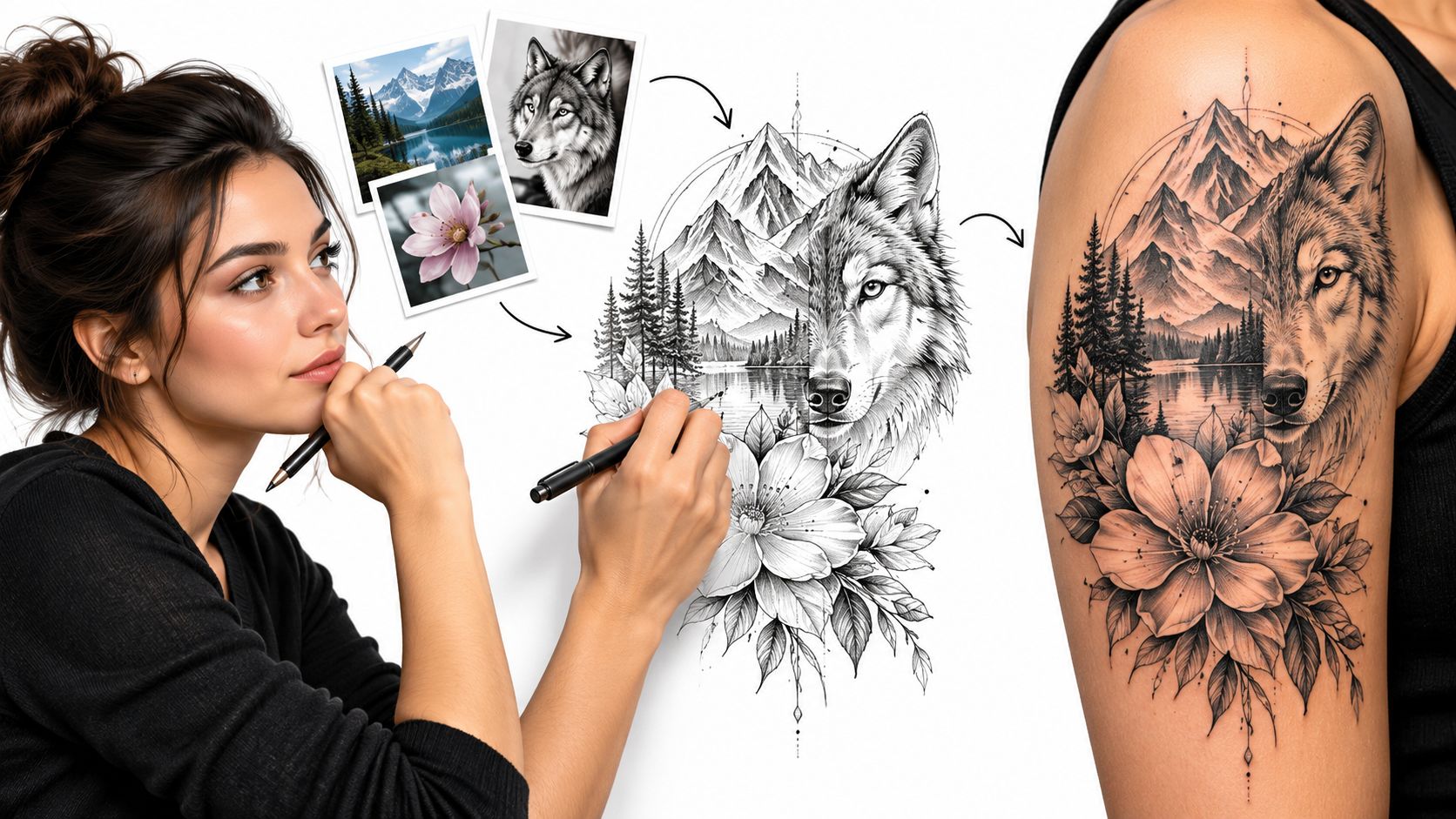
Start with a brief, not a finished picture
Your brief should answer practical questions:
- What is the subject? This could be a wolf, a family symbol, a botanical form, an architectural detail or an abstract idea.
- What should it feel like? Calm, bold, dark, delicate, ornamental, realistic or graphic are useful creative signals.
- Where will it go? The same design behaves differently on a forearm, ribcage, thigh or shoulder.
- How visible should it be? Visibility affects size, placement and how you'll feel wearing it at work or in formal settings.
- Which references help? Gather examples of line quality, shading, composition and colour. They're starting points, not instructions to reproduce another person's tattoo.
The artist then develops original artwork for your body. A strong brief changes as you talk. You may arrive with a detailed reference and discover that its proportions won't work at your chosen size. Alternatively, you may arrive with only a subject and leave with a clearer direction after discussing contrast, negative space and placement.
The design conversation also explains why custom work involves a different price and timeline from selecting flash. The artist is solving a visual and technical problem specifically for you, rather than applying a ready-made image.
Timebomb's Croydon studio states that it doesn't tattoo the same piece twice, which reflects a custom-first approach where each commission is developed around an individual brief rather than reused.
A consultation may lead to a single appointment, a larger design meeting or a referral to an artist whose portfolio better matches the requested style. The important thing is that the brief comes first. A finished image can be useful, but a clear explanation of what you want the tattoo to do is more valuable.
A later stage may involve checking the drawing on the body, discussing the stencil and agreeing adjustments before tattooing begins. That physical check matters because a design that looks balanced on a screen may need changes when it follows the curve of an arm or shoulder.
Inside the Custom-First Studio Process
A professional custom process has several distinct stages. The client contributes information at each point, while the studio turns that information into an executable tattoo plan.
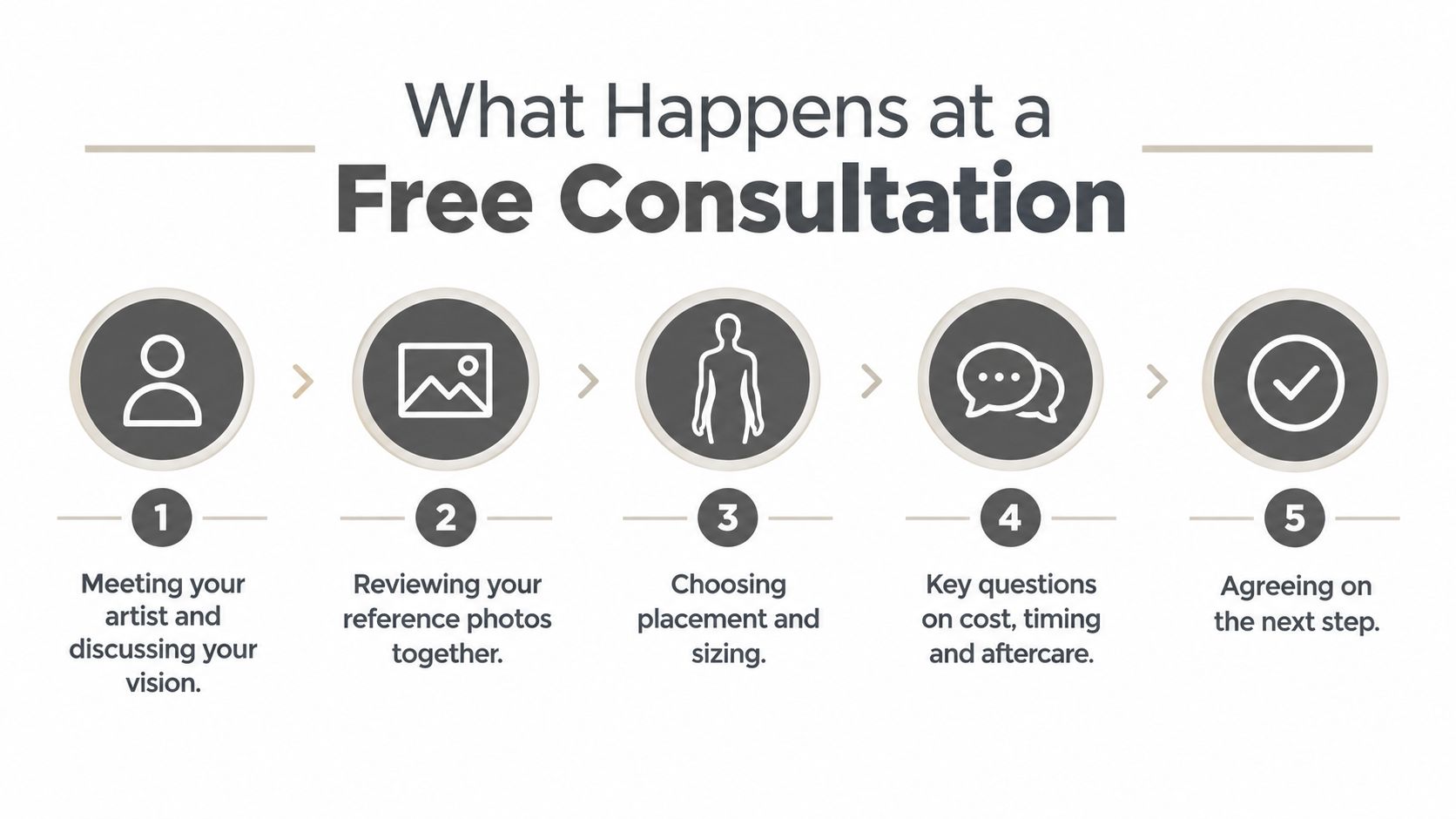
The stages from enquiry to healed work
Enquiry: You send the core idea, reference images, preferred placement and any timing considerations. You don't need to know the technical vocabulary. “A black and grey bird on my upper arm” gives an artist something workable.
Consultation: You and the artist discuss the body site, size, style, visibility, skin condition and the practical demands of the design. Larger realism, portrait and sleeve projects usually benefit from more planning than a simple symbol.
Brief and artist match: The studio identifies the right skill set for the work. Fine Line, Japanese, Blackwork, Traditional and Hyper-Realism each demand different decisions about line, shading, composition and scale. Resident and guest artists can give a studio more ways to match the brief to a specialist.
Design development: References become a composition made for your body. The artist may simplify small details, strengthen contrast, open negative space or change the flow so the piece reads naturally from different angles.
Booking and application: Once the direction is agreed, the studio confirms timing, cost and appointment details. The stencil, equipment preparation and treatment setup happen before the machine touches skin.
Aftercare: The artist provides instructions suited to the tattoo's saturation, size and location. Healing is part of the result, not an optional extra.
A custom-first workflow prevents the appointment from becoming a rushed design meeting. It gives the artist time to think about the drawing and gives you time to make decisions before the permanent stage.
The client's contribution remains important throughout. Tell the artist what you like in a reference and what you don't. Mention whether a tattoo needs to be concealed. Explain if the project may grow into a sleeve later, because the first piece may need to leave room for future additions.
The process also accommodates different levels of certainty. You can arrive with a precise concept, a collection of visual references or only a broad theme. The consultation turns that starting point into decisions that can be checked before booking.
What Happens at a Free Consultation
A free consultation should feel like a working conversation, not an audition. You'll usually meet an artist or studio representative, explain the idea, show your references and discuss what the tattoo needs to achieve.
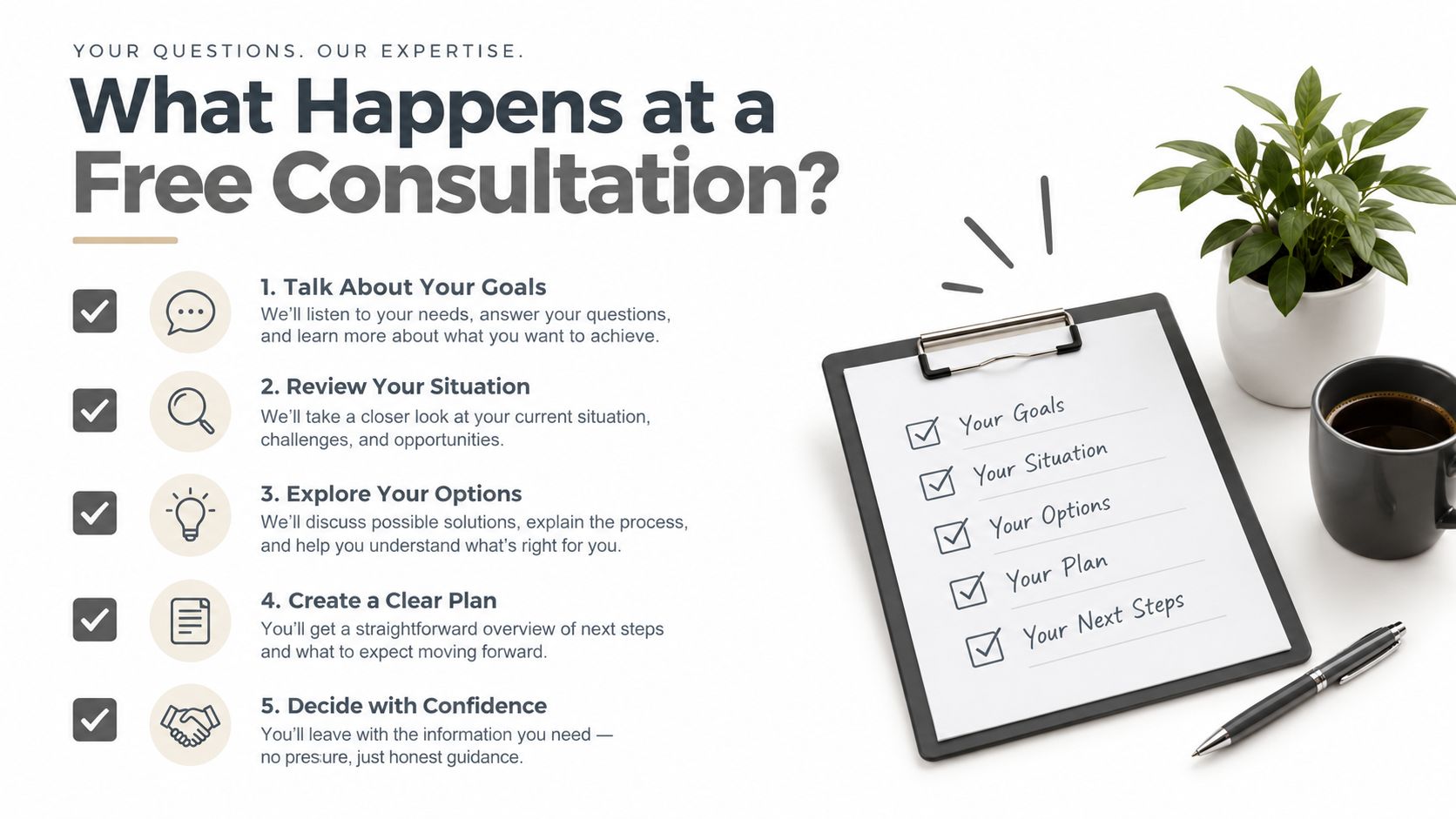
The questions that shape the design
A good artist will ask about:
- Subject and meaning: What should the image include, and which parts matter most?
- References: Do you prefer the line quality from one image, the composition from another and the mood of a third?
- Placement: How does the design sit when the body is relaxed and when it moves?
- Scale: Is the proposed size large enough for the detail to remain legible?
- Visibility: Do you want the piece displayed every day, or should clothing cover it in professional settings?
- Skin condition: Are there rashes, cuts, wounds or infected areas near the intended site?
- Medical considerations: Are there circumstances the artist needs to know before assessing the appointment?
- Healing and timing: Can you follow the aftercare requirements and allow the tattoo to heal properly?
Bring a small, organised reference folder rather than an unfiltered stream of images. Include examples of designs you like, notes about placement, an approximate size and a sentence describing the feeling you want. If you're unsure about colour, say so. It's easier for an artist to compare options when uncertainty is stated clearly.
| Bring to the consultation | Studio confirms during the meeting |
|---|---|
| Reference images showing subjects, line work or mood | Whether the requested style matches the artist's strengths |
| A preferred body area and any visibility concerns | Suitable placement, scale and body flow |
| An approximate size, even if it's only a rough idea | How detail, contrast and shading will behave at that size |
| Notes about meaning, future additions or existing tattoos | Whether the concept needs simplifying or expanding |
| Questions about timing, cost and aftercare | The next stage, likely appointment structure and preparation |
The word free doesn't mean the meeting has no value. It means you can explore the project before paying for the tattoo appointment. It also gives the studio a chance to identify risks early, including unsuitable placement, unrealistic detail or skin that needs attention before treatment.
Leave with a clear next step. That might be booking, sending additional references, changing the size, choosing another artist or deciding not to proceed. A useful consultation should make all of those decisions easier.
Choosing a Style That Suits You and the Brief
Style isn't a label you add after choosing an image. It controls how the artist uses line, shading, colour, contrast and open skin. It also affects the size and placement needed for the tattoo to remain readable.
Traditional and Old School designs use strong outlines, clear shapes and deliberate colour blocks. They can suit clients who want a graphic, recognisable tattoo with visual structure. Neo-Traditional work keeps some of that clarity but often allows more decorative detail, varied line weight and richer modelling.
Black and Grey can create depth through tonal range rather than colour. Realism, Colour Realism and Portraits demand careful reference selection and enough space for the artist to describe form. A face or animal may lose its character if compressed into a size that can't support the necessary detail.
Fine Line and micro or small tattoos can be subtle and precise, but small doesn't mean technically simple. Closely packed detail has less room to remain distinct as the tattoo heals and ages. Dotwork builds images through controlled points and can suit ornamental, geometric or spiritual compositions.
Japanese work often benefits from a larger planned canvas, particularly when the composition needs a clear flow across a limb or body panel. Blackwork can range from bold solid shapes to intricate patterning, while New School favours exaggerated forms, lively colour and a more illustrative approach.
Use the tattoo style guide to familiarise yourself with the main categories, then judge each style against your own brief rather than selecting one because it's currently visible online.
| Style family | Often suits | Main trade-off |
|---|---|---|
| Traditional, Old School | Clear symbols, bold motifs, compact compositions | Less room for delicate realism |
| Neo-Traditional, New School | Decorative or expressive artwork | Detail and colour need sensible scale |
| Black and Grey, Blackwork | Strong contrast, dramatic imagery | Dense coverage can increase healing demands |
| Fine Line, Dotwork | Light visual weight and pattern-led ideas | Small details need spacing and restraint |
| Realism, Colour Realism, Portraits | Recognisable people, animals and objects | References, scale and artist skill are critical |
| Japanese | Larger flowing compositions | Works best with long-term planning |
| Micro and small tattoos | Simple symbols and discreet pieces | Complex images may need simplification |
The right choice is the style that supports the subject, placement and artist's strengths. A strong artist may advise against your first stylistic idea if another approach will produce a clearer and more durable result.
Safety, Hygiene and UK Rules Worth Knowing
Safety belongs in the design conversation because the tattoo process affects skin, not just appearance. UK Government infection-control guidance identifies risks including bacterial infection and blood-borne viruses such as hepatitis B, hepatitis C and HIV. It also notes that the UK currently has no nationally recognised accredited training requirement for tattoo practitioners, so portfolio quality alone doesn't prove safe practice.

In England and Wales, tattoo and piercing businesses must register with the local council where their premises are located. Registration covers tattooing, piercing and electrolysis, and local byelaws can govern staff hygiene and the cleanliness and safety of premises, furniture and equipment. You can check the relevant requirements through the UK Government's tattooing and skin-piercing licence guidance.
Separate hygiene checks from ink questions
Ask calmly and specifically:
- Equipment: Are needles single-use and disposable, or sterilised correctly when a reusable item is permitted?
- Preparation: Is the treatment area prepared for the individual appointment?
- Cross-contamination: How are gloves, surfaces, sharps and waste handled?
- Pigments: Can the artist identify the pigments and batches being used?
- Aftercare: Will you receive written guidance suited to the design and placement?
- Piercing jewellery: If you're booking a piercing, what material and threading standard does the studio use?
UK local-authority guidance highlights decontamination, sterilisation, personal protective equipment, sharps management, waste handling and aftercare as core control areas. The Government's UK REACH restriction for tattoo inks and permanent make-up, dated December 2025, concerns substances used in tattoo inks and permanent make-up to reduce risks to human health. Ink compliance and practitioner competence are separate questions. One doesn't automatically prove the other.
For ordinary decorative tattooing, the law is clear. Under the Tattooing of Minors Act 1969, tattooing anyone under 18 is an offence in the UK unless performed for medical reasons by a qualified medical practitioner or someone working under their direction. You can read the Tattooing of Minors Act 1969 directly.
Your studio should also explain healing expectations. Guidance on how long a tattoo takes to heal should complement, not replace, the artist's personalised aftercare advice.
Designing for Permanence and Real Ageing
Permanence isn't only an emotional question. It's a design constraint, alongside size, placement and colour.
A design has to leave enough room for its components to remain distinguishable. Very fine lines, dense shading and closely spaced details have less tolerance when used at a small scale than simpler, higher-contrast shapes. This doesn't make fine detail wrong. It means the artist may need to enlarge it, simplify it or create more separation between elements.
Think beyond the fresh tattoo
Fresh tattoos can look exceptionally crisp. The more useful question is how the composition will read after healing and as the skin changes. Body movement, friction, sun exposure and the natural softening of pigment can all influence the long-term appearance.
Placement affects more than visibility. In YouGov's 2022 Great Britain survey, 26% of adults reported having a tattoo, while 11% reported at least one visible tattoo on areas including the head, face, neck, forearms, wrists or hands. The same survey recorded forearms as a selected location for 34%, wrists for 26%, hands for 20%, chest for 19%, upper back for 17%, stomach for 13% and ankles for 10% of respondents, with the figures referring to the listed body-area selections in that survey. These results are reported in YouGov's workplace tattoo research.
Visibility can also shape professional comfort. 63% of Britons considered face and neck tattoos unprofessional, compared with 28% who did not, according to the same YouGov research. That doesn't dictate your choice, but it gives a client a reason to discuss concealability before approving a highly visible placement.
Removal isn't a simple reset button. NHS commissioning material states that complete laser tattoo removal is highly variable and may generally require 12 to 16 sessions, sometimes up to around 20 or fewer, depending on skin type, tattoo colour, location, intensity, scarring and layering. The figures come from this NHS Scotland evidence summary on tattoo removal.
Design principle: Don't ask only whether you like the image today. Ask whether the size, spacing and placement give the image room to remain itself over time.
A good consultation may therefore include a future-use conversation. Could the tattoo later be incorporated into a sleeve? Is there enough space for a cover-up if your preferences change? Would a test placement or larger composition reduce the risk of regret? These questions don't make the process negative. They give you more control.
From First Idea to Booked Appointment
The path from idea to appointment is more straightforward when each decision happens in the right order.
Start with the subject, meaning and references. Add the intended placement, approximate scale, preferred visibility and any style direction. Then send the brief to a studio or bring it to a consultation. The artist can assess whether the concept suits the body site and whether the requested detail needs adjustment.
Next, confirm the practical points. Ask who will create the design, whether the artist's portfolio shows the style you want, how the studio handles hygiene and pigments, what the appointment involves and what aftercare you'll receive. For larger projects, agree whether the work will happen in stages and how the composition will remain coherent between sessions.
A simple piece may be suitable for a walk-in if an artist has availability. Detailed work, portraits, realism and sleeves need more planning. If you're comparing expected costs, this guide to how much a small tattoo costs can help you understand why size, detail, placement and artist time affect the quote.
Before booking, check the design against five questions:
- Does the style suit the subject?
- Is the size large enough for the detail?
- Can you live comfortably with the placement?
- Have you discussed skin condition, healing and aftercare?
- Are you happy with the artist and studio standards?
Timebomb Tattoo & Piercing offers free consultations, custom tattooing across a broad range of styles, professional body piercing and walk-in availability when artists have space. The Bournemouth studio is at 109 Old Christchurch Road, BH1 1EP. The Croydon studio is at 22 George Street, CR0 1PA.
You can contact the studio by phone, email or online enquiry form. You can also visit in person if you're nearby and want to discuss a small tattoo, piercing or larger custom project face to face. The hardest step is often the first message, and that message doesn't need to contain a finished drawing.
Timebomb Tattoo & Piercing offers custom tattoo design, free consultations and professional piercing in Bournemouth and Croydon, with artists who can help refine your idea around style, placement, hygiene and long-term wear. Visit Timebomb Tattoo & Piercing to send an enquiry, arrange a consultation or find the studio details that suit you.