
You've found a geometric design you like, saved the reference images, and now you're wondering whether it will work on your body. The same mandala can look balanced on a flat forearm and distorted across a curved ribcage. A line that appears perfectly straight on paper may need to bend around muscle, movement, or a change in anatomical direction.
This guide covers seven blackwork tattoo geometric directions, with attention to what each motif demands from the skin and from the client. The practical decisions are proportion, spacing, density, placement and session planning. A strong design isn't just attractive in a portfolio. It has to remain legible when the body moves, heals and changes.
Table of Contents
- 1. Sacred Geometry and Mandala Patterns
- 2. Geometric Linework Sleeves and Panels
- 3. Geometric Animal and Creature Forms
- 4. Minimalist Geometric Symbols and Icons
- 5. Architectural and Isometric Geometric Designs
- 6. Blackwork Geometric Full-Back and Chest Pieces
- 7. Dotwork and Stippled Geometric Compositions
- 7-Point Comparison of Blackwork Geometric Tattoo Styles
- Book a Geometric Blackwork Consultation That Fits Your Body
1. Sacred Geometry and Mandala Patterns
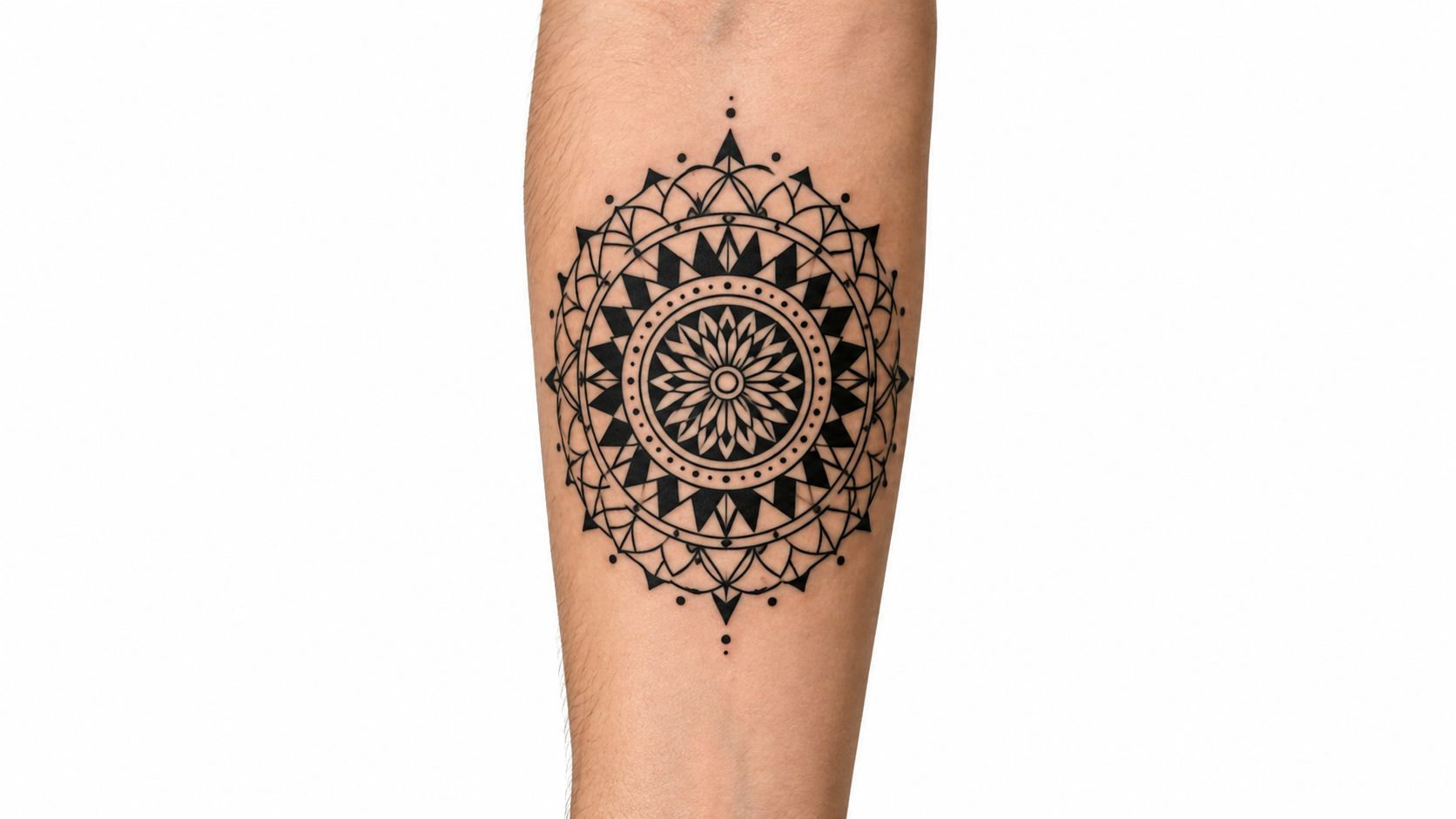
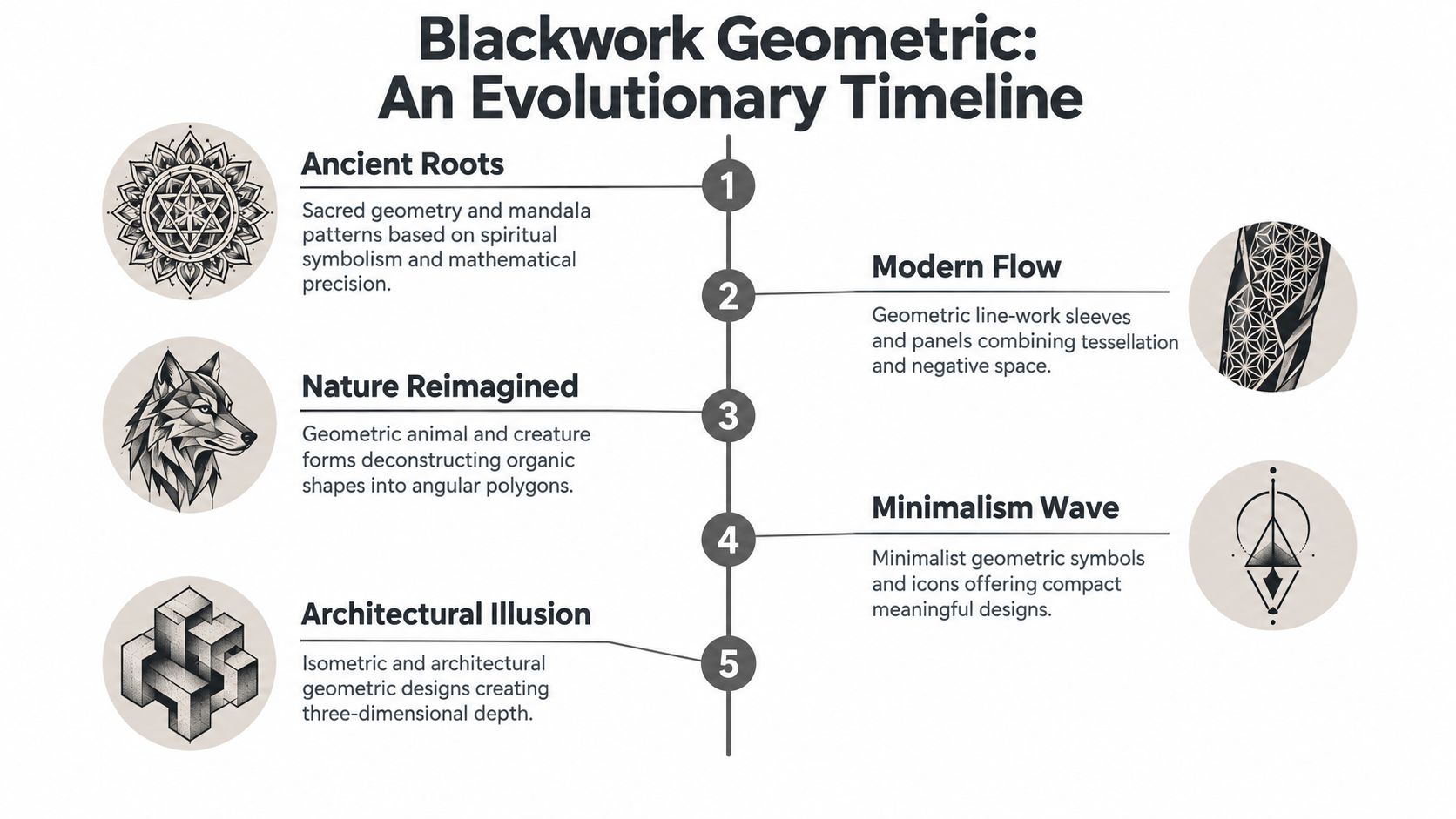
Mandalas depend on radial symmetry, so the centre point matters more than the outer decoration. On an inner forearm, a circular mandala can sit on a relatively controlled surface, but the artist still needs to account for the taper towards the wrist. A seven-point radiating structure may need adjusted spacing so its outer sections don't become cramped as the arm narrows.
A shoulder blade gives more room for nested triangles and concentric forms, but the surface curves in several directions. The design should be mapped while the client is standing and viewed from more than one angle. A chest-centred piece can use the sternum as a visual axis, although breathing and the changing plane of the pectoral muscles make exact symmetry more demanding than a flat drawing suggests.
Practical rule: The more detailed the mandala, the more carefully its size must be matched to the body area. Shrinking a complex design to fit a wrist or ankle can turn deliberate negative space into muddy black.
A wrist mandala combining Fibonacci-inspired spirals with blackwork circles needs particularly clear line separation. Ask for a digital mock-up before booking, and bring high-resolution references showing the symmetry you actually want rather than several unrelated examples. Discuss whether the design should remain purely circular or extend into ornamental lines that follow the limb.
Plan for a two to three-hour session depending on complexity and size. Choose an artist with a portfolio that shows healed geometric precision, not only fresh black ink. For broader research on circular symbolism and tattoo placement, see this guide to circle tattoo ideas.
2. Geometric Linework Sleeves and Panels
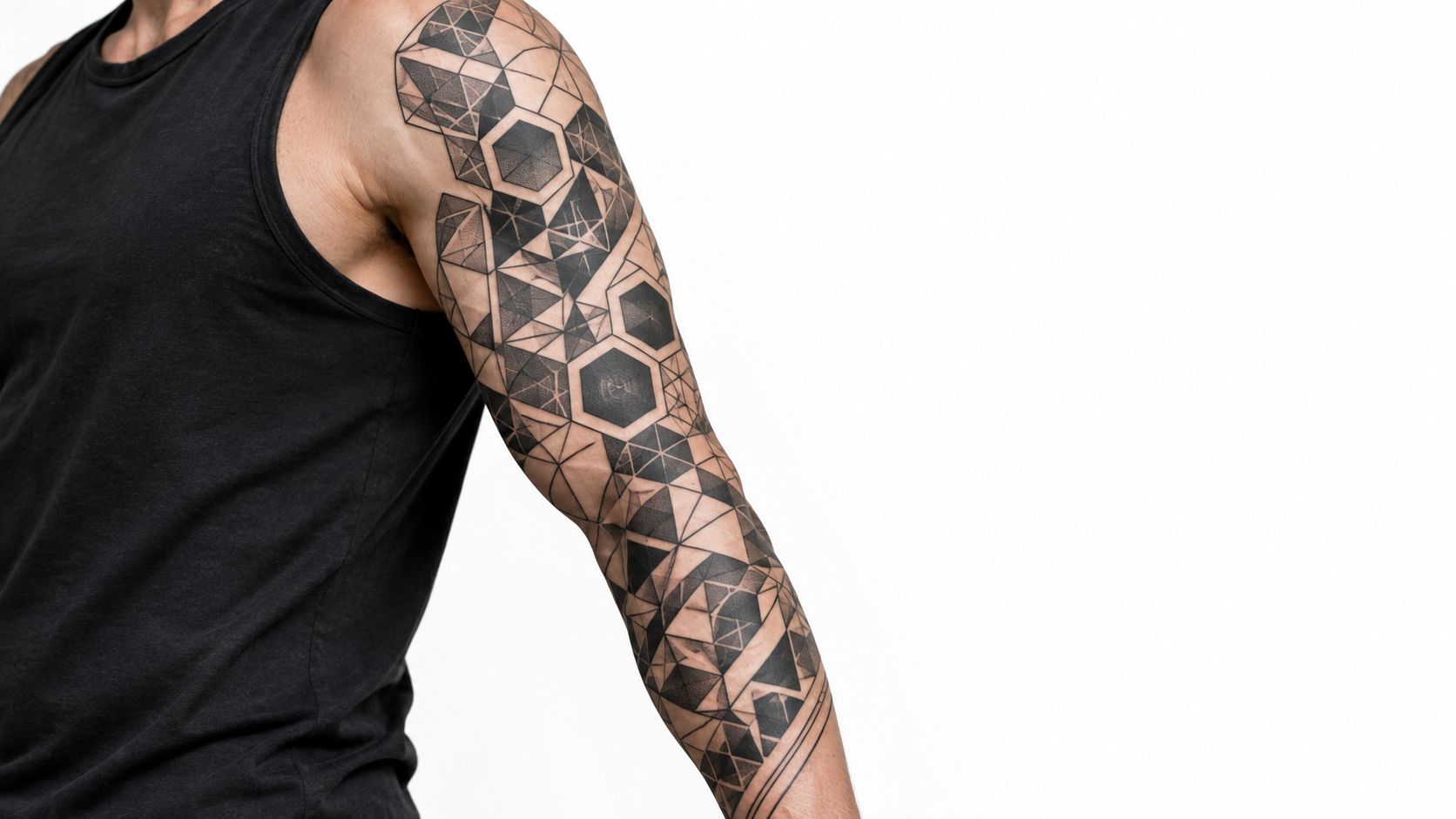
A sleeve succeeds or fails through flow. Interlocking triangles, hexagons and polygons need to travel around the arm without producing an accidental visual stop at the elbow. The outer forearm is comparatively straightforward, while the inner arm, elbow ditch and upper-arm curve require wider spacing or a deliberate change in pattern.
A quarter-sleeve can work well when the client wants a defined project rather than a full commitment. Negative-space forms can create depth, but they need enough skin between them to remain distinct after healing. A half-sleeve divided into panels by bold vertical lines gives the artist clear control over composition, although hard panel boundaries can look disconnected if they don't follow the arm's musculature.
For a full arm or leg sleeve, decide whether the design will be dense everywhere or gradually increase in saturation. A graduating structure usually gives the eye somewhere to rest and makes later expansion easier. Complete coverage creates greater impact, but it leaves less flexibility for future additions or correction.
- Check the flow: Ask to see the design from the front, side and back of the limb.
- Set the visual weight: Decide where the darkest areas will sit before the stencil is finalised.
- Plan the sessions: Full sleeves generally require two to four sessions, with the exact schedule depending on coverage, detail and healing.
- Protect future options: Preserve intentional skin breaks if you may extend the work later.
A digital mock-up should show the pattern wrapping around the arm, not just a flat image. Discuss the project structure and expected tattoo sleeve cost during the consultation, especially if the design includes large saturated areas.
3. Geometric Animal and Creature Forms
Geometric animals need to remain recognisable while being reduced to angular planes. A wolf head on the upper arm works because the artist can use the bicep's broader surface for the skull and let the muzzle taper towards the elbow. Triangular sections can define the eyes and cheekbones, but too much abstraction removes the expression that made the client choose a wolf in the first place.
A fox in side profile on the ribcage presents a different problem. The ribs are curved, mobile and difficult to keep visually flat, so the head may need to be larger and less intricate than the reference drawing. An eagle spanning the upper back has more room for wing structure, but the scapulae move beneath the skin. The artist should design the wings to accommodate that movement rather than forcing rigid bilateral symmetry.
A geometric animal is not a photograph broken into polygons. It's a hierarchy of recognisable features, controlled angles and deliberate empty space.
Size determines how much construction the design can carry. A lion profile with an interconnected polygonal mane can support more internal geometry on the upper arm or calf than on a small wrist. During consultation, bring clear frontal or profile references and decide how abstract the result should be.
Discuss whether you want a complete animal, a head, or a partial form emerging from linework. Ask to see healed examples of geometric animal tattoos, then confirm the placement, orientation and level of black saturation. A relatively flat forearm, upper arm or calf usually gives the artist more control over proportion than a highly curved or constantly flexing area.
4. Minimalist Geometric Symbols and Icons
Small symbols leave no room for imprecise spacing. A circle on the inner wrist, an interconnected triangle on a finger, or a square-and-circle combination behind the ear may take less time than a sleeve, but the technical margin is narrower. At small scale, one uneven line can change the balance of the whole mark.
Placement also affects durability. Fingers experience friction and movement, while the ankle flexes inside footwear. A stationary, flatter area is usually easier to control, but the best location still depends on the symbol's orientation and the client's tolerance for visibility. An inner wrist circle measuring one to one and a half inches needs enough clearance from the wrist crease to avoid crowding and distortion.
Prioritise precision over reputation alone. Ask for an exact digital mock-up showing the final proportions on your body, not just a clean graphic on a white background. A geometric infinity symbol may look simple, but its loops must remain balanced once the ankle or wrist changes direction.
Walk-ins can suit quick, simple designs when an artist has space, but appointment planning is safer if the symbol has personal meaning or needs custom drafting. During consultation, cover:
- Scale: Confirm the minimum size that preserves the intended geometry.
- Movement: Check nearby creases, joints and friction points.
- Longevity: Discuss whether the design has enough spacing to age without losing its structure.
- Meaning: Make sure the chosen symbol communicates what you intend, especially if it resembles a rune, logo or established sign.
The design may be small, but the decision about placement is permanent. Don't let a short appointment encourage a rushed stencil check.
5. Architectural and Isometric Geometric Designs
Architectural geometry depends on perspective. An isometric cube, an impossible staircase or a building facade only reads correctly when the line relationships remain consistent. A forearm can provide a controlled vertical field for a technical structure, while the chest or back can support a larger cube system with more depth cues.
Ribcage placement is harder. The curved surface can make a straight facade appear to lean as the client moves, so the artist must adapt the drawing to the body instead of applying a rigid blueprint. A three-point perspective design may need carefully chosen line weights, with stronger structural edges and lighter secondary lines to preserve depth without filling the composition.
Find an artist who can explain whether your concept uses isometric, one-point, two-point or impossible geometry. You don't need an artist to hold an architecture qualification, but you do need evidence that they understand technical perspective and can translate it onto moving skin.
Consultation test: Ask the artist to explain which lines establish the perspective, which lines can follow the body, and where the design will deliberately break from mathematical accuracy.
Bring an architectural drawing or several high-resolution references, then request mock-ups from different viewing angles. A structure intended for the forearm should be checked with the arm relaxed, rotated and bent. On the chest or back, evaluate it from the front, side and three-quarter view.
These pieces often require a longer session because accuracy matters more than speed. Rushing a perspective design can produce inconsistent angles, uneven line weight and an illusion that collapses when the body moves.
6. Blackwork Geometric Full-Back and Chest Pieces
Large chest and back compositions give the artist room to combine mandalas, architectural structures, tessellations, animals and broad fields of black. They also expose every planning mistake. A full-back design needs a central axis, a clear relationship with the spine and a density pattern that still works when viewed from a distance.
The back is not a flat canvas. The spine, shoulder blades and lower back all change the surface, while the client's posture alters the apparent symmetry. A chest piece has additional concerns around the sternum, pectoral movement and the transition towards the shoulders. A design that looks balanced while lying down may need adjustment when the client is standing naturally.
Build the composition in stages. The first appointment might establish the main geometry and negative-space framework, with later sessions adding saturation or peripheral motifs after the skin has healed. A large project should be mapped from the front, back and three-quarter angles before the first stencil is applied.
- Define the structure: Decide which element anchors the piece and which motifs support it.
- Set the density: Mark solid black zones, stippled transitions and deliberate skin breaks.
- Agree the schedule: Discuss how many appointments each section may require and how healing will affect the order.
- Plan the support: Extensive work may need an assistant, breaks and careful positioning.
- Protect the future: Leave options for expansion, correction or redesign where the composition allows.
Substantial full pieces can become a six to twelve-month project, depending on the design, appointment spacing and healing. Don't treat that timeline as an inconvenience. It gives the artist time to assess healed sections before committing more pigment.
7. Dotwork and Stippled Geometric Compositions
Dotwork changes the artist's unit of control from the line to the individual mark. A stippled mandala on the forearm can move from dense dots at the centre to sparse points around the edge, creating depth without continuous shading. The gradient only works if the spacing is intentional. Random gaps look unfinished rather than atmospheric.
A geometric animal can use changing dot density to separate the eyes, planes and silhouette. An abstract optical composition may use dense clusters as focal points and lighter fields to suggest recession. These effects demand patience, because the artist is building tone through repeated punctures rather than laying down a solid area in one controlled pass.
Dotwork usually takes 40 to 50% longer than equivalent linework, so plan the appointment around sustained concentration rather than a quick finish. Pain can feel repetitive because the skin receives many separate punctures over the same design area. A flat, relatively stationary placement such as the forearm generally gives the artist better control than a high-friction or constantly moving site.
Dot density is part of the design, not an afterthought. Decide where the darkest concentration belongs before the first dot is placed.
Choose an artist who regularly shows healed stippling. Discuss the intended density at focal points and edges, aftercare, and whether future reinforcement may be needed. Dotwork can require a touch-up after five to ten years, depending on placement, skin and how the tattoo ages.
Bring high-resolution references and be clear about whether you want a soft gradient, crisp pointillism or a more textured blackwork result. Further style comparisons are available in this guide to tattoo styles.
Here's a practical video reference for seeing stippling technique in motion:
7-Point Comparison of Blackwork Geometric Tattoo Styles
| Style | Complexity 🔄 | Resources & Time ⚡ | Expected Outcomes & Longevity 📊⭐ | Ideal Use Cases 💡 | Key Advantages ⭐ |
|---|---|---|---|---|---|
| Sacred Geometry & Mandala Patterns | High, demands exceptional precision and perfect symmetry | Moderate time per piece (2–3 hrs typical); specialist portfolio required | Strong meditative visual impact; ages well with solid black linework ⭐⭐⭐⭐ | Personal/spiritual pieces; forearm, shoulder, chest; customisable sizes | Timeless, highly customisable, strong visual presence |
| Geometric Line-Work Sleeves & Panels | Very high, multi-panel flow and anatomy mapping across limb | High time & cost (8–15+ hrs); multi-session project management | Bold, unified composition with lasting clarity when healed ⭐⭐⭐⭐ | Collectors wanting cohesive arm/leg coverage; staged projects | Comprehensive visual impact; flows with anatomy; staged completion |
| Geometric Animal & Creature Forms | Medium, balance abstraction with recognisability | Low–Medium time (1–6 hrs) depending on size; flexible budget | Memorable, symbolic results that scale well; ages reliably ⭐⭐⭐ | Symbolic animal pieces; first-timers to large-format animal work | Combines personal symbolism with modern aesthetic; versatile sizing |
| Minimalist Geometric Symbols & Icons | Low, simple execution but demands technical precision | Low time & cost (15–45 mins); often walk-in friendly | Subtle, timeless small-scale results; may lack distance visibility ⭐⭐ | Discreet placements (wrist, finger, behind ear); first tattoos | Affordable, quick, highly versatile and easily concealed |
| Architectural & Isometric Geometric Designs | Very high, requires mastery of perspective and technical drawing | High time (3–5+ hrs); needs artist with architectural/technical background | Striking depth and illusionary impact; niche and long‑lasting ⭐⭐⭐⭐ | Architects, engineers, spatial-design enthusiasts; flat areas | Unique optical depth; highly technical and conversation-starting |
| Blackwork Geometric Full-Back & Chest Pieces | Very high, complex multi-layer coordination across large canvas | Very high time & cost (15–40+ hrs; typically £2,000–£5,000+); multi-session timeline | Maximum transformative impact and photographic presence; long longevity ⭐⭐⭐⭐⭐ | Major statement pieces for collectors; long-term projects | Multi-layered narratives; highly distinctive and social-media friendly |
| Dotwork & Stippled Geometric Compositions | Very high, meticulous stippling, each dot matters | Very time-consuming (40–50% longer than line equivalents); specialist artist; possible touch-ups | Rich texture and mesmerising detail; may need reinforcement over years ⭐⭐⭐⭐ | Medium-to-large pieces where texture/depth matters; detail-focused clients | Unique textured aesthetic; organic depth and optical effects |
Book a Geometric Blackwork Consultation That Fits Your Body
Bring your reference images, a rough idea of size and your preferred placement to a free consultation at Timebomb Tattoo & Piercing, with studios at 109 Old Christchurch Road, Bournemouth, BH1 1EP, and 22 George Street, Croydon, CR0 1PA. The studio offers custom tattooing across styles including Blackwork and Dotwork, with resident and guest artists available for different specialisms.
Use the consultation to settle the decisions that matter before booking. Ask how the design will follow curvature, whether the negative space is sufficient, how much density the placement can support and whether the work should be divided into stages. Large sleeves, chest pieces and full-back compositions are best planned by appointment, while smaller tattoos may be possible as walk-ins when an artist has availability.
For geometric blackwork, ink choice and studio controls deserve direct questions. UK tattoo businesses in England and Wales must register with the relevant local council, and registration covers the premises and local hygiene requirements, as explained in the UK Government guidance on tattoo and skin-piercing licences. The Health and Safety Executive's UK REACH assessment of tattoo inks identifies potential hazards from substances used in tattoo inks, so ask the artist to record the manufacturer, product name and batch information for your session.
Aftercare is part of the result. Avoid picking scabs, excessive exercise, sweating and hot baths while the area heals, and follow the artist's written advice. Seek NHS 111 guidance if you feel unwell, have a temperature of 38°C or above, or develop concerning swelling, bruising, rash, tenderness or unusual heat, following the NHS aftercare guidance. Tattoo removal isn't guaranteed, and NHS Scotland evidence notes that laser treatment can involve multiple sessions as well as risks such as scarring and dyspigmentation, particularly when pigment is dense or placement is difficult, as detailed in this NHS Scotland tattoo-removal evidence summary.
To book, call, email or use the online form at tattoosnearme.co.uk, or visit either studio in person and ask about walk-in availability for smaller pieces when an artist has space. Timebomb Tattoo & Piercing provides custom tattoos and professional body piercing, with private tattoo spaces and aftercare guidance from artists. Use the appointment to map proportions, density and session structure before you commit, and make sure the geometry fits the body area it will live on.
Timebomb Tattoo & Piercing offers free consultations for custom geometric tattoos, including Blackwork and Dotwork, at its Bournemouth and Croydon studios. Bring your references and placement idea, then visit Timebomb Tattoo & Piercing to enquire by phone, email or online form and book a consultation or ask about walk-in availability for a smaller piece.