
A circle tattoo can look simple at first glance, but is it really just a shape? For some people it stands for balance. For others it marks grief, spiritual practice, nature, time, protection, or a clean geometric aesthetic. That's the gap in a lot of circle tattoo content. It often focuses on symbolism alone and skips the part that decides whether the tattoo still looks right years later: line weight, placement, skin movement, colour choice, and the artist's actual style.
A tattoo of a circle can be tiny and discreet, bold and graphic, or built into a much larger custom piece. The strongest option depends on what you want the circle to say, how large you want it, where it will sit on the body, and how much upkeep the finished tattoo may need. That matters even more with clean round shapes, because small flaws tend to show quickly.
There's also a long UK connection to circular tattoo imagery. British punk youth made the Circle-A symbol highly visible in the 1970s and 1980s, and it was often tattooed on the body, giving circular tattoo forms a clear place in modern UK subculture history through punk bands and associated style as discussed in this tattoo-history reader.
If you're weighing style, sizing, placement, or which artist to book with, Timebomb Tattoo & Piercing offers free consultations for design direction, placement advice, and artist matching. Appointments are recommended, but walk-ins may be possible when availability allows. Here are eight circle tattoo ideas worth considering.
Table of Contents
- 1. Enso Circle (Zen Circle)
- 2. Geometric Circle Mandala
- 3. Celestial Circle (Moon Phases & Stars)
- 4. Minimalist Circle Outline (Stacked Rings)
- 5. Yin-Yang Circle
- 6. Circle with Floral Integration
- 7. Abstract Watercolour Circle
- 8. Blackwork Circle Patterns & Geometric Bands
- Comparison of 8 Circle Tattoo Styles
- Turn Your Circle Tattoo Idea Into a Booking
1. Enso Circle (Zen Circle)
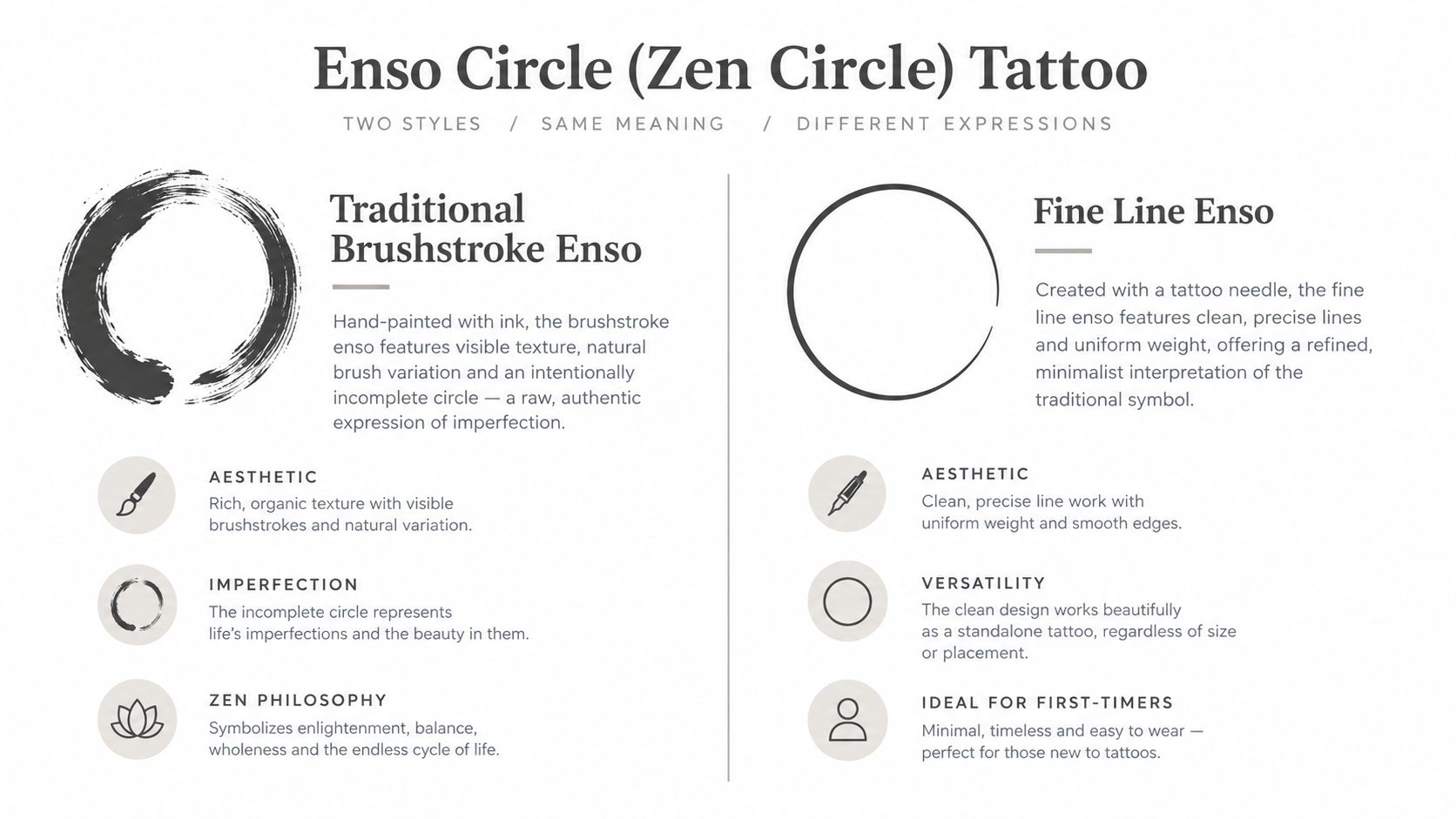
The Enso is one of the most thoughtful ways to approach a tattoo of a circle. It comes from Zen practice and is usually shown as a single brushstroke, sometimes fully closed and sometimes left open. That small gap changes the meaning. A closed version can feel complete and centred. An open version often speaks more clearly about imperfection, growth, and the idea that life isn't neatly finished.
This design suits people who want a spiritual tattoo without heavy decoration. Yoga practitioners, meditation-focused clients, and people drawn to minimalist black ink often choose it because the mark feels calm rather than loud.
How the meaning affects the execution
An Enso shouldn't look like a machine-perfect compass circle unless that contrast is intentional. Its character comes from stroke pressure, taper, texture, and slight irregularity. If the line is too thin, it can lose that ink-brush feeling. If it's too thick on a very small placement, it can heal heavier than intended.
A common sweet spot is around 2 to 3 inches, because that gives the artist enough space to show the brushstroke quality without making the piece oversized. Black ink usually suits this style best. If you're collecting ideas, it helps to browse a broader range of body art tattoo styles so you can decide whether you want a true brushstroke feel, a cleaner fine line version, or a dotwork interpretation.
Practical rule: Bring reference images that show the exact brush texture you like. One person's “minimal” Enso is another person's “too polished”.
Placement matters more than many first-time clients expect. A soft, slightly expressive circle usually heals better on areas with less constant stretching than on places that fold and twist all day. Upper arm, upper forearm, shoulder blade, and calf often give the circle room to breathe.
Questions worth asking in consultation
- Brushstroke feel: Do you want visible dry-brush texture, a smooth line, or dotwork texture?
- Open or closed form: Does the gap have symbolic meaning, or do you just prefer the look?
- Future expansion: Will this stay standalone, or do you want to add kanji, waves, leaves, or a larger sleeve later?
2. Geometric Circle Mandala
Some circle tattoos whisper. A mandala doesn't. It pulls the eye straight to symmetry, repetition, and layered detail. If your idea of a tattoo of a circle is something spiritual but highly structured, this is often the strongest route.
Traditional and modern mandalas both use concentric organisation, but their tattoo success depends on space. The more petals, points, negative gaps, and repeating shapes you pack into the design, the more important scale becomes.
Here's a visual reference for Enso style before moving into more structured geometry:
Precision first, symbolism second
A mandala can hold personal layers. Some clients assign meaning to each ring. Others connect with symmetry and stillness. Either approach works, but the execution has to support the idea. Very dense patterning on a small wrist circle often looks sharper on paper than on skin over time.
Back, chest, and thigh placements tend to support symmetry best because they offer broader, flatter surfaces. Many clients also choose a phased approach, with the main outline first and the denser interior detail added later. If you want to review how different artists handle symmetry and detail, a tattoo gallery with varied styles is useful before you book.
A good consultation for a mandala should cover more than “do you like this pattern?” It should include stencil fit, pattern spacing, line hierarchy, and whether the centre of the design needs to align with the body in a specific way.
For extra inspiration on how artists build circular layouts, this video gives a useful style reference:
What to ask before you commit
- Symmetry tolerance: Are you comfortable with a perfectly formal design, or do you want a more organic mandala?
- Detail density: Will the smallest shapes still read clearly at your chosen size?
- Session planning: Is it smarter to split the work into stages for cleaner healing and better concentration?
A large mandala can be dramatic. A rushed small one can blur into visual noise. That's the difference.
3. Celestial Circle (Moon Phases & Stars)
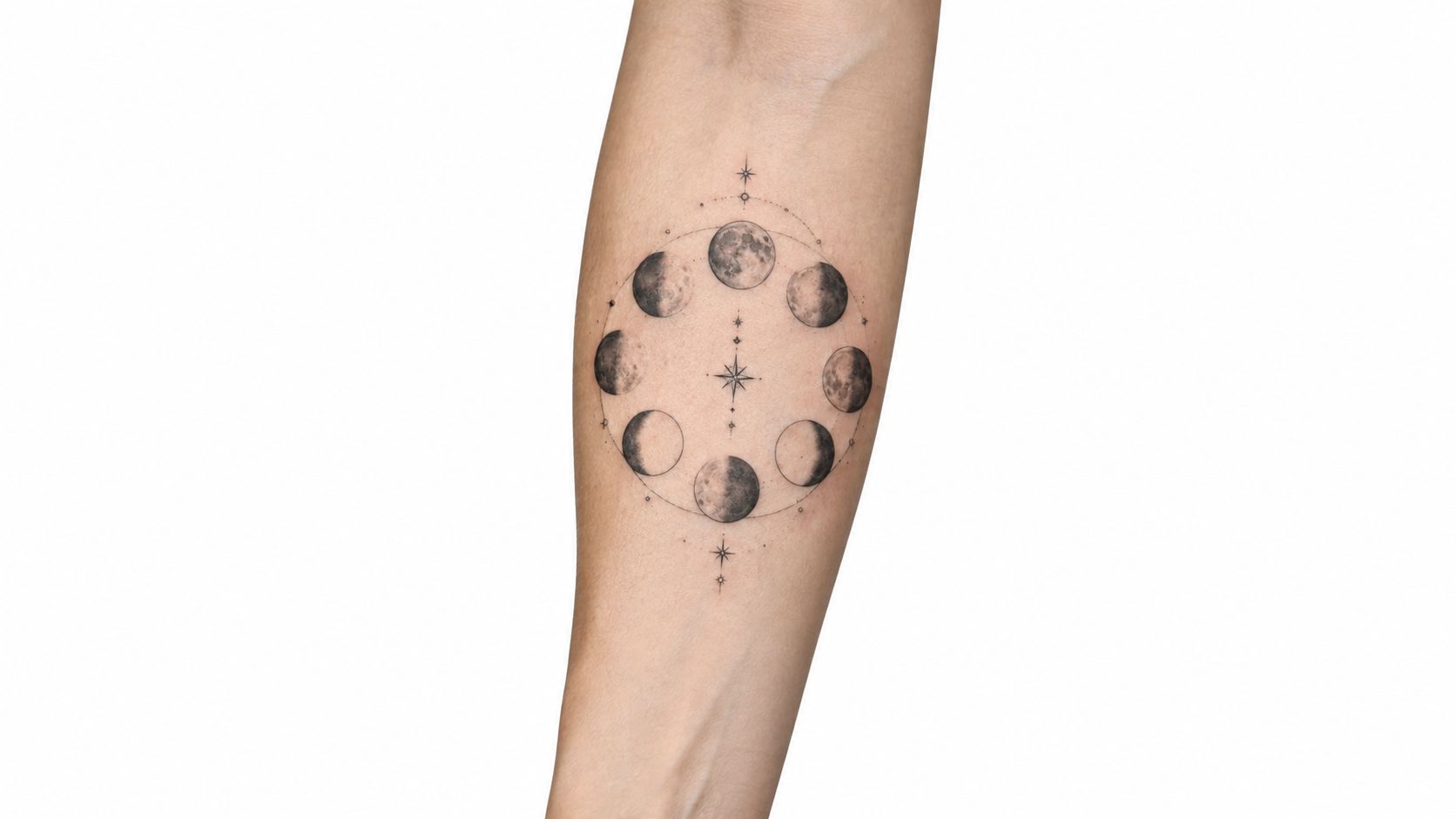
A celestial tattoo of a circle usually appeals to people who think in cycles. Moon phases, stars, planets, and constellations all fit naturally inside a round composition because the circle already suggests orbit, repetition, and return. That makes it a strong option for a life-change tattoo, a memorial piece, or a design linked to timing, femininity, spirituality, or personal transformation.
Moon phase circles are especially popular because they tell a story without needing words. New moon to full moon and back again can represent grief, recovery, reinvention, or a connection to the night sky.
Best placements for keeping the circle readable
Forearm, calf, upper arm, shoulder blade, and thigh usually work well because they give the artist enough room to keep the circle balanced. A tiny wrist version can be elegant, but only if the moons and stars are simplified. If every lunar texture and every starburst is miniaturised too aggressively, the design loses clarity.
This style also raises a practical ageing question that many trend-driven articles skip. Perfect circles and fine celestial details can blur unevenly over time if the linework is very fine or the tattoo sits on a high-movement area. That matters because simple geometry shows change quickly. UK-facing guidance and trend commentary also note that tattooing is common, that complications can include bacterial infection and allergic or skin reactions, and that around 20% of UK adults are estimated to have a tattoo, while a 2019 UK survey found 2% reported a skin infection after a special procedure, with one in ten of those with side effects needing medical treatment as summarised in this UK trend and advice article.
Fine detail looks magical on day one. It only stays readable if the size, placement, and line weight are chosen with restraint.
Good custom directions
Some real-world examples work better than others:
- Compact forearm piece: A simple moon phase ring in black and grey.
- Larger calf or thigh design: Moon phases with constellations and subtle orbit lines.
- Memorial variation: One highlighted phase placed at the top of the circle to mark a meaningful date or period of life.
Ask your artist to show where the darkest moon sits, where negative space is needed, and whether the stars are decorative filler or part of the story.
4. Minimalist Circle Outline (Stacked Rings)
How much meaning can a few clean rings carry? More than many detailed tattoos, because this style puts every technical choice on display.
A stacked circle tattoo works like architectural drafting on skin. The symbolism often comes from repetition, balance, continuity, or stages of growth, while the impact comes from precision. One uneven arc can change the whole mood. In a dense mandala, the eye has other details to read. Here, the eye goes straight to the outline.
That makes consultation more important than the design may first suggest. Ask your artist how they keep concentric circles even on curved body areas, whether they freehand any adjustments after stencilling, and how much space each ring needs to stay distinct as the tattoo settles over time.
Small scale creates the biggest misunderstanding. A plain circle looks simple on paper, but stacked rings demand steady line control, equal spacing, and enough breathing room between each band. If you are pricing a very small version, a guide on how much a small tattoo can cost helps explain why minimal does not always mean quick.
Placement decides whether the design reads as calm or slightly off. Flatter areas such as the upper inner forearm, upper arm, shoulder blade, and calf usually hold circular geometry better than fingers, the side of the wrist, or other high-movement spots. Body curvature matters here. A ring that looks perfect on a flat stencil can appear stretched once it wraps around muscle or bone.
A useful way to plan this style is to choose the meaning first, then match it to the build of the tattoo:
- One clean ring: unity, closure, focus. Best for the smallest version because the eye only has to read one line.
- Two or three rings: partnership, layered identity, past and present. Works well if spacing is wide enough to prevent the lines from visually merging.
- Multiple narrow rings: time, rhythm, expansion. Better at a larger size, where the artist can preserve clean gaps and avoid crowding.
Colour is usually unnecessary here, and that is part of the appeal. Black ink tends to keep the graphic effect clearer for longer than fine pastel outlines. If you want a very light grey version, ask how soft the result will look after healing and whether the contrast will still suit your skin tone.
The strongest stacked ring tattoos feel restrained because every decision has a job. Line weight, spacing, size, and placement all carry part of the meaning.
5. Yin-Yang Circle
What makes a yin-yang tattoo so hard to get right when the symbol looks so simple?
The answer is precision. A yin-yang only works when balance is visible at a glance. The outer circle has to look true, the S-curve needs a smooth flow, and the two dots must sit cleanly in their halves. If any one part feels off, the meaning shifts with it. A symbol meant to show harmony can start to look tense or lopsided.
This design also asks you to match symbolism to build. The classic black-and-white version suits smaller tattoos because the message depends on bold contrast, not tiny detail. Once you add koi scales, floral textures, stars, or layered shading, the detail density rises quickly. That usually means going larger so the two halves still read as one symbol instead of two crowded pictures trapped inside a circle.
A useful way to judge customisation is to ask a simple question: does the added imagery support the idea of interdependence, or does it distract from it? Sun and moon pairings usually keep the concept clear. Koi and serpents can work well because their bodies follow the internal curve naturally. Busy scene-work inside each half often weakens the design, especially at small sizes where contrast matters more than storytelling.
Placement changes the outcome more than many people expect. A yin-yang behaves a bit like a coin. It looks best where the surface lets the circle stay visually round. The upper back, chest, outer thigh, and flatter part of the upper arm usually give the artist better control than the side wrist, ribs, or any spot that twists and flexes constantly. On curved anatomy, ask the artist whether the stencil still looks balanced from straight on and from the side.
Black saturation matters here. So does skin break. The dark half needs enough solid fill to stay rich after healing, and the light half needs clean negative space or very restrained shading. If you want a colour version, ask how the colours will age against each other. A yin-yang relies on clear separation, so low-contrast colour choices can blur the message over time.
Bring these questions to the consultation:
- How large does this design need to be for the line thickness and inner details I want?
- Will the placement distort the circle when my arm or torso is at rest?
- Should the white half stay open skin, or would soft grey help the balance?
- Have you tattooed symmetrical circle pieces that healed cleanly?
The best artist for this piece is not just good at symbolism. They need steady line control, even packing, and a good eye for symmetry. With a yin-yang, the meaning lives inside the execution.
6. Circle with Floral Integration
If you like the order of geometry but don't want the tattoo to feel cold, floral integration is a smart middle ground. The circle acts as structure. The flowers soften it. Depending on the style, the result can feel romantic, memorial, botanical, decorative, or symbolic.
This is one of the most flexible ways to wear a tattoo of a circle because the florals can sit inside the ring, grow through it, or form the circle themselves. Roses, peonies, chrysanthemums, wildflowers, and birth flowers all shift the mood.
Meaning changes with flower choice and line balance
A memorial piece might use a favourite flower and keep the ring clean and restrained. A more decorative tattoo might use a heavier frame with petals overlapping the edge. Fine line florals can look airy and elegant, but they need enough scale to avoid healing into a soft blur, especially where petals cluster.
There's also a long British tattoo history behind this broader category of closed-form and ring-like motifs. One tattoo-history source reports that Harmsworth Magazine estimated in 1898 that as many as one in five members of the British gentry were tattooed, showing a 20% prevalence estimate among the elite, which helps place circular and closed-form motifs inside a much older British tattoo tradition in this historical overview.
Placement and colour decisions
Colour can make a floral circle lush and expressive, but black and grey usually offers a calmer, longer-lasting read if your main concern is ageing gracefully. Upper arm, thigh, shoulder blade, and chest often give enough room for petals, leaves, and negative space to stay distinct.
Useful consultation prompts include:
- Flower meaning: Is this about memory, season, personality, or just aesthetics?
- Frame role: Should the circle look bold and obvious, or almost disappear behind the florals?
- Future additions: Will this become part of a sleeve, bouquet, or larger ornamental piece?
This design succeeds when the geometry supports the flowers instead of trapping them.
7. Abstract Watercolour Circle
What should a circle do if you want it to feel more like a mood than a boundary?
An abstract watercolour circle answers that by softening the usual rules. The round shape may be painted with washes, blooms, and fading edges, so the eye reads a circle even when the line is incomplete. The meaning often shifts with that choice. A crisp ring suggests order and closure. A watercolour ring usually reads as emotion, motion, memory, or change.
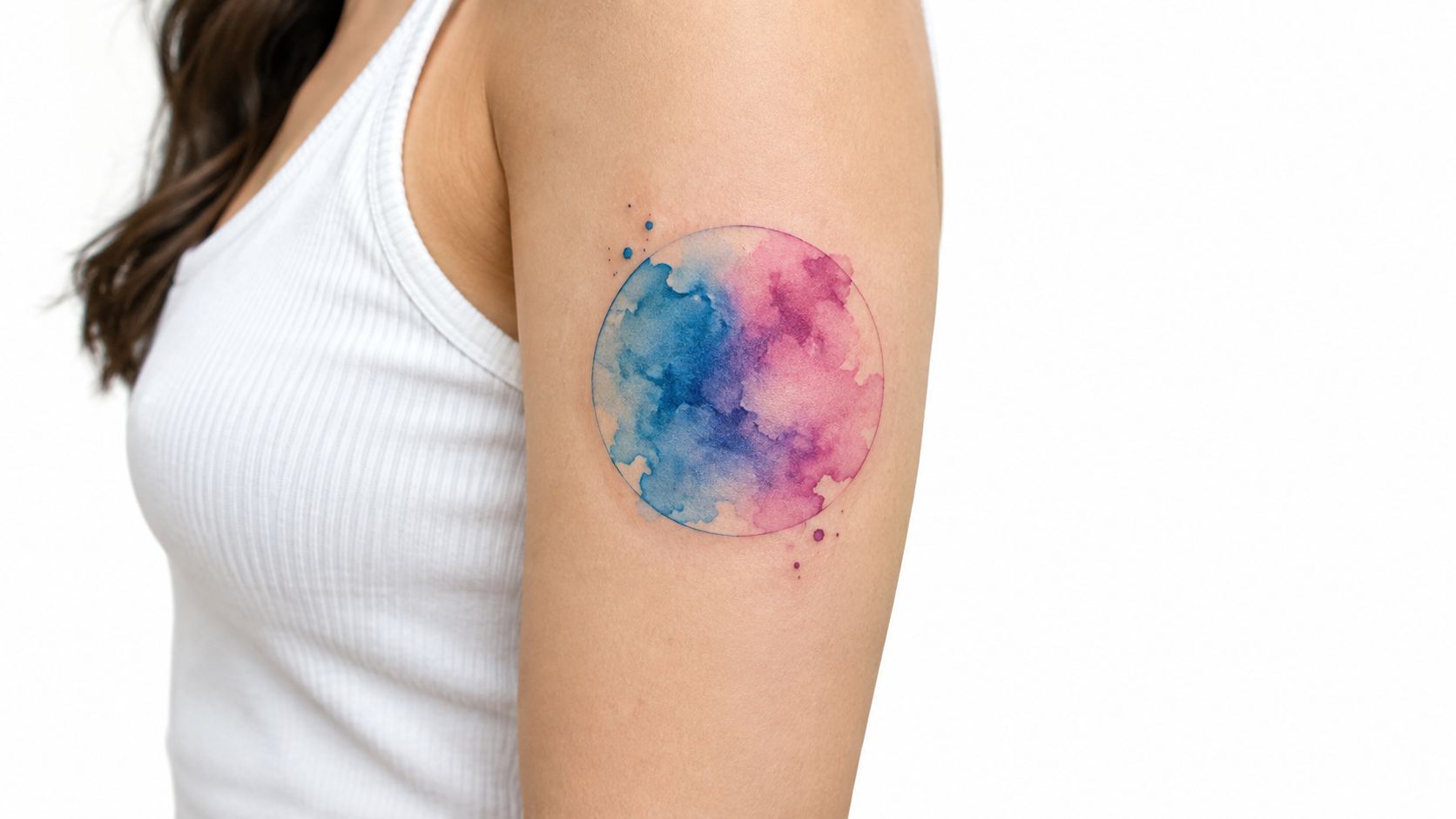
The execution decides whether that feeling survives on skin. Watercolour effects depend on controlled softness, not randomness. An artist has to place colour where it can blur slightly with age without collapsing into one dull patch. That is why this style usually works better at medium or larger sizes. If the circle is too small, the gentle transitions that make it interesting can heal into a vague stain.
Colour choice matters for ageing too. Blues, magentas, violets, and teal mixes often keep their identity better than very pale pastel washes, especially if your design relies on contrast between one tone and the surrounding skin. A faint grey or black guide line can also help the circle keep its shape over time, even if the tattoo still looks loose and painterly from a distance.
Placement changes the result more than many people expect. Flat areas such as the upper arm, thigh, shoulder blade, or upper chest give the circle a steadier surface, so the round composition stays readable. On curved or mobile areas like ribs or near joints, the circle can stretch visually when the body moves. That does not make those placements wrong. It means the artist should build the composition for that curve instead of forcing a perfect compass-drawn ring.
A good consultation for this design sounds more like an art brief than a flash pick. Ask to see healed colour pieces. Ask how saturated the centre should be compared with the outer wash. Ask whether the circle is being built with an actual outline, a broken edge, or colour alone. Those answers tell you how the tattoo will read in five years, not just on the day it is done.
Studio standards matter just as much as style. A UK hazards report on tattooing found hygiene problems in some treatment-area swabs, water samples, and diluted disinfectants, which is a useful reminder to choose a studio with disciplined cleaning and setup practices, especially for a colour-led piece that needs careful healing in this UK hazards report.
If you want the circle to feel fluid, expressive, and less formal, this approach can work beautifully. Just match the symbolism to the method. Soft meaning needs precise execution.
8. Blackwork Circle Patterns & Geometric Bands
If you want impact, blackwork is the clearest answer. A blackwork tattoo of a circle uses contrast instead of softness. Solid fills, patterned bands, dotwork texture, repeating stripes, and strong negative space can turn a simple round form into something architectural and bold.
This category covers a lot of ground. It might be a concentric wrist band, a shoulder piece built from radiating geometry, or a larger chest or thigh pattern that uses circles as anchors. It also suits collectors who prefer tattoos that read clearly from a distance.
Bold designs still need technical discipline
Heavy blackwork often ages more assertively than ultra-fine detail, but that doesn't mean every blackwork circle is automatically easy. Saturation has to be even. Pattern spacing has to be deliberate. The geometry has to suit the body, especially if the tattoo wraps.
Cultural sensitivity matters too. If you're looking at Polynesian-inspired or Maori-influenced pattern language, work from respectful references and speak openly with your artist about what belongs in the design and what doesn't.
A broader UK trend point supports why this style is increasingly relevant. Recent UK-facing discussion highlights growing interest in symbolic tattoos, fine line work, patchwork sleeves, micro-realism, and AI-assisted mock-ups, which suggests many circle tattoos now function less as isolated flash and more as building blocks inside personalised custom work in this UK skin-piercing and trend context.
Hygiene and aftercare aren't optional
Heavy saturation creates a bigger healing responsibility. UK public-health guidance identifies infection risk as a core issue in tattooing, including bloodborne viruses such as hepatitis B, hepatitis C, and HIV, and notes that 95% of respondents received aftercare advice, 82% reported no negative effects, while the most common adverse effects were burning or swelling at 9%, lumps or nodules at 6%, and scar tissue at 4% in this UK infection prevention guidance.
Hand hygiene and aftercare basics are part of that picture. A UK local-authority infection-control guideline states that hand hygiene must be done before and after each skin-piercing procedure, before gloves, after glove removal, and after contamination, with regular hand washing taking 15 to 30 seconds and hand washing before a skin-piercing procedure taking 2 minutes in this infection-control guidance. UK aftercare guidance also says infection risk can be greatly reduced by basics such as washing hands before touching the tattoo and keeping the area covered with non-stick gauze secured with hypo-allergenic tape in this tattoo aftercare sheet. A separate UK skin-piercing guidance source states that liquid soap is sufficient and antiseptic preparations with a residual effect on the skin aren't required in tattoo and piercing settings in this toolkit.
For a circle, that matters because blowout, scarring, or uneven healing shows up fast in bold geometry.
Comparison of 8 Circle Tattoo Styles
| Style | 🔄 Implementation Complexity | ⚡ Resource Requirements | ⭐ Expected Outcomes | 📊 Ideal Use Cases | 💡 Key Advantages / Tips |
|---|---|---|---|---|---|
| Enso Circle (Zen Circle) | Low–Moderate, single brushstroke but needs skilled execution | Low, short session, fine-line tools, minimal ink | Meditative, minimalist, high symbolic clarity at close range | Wrist, ankle, chest, behind ear; standalone or paired with calligraphy | Fast & affordable; discuss line weight; 2–3" ideal; use black ink |
| Geometric Circle Mandala | High, intricate symmetry and multiple layers | High, experienced artist, grid/stencil work, multiple sessions | Visually striking, deep symbolic detail and customization | Back, chest, thigh, large scalable pieces | Request mock-up for symmetry; flat areas best; plan for touch-ups |
| Celestial Circle (Moon Phases & Stars) | Moderate, fine shading + small-detail precision | Moderate, shading tools, fine-line work, careful placement | Emotional, symbolic (cycles), visually versatile across styles | Wrist, forearm, calf, thigh, back; personal astronomical motifs | Choose meaningful phases; request mock-up; black & grey for realism |
| Minimalist Circle Outline (Stacked Rings) | Low, very simple design but demands perfect geometry | Very low, quick session, fine-line technique | Clean, discreet, durable; ages well with minimal blur | Finger, wrist, ankle, behind ear, upper arm; easy integration | Ask for stencil preview; black ink only; flat areas heal best |
| Yin‑Yang Circle | Low–Moderate, simple form but symmetry is critical | Low–Moderate, precise contrast, clean fills | Instantly recognisable, timeless symbolism, scalable | Chest, shoulder, wrist, ankle; standalone or integrated with motifs | Personalise to avoid cliché; request detailed stencil; avoid muddy greys |
| Circle with Floral Integration | High, combines geometric precision with floral realism | High, colour pigments or realism skills, longer sessions | Elegant, personalised, high visual impact for medium–large pieces | Thigh, upper arm, back, chest, forearm; feminine or botanical themes | Bring flower refs; discuss palette and aftercare; flat areas preferred |
| Abstract Watercolour Circle | Very high, specialised watercolour technique and colour layering | Very high, specialist artist, multiple colour layers, longer healing | Unique, painterly, gallery-quality but colour fades faster | Back, thigh, chest, upper arm (minimum ~4–5") | See healed photos; expect touch-ups every 3–5 years; find specialist |
| Blackwork Circle Patterns & Geometric Bands | High, precise patterning and heavy fill work | High, large black saturation, long sessions, expert blackwork artist | Bold, graphic, extremely long‑lasting and high contrast | Upper arm bands, chest, calf, wrist/ankle bands; scalable | Discuss cultural sensitivity for tribal motifs; request detailed stencil |
Turn Your Circle Tattoo Idea Into a Booking
The best circle tattoo usually starts with a simple question. What do you want the circle to mean for you? Once that's clear, the design gets easier to shape. An Enso feels very different from a mandala. A moon phase ring asks for different line choices than a blackwork band. A floral circle carries different visual weight than a stacked minimalist outline.
From there, the practical choices matter just as much as the meaning. Pick a visual style that suits the symbol, then choose a size and placement that can support the detail. If you want soft petals, tiny moons, painterly colour, or precise geometry, the body area has to help the tattoo rather than fight it. Flatter areas often preserve circular symmetry more cleanly, while high-movement placements can make very fine linework harder to maintain over time.
Artist selection is where many clients either protect the idea or weaken it. Don't just look for someone who tattoos well in general. Look for an artist whose portfolio already shows the specific thing your tattoo needs. That could be brushstroke expression, crisp symmetry, strong black saturation, soft botanical linework, or healed colour work. If you can, ask to see healed tattoos as well as fresh ones. Fresh work shows ambition. Healed work shows judgment.
Bring reference images to your consultation, but use them as a starting point rather than a final answer. A good artist will help you refine line weight, simplify areas that are too small, and decide whether the design should stay standalone or connect to future work. This is also the right time to discuss cultural context if you're borrowing from spiritual, religious, or heritage-based imagery.
You should also talk through session planning and healing expectations before you book. Ask whether the design needs one sitting or more than one. Ask how the artist would adapt the circle to your chosen body area. Ask what aftercare will involve, whether touch-ups are likely, and how the tattoo may change with time. Those questions are especially useful for fine line, dense mandalas, and colour-heavy pieces.
If you're ready to turn an idea into a finished design, Timebomb Tattoo & Piercing offers free consultations for tattoos and piercings at its Bournemouth and Croydon studios. You can book or enquire by phone, email, or the online contact form through the Timebomb Tattoo & Piercing website. Appointments are recommended for larger or more detailed tattoos, while walk-ins may be accommodated when an artist has availability. Whether you want a small symbolic ring or a larger custom tattoo of a circle, a focused consultation will help you get the symbolism and the execution right.
Timebomb Tattoo & Piercing can help you turn a tattoo of a circle into something that fits both your meaning and your skin, whether you want a fine line Enso, a bold blackwork band, or a detailed custom mandala. For free consultation advice on design, sizing, placement, and artist matching, visit Timebomb Tattoo & Piercing and choose the Bournemouth or Croydon studio to book, enquire by email, or call about current appointment and walk-in availability.