

You've saved a dozen reference images, narrowed your ideas to a dragon, koi or peony, and now you're wondering how they'll fit on your body. A Japanese tattoo can look simple from a distance, but a successful piece depends on much more than choosing a striking subject. The artist has to plan movement, background, spacing, colour and future extensions before the first line is placed.
That's why Japanese tattooing rewards patience. Whether you're considering a sleeve in Bournemouth, a backpiece in South London or a smaller neo-traditional design, you're choosing a visual language built around body flow and long-term composition, not a collection of isolated stickers.
Table of Contents
- Understanding the Scale of Japanese Tattooing
- The Historical Journey of Irezumi to the UK
- Core Elements and Composition Rules
- Decoding Traditional Motifs and Symbolism
- Tebori Versus Modern Machine Techniques
- Hygiene Standards and the Healing Process
- Planning Your Custom Piece and Next Steps
Understanding the Scale of Japanese Tattooing
A first consultation often begins with a client opening a phone gallery and saying, “I want this dragon, but perhaps on my upper arm.” That's a reasonable starting point, but it isn't yet a Japanese composition. The artist will usually ask what happens around the dragon, how the design should travel over the shoulder, whether the chest may be added later and where the background should break across the skin.
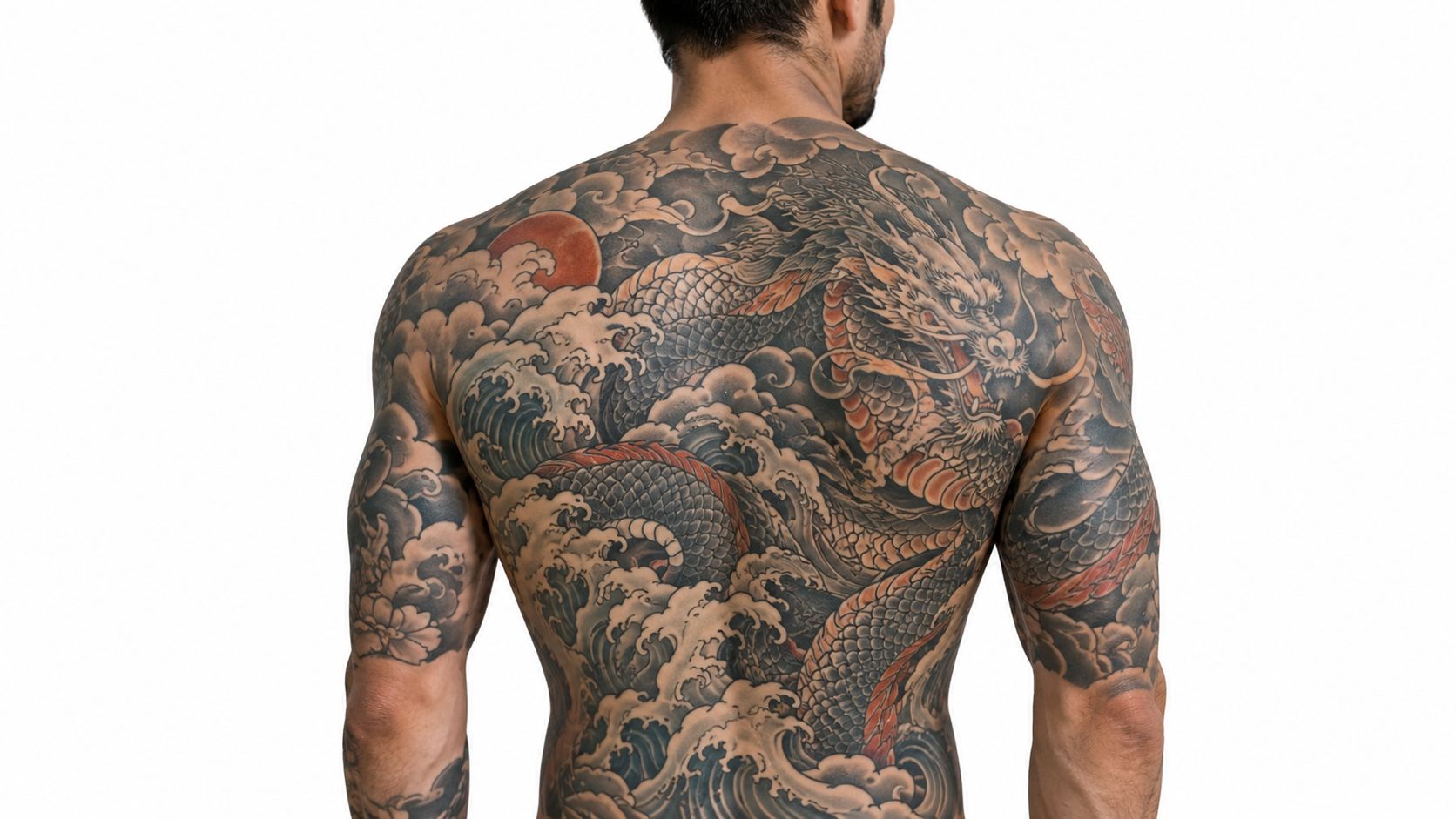
Traditional irezumi is built as an integrated body system. The classic approach uses large-scale movement across the back, torso and limbs, with subjects connected by wind, water, clouds, rocks and carefully planned skin breaks. Even when the finished work begins as a sleeve, the composition should make sense on the arm as a complete form and leave sensible options if you later decide to connect it to the chest or back.
Why the consultation starts with the body map
A good artist will look at your body before finalising the drawing. The shoulder cap, biceps, elbow, forearm, ribs and back each create different visual problems. A koi that looks balanced on a flat sheet may become cramped when it turns around the upper arm. A dragon's head may need to face into the body's movement rather than point towards the wrist.
The planning conversation should cover:
- Placement and scale: Decide whether the design is a contained sleeve, a larger panel or the first stage of a wider composition.
- Directional movement: Establish how the main subject travels over muscles and joints rather than stopping awkwardly at them.
- Background structure: Reserve room for waves, wind bars, clouds or rocks instead of adding them as an afterthought.
- Session planning: Large pieces are normally approached in stages, giving the skin time to recover and allowing the artist to maintain consistency.
- Future expansion: Tell the artist if you may want a chest panel, backpiece or additional sleeve later.
Practical rule: If the artist only discusses the main image and never asks how it should wrap around your body, you haven't discussed the whole tattoo yet.
Japanese tattooing is a major specialist category in the UK rather than an obscure import. One reported UK preferences study measured Japanese-style tattooing at 7.29% of all tattoo styles actively sought by clients, placing it behind black and grey and blackwork, as recorded in the Royal Collection Trust's account of Japanese tattoo history and British interest. The figure helps explain why British studios commonly present Japanese work alongside realism, traditional and fine-line tattooing, while still treating it as a specialist discipline.
Traditional body coverage also affects your expectations around time and cost. Neutral UK style guidance describes full-scale Japanese work as a project that can require 50 to 100 hours, with specialist pricing starting from about £7,500, depending on the scope and artist, as outlined in Tattoodo's guide to Japanese tattooing. Those figures aren't a quote for your tattoo. They're a reminder to discuss the complete project, not just the first appointment.
The Historical Journey of Irezumi to the UK
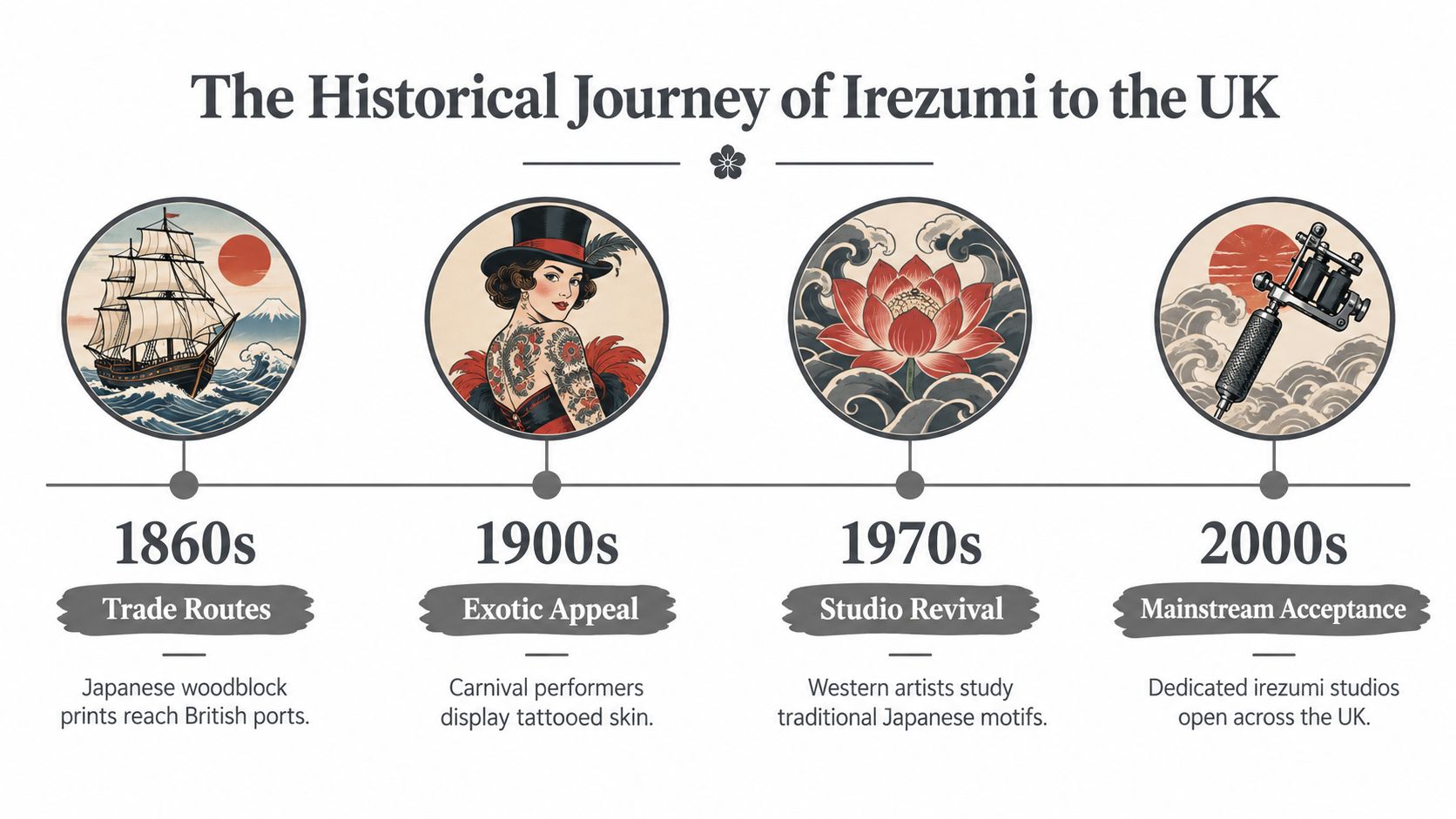
Japanese tattoo aesthetics have a longer relationship with Britain than many clients realise. The tradition developed intricate large-scale body designs during Japan's Edo period, and the Pitt Rivers Museum describes how Japanese tattooing became associated with elaborate full-body imagery rather than isolated decorative marks. That history matters because the structure of a modern Japanese sleeve or backpiece still depends on the same broad principle, the body is treated as a connected canvas.
British royal interest
The connection crossed into British history through documented royal visits. In 1869, Prince Alfred, Duke of Edinburgh, received a dragon tattoo in Tokyo. In 1906, Prince Arthur of Connaught was tattooed during a visit connected with presenting the Order of the Garter. Royal Collection Trust also records that Prince George, later King George V, was tattooed in Japan.
These events don't mean Japanese tattooing became immediately mainstream in Britain. They do show that the craft and its visual language were already visible to influential British visitors during the late nineteenth and early twentieth centuries. The exchange was not a recent social-media phenomenon. British travellers encountered Japanese tattooing in Japan, where the work was already recognised for its technical sophistication.
The Pitt Rivers Museum overview of Japanese tattooing is useful for understanding why the style feels different from a Western flash tradition. The historical model is based on planned relationships between the torso, limbs, back, background and central subjects. That approach still influences how dedicated artists design large work today.
From historical craft to modern UK studios
Modern British artists interpret Japanese tattooing through different methods and influences. Some follow traditional conventions closely, while others produce Japanese-inspired, neo-traditional or machine-based work with more flexible placement and colour choices. Both can be thoughtfully designed, but they aren't identical categories.
The distinction is useful when you're choosing an artist. Ask whether you want a traditional body composition, a Japanese-style sleeve, or a standalone design using Japanese motifs. You don't need to use specialist terminology perfectly. You do need to explain how much structure, coverage and cultural reference you want the artist to build into the work.
Japanese tattooing has strong cultural visibility in Britain, but it remains a specialist choice rather than the dominant mass-market style. UK coverage has described it as one of the most sought-after styles in London while also presenting it as a minority preference behind black-and-grey and blackwork, a tension discussed in Hammersmith Tattoo's overview of London tattoo trends. In practical terms, that means Japanese work should be approached as a lasting commitment to composition, not merely a passing fashion.
Core Elements and Composition Rules
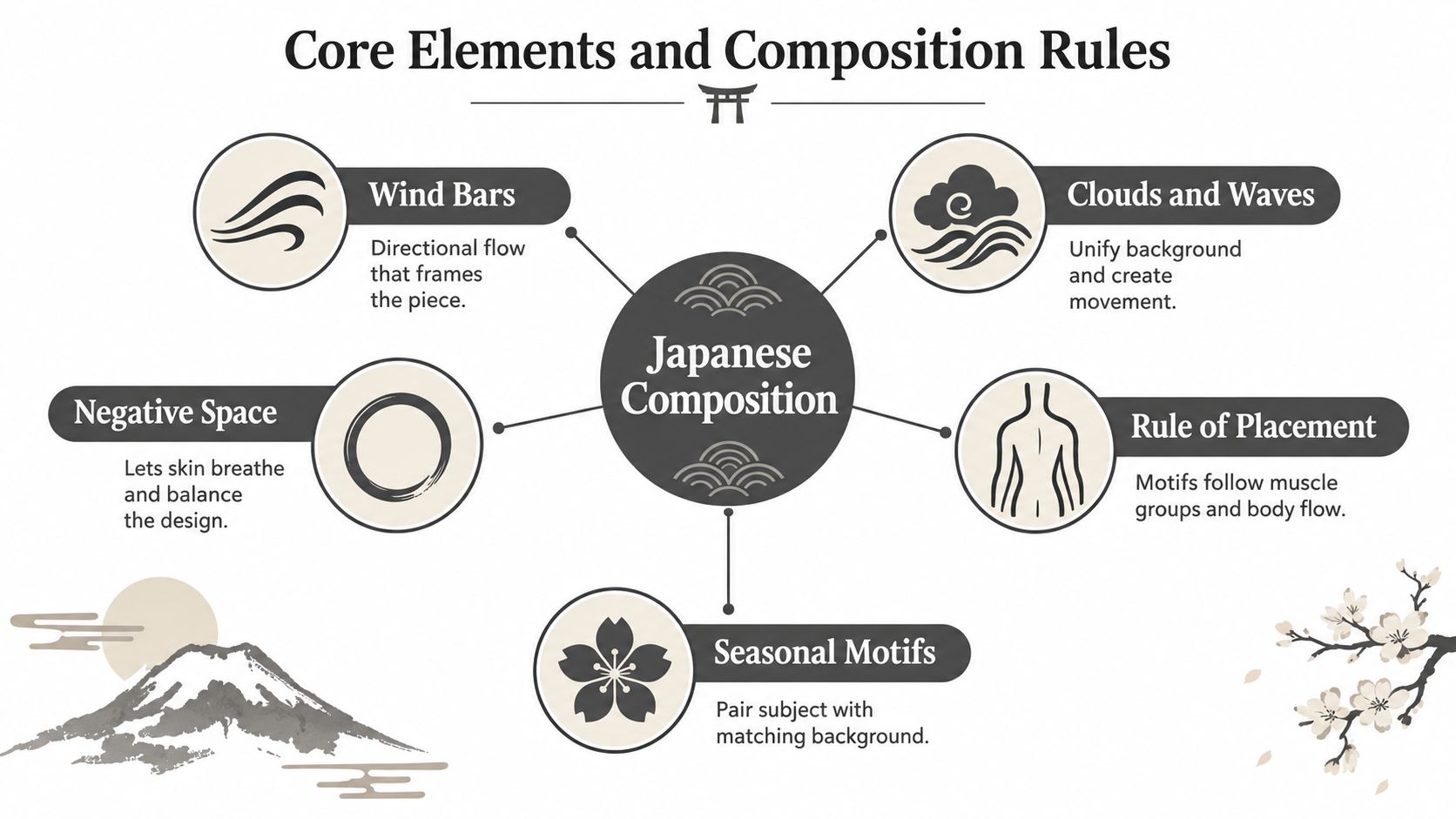
A Japanese tattoo is often judged by its dragon, koi or mask, but the background determines whether the whole piece reads as one design. To understand the style, look past the central subject and study how the artist connects it to the body.
Read the background first
Start by identifying the connective tissue:
- Wind bars create directional bands that frame the subject and help the eye travel around a limb.
- Water currents and waves give a sleeve or backpiece energy, particularly around koi, dragons and other water-associated subjects.
- Clouds soften transitions and provide a visual bridge between figures, flowers and larger areas of skin.
- Rocks and ground forms anchor parts of the design and stop every subject appearing to float.
- Seasonal flowers and leaves establish a relationship between the central subject and its environment.
These elements aren't filler. They control rhythm. Without them, a large tattoo can look like separate images placed beside one another. With them, the background gives each subject a role within the same visual sentence.
Understand negative space
Negative space, sometimes called a skin break, is the exposed skin between major forms and background elements. It gives the eye somewhere to rest and prevents dense colour from becoming visually heavy. On a curved body, those breaks also help the design remain legible as it turns away from a direct viewpoint.
The artist may leave skin visible around a flower, between wave crests or along a wind bar. That decision should be made during the layout stage. Filling every available area with detail rarely creates a stronger Japanese tattoo. It can remove contrast and make the composition harder to read as the tattoo settles into the skin.
The strongest background doesn't compete with the subject. It gives the subject room to move.
Follow the body's direction
Japanese composition respects the natural movement of the body. Water generally travels downwards, while wind bars and clouds can wrap around a limb to create circulation. A subject should sit with the muscle groups rather than fighting them.
Ask to see the stencil from several angles before work begins. Raise your arm, turn your shoulder and check how the design changes when the body moves. A sleeve needs to work from the front, side and back, not only while your arm rests flat on a table.
Seasonal pairings can also influence the background. Cherry blossoms, maple leaves and peonies create different moods and visual weights, so the artist needs to consider the entire palette before choosing every decorative element. That's why a consultation based only on a single reference image is rarely enough for a major custom piece.
Decoding Traditional Motifs and Symbolism
The main subject gives a Japanese tattoo its emotional centre, but symbolism works best when it connects to your own story. You don't have to choose a motif because it is popular. You should understand what the image communicates and whether it suits the stage of life you want to mark.
Koi and the upward journey
The koi is often associated with perseverance, effort and overcoming adversity. Its visual direction matters. A koi swimming upstream suggests struggle and continued movement, while the same fish travelling downstream can communicate a different point in the journey.
That makes the koi useful for clients who want a design about endurance without choosing an overtly aggressive image. The artist can reinforce the meaning through waves, water movement and seasonal flowers. The composition then says more than “I like fish.” It shows a subject moving through resistance.
Dragons and protective strength
In Japanese symbolism, the dragon is commonly understood as a guardian associated with wisdom, rain and protection rather than a simple destructive monster. Its long body also suits large-scale composition because it can curve around a shoulder, travel across the back or create movement through a sleeve.
A dragon design still needs a clear personality. Do you want a calm guardian, a powerful storm-associated figure or a more dramatic creature surrounded by waves and clouds? The answer affects the expression, posture, colour balance and placement. Clients exploring the format can compare approaches in this guide to dragon sleeve tattoos.
Flowers and seasonal meaning
The peony is traditionally associated with wealth, honour and richness, while cherry blossoms can suggest the passing nature of life. Maple leaves bring a different seasonal feeling and can add warmth or a sense of transition. These interpretations give the artist more than a list of objects to draw. They provide a visual vocabulary for the story behind the tattoo.
Mythical guardians such as the Foo Dog, also known as Komainu, can communicate protection at an entrance or boundary. The phoenix can suggest renewal and transformation. A hannya mask carries a more complex emotional range, combining beauty, grief and fury rather than functioning as a simple horror image.
Build meaning collaboratively
Bring personal context to the consultation, but don't arrive expecting to dictate every detail from a reference sheet. Tell the artist what you're commemorating, overcoming or protecting. They can then help match that idea to a subject, direction, seasonal setting and background.
A meaningful tattoo doesn't need to explain your entire life to everyone who sees it. It needs to make sense to you, while giving the artist enough information to create a balanced composition instead of assembling symbols at random.
Tebori Versus Modern Machine Techniques
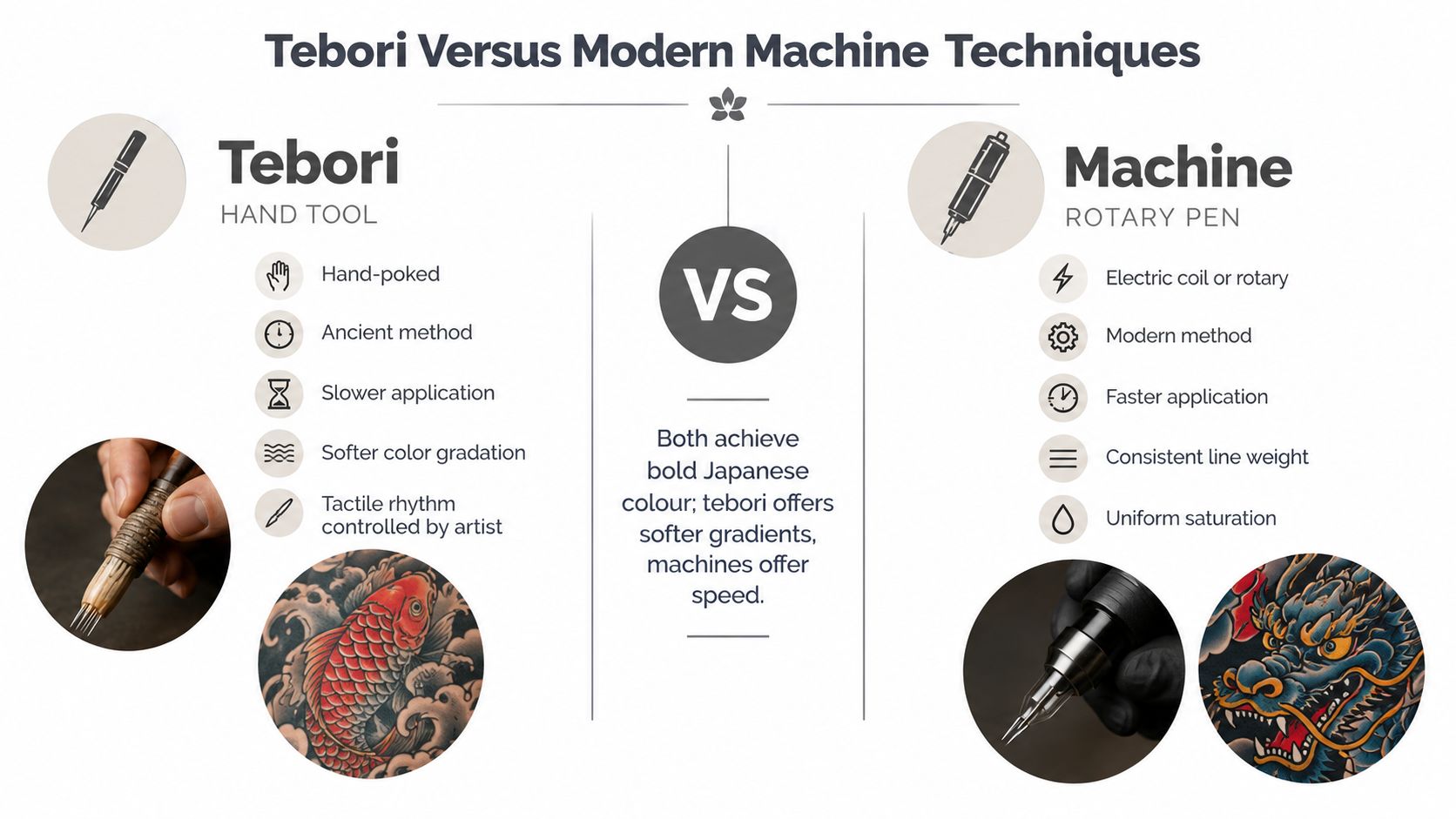
The method used to place ink affects the visual texture, working rhythm and experience of a Japanese tattoo. Tebori means hand-carving or hand-poking. The artist uses a bamboo or metal tool fitted with a bundle of needles, guiding pigment into the skin through repeated hand movements.
What tebori changes
Tebori has a tactile rhythm controlled by the artist. It can produce soft, organic gradients and a distinctive texture, particularly in shading and colour saturation. The application is generally slower than machine tattooing, so the client needs to be comfortable with a more deliberate process.
The hand method also demands stamina from both people. The artist maintains a consistent rhythm while working over skin that may already be sensitive from earlier passes. The client has to remain still and communicate clearly about discomfort, breaks and positioning.
What machines offer
Rotary pens and coil machines allow artists to work with a consistent line weight and controlled saturation. They're familiar tools for many UK tattooists and can make large projects easier to schedule in manageable sessions. Bold outlines, precise details and broad colour areas can all be achieved with machine work when the artist understands Japanese composition.
Machine tattooing doesn't automatically make a piece less authentic or less considered. The quality depends on the artist's design knowledge, technical control, hygiene standards and ability to work within the conventions they're presenting.
Choosing between the two
Some artists combine methods, using a machine for outlines and selected areas while applying tebori for softer shading or colour. Others work entirely by machine or offer hand work only for particular parts of a project. Ask what the artist means by tebori, where they learned it, and which parts of your design would use the method.
| Tebori | Modern machine work |
|---|---|
| Hand-poked application | Electric rotary or coil application |
| Slower, tactile rhythm | Faster and more consistent application |
| Soft, organic gradients | Controlled line weight and saturation |
| Requires specialist experience | Widely used across contemporary studios |
Pain and healing vary with placement, saturation, your skin and the artist's technique. No honest artist can promise that one method will feel easier for every client. The best choice is the method that suits the composition and the practitioner's strengths, not the label that sounds most traditional.
Hygiene Standards and the Healing Process
Large Japanese tattoos involve repeated skin trauma, dense saturation and sessions that may last longer than a small flash appointment. That makes infection control and aftercare central parts of the project, not paperwork to rush through at the end.
UK government guidance states that tattooing can carry risks including transmission of hepatitis B, hepatitis C and HIV when it isn't carried out properly, and its national guidance focuses on evidence-based infection prevention and control in the industry. You can review the UK government guidance on tattooing infection prevention and control before booking.
What a professional setup should show
A studio should be able to explain how it separates clean and dirty areas, protects surfaces and handles single-use materials. UK infection-control guidance says needles must go directly into a sharps container after use. It also requires disposable items such as pigment caps, trays, wipes and paper towels to be discarded, while reusable instruments must be pre-cleaned, placed in an ultrasonic cleaner and sterilised in an autoclave before reuse, as set out in body-art infection-control guidance from Braintree District Council.
The UK also has no nationally recognised accredited training courses for tattooing. That means you should ask how the studio checks artist competence and documents its own procedures rather than assuming a certificate alone proves safe practice.
Follow a calm aftercare routine
Your artist's instructions take priority, especially if they use a particular dressing. A UK local-authority handbook advises clients to:
- Remove the dressing after a minimum of six hours, unless your artist gives different instructions for the covering used.
- Wash gently with warm water and mild, unperfumed soap.
- Pat the tattoo dry with a clean towel, rather than rubbing it.
- Apply a suitable antiseptic cream sparingly if advised by the relevant guidance or your artist.
- Avoid re-covering the area.
- Continue gentle washing at least twice daily for at least ten days.
The detailed Derby City Council tattooing guidance explains this routine. Keep clothing loose and clean, avoid picking at flakes and follow the studio's advice about exercise, swimming and sun exposure.
Know when to seek help
Some tenderness, redness and swelling can occur during healing, but worsening symptoms need attention. NHS guidance says that if a tattoo becomes more red or swollen, it may be infected, and you should contact the tattooist or arrange an appointment with a GP or walk-in centre. Very red or swollen skin, fever or an inability to access a GP within 24 hours may require hospital A&E because these signs can indicate a serious infection, according to NHS advice on tattoo and piercing complications.
For a wider explanation of healing stages and warning signs, see this guide to how long a tattoo takes to heal. Don't hide a concern because you're worried about bothering the artist. Early advice is safer than waiting.
Planning Your Custom Piece and Next Steps
Start with a small collection of useful references rather than an oversized gallery of unrelated tattoos. Include examples of backgrounds you like, colour palettes, body placements and the type of mood you want. A dragon from one artist and a sleeve from another can help communicate direction, but the final design should be created for your body.
At consultation, be ready to discuss:
- The story: Explain the personal meaning, even if you don't want it represented literally.
- The scope: Say whether you're considering a standalone sleeve, a backpiece or a design that may grow.
- The practical details: Discuss placement, size, work schedule, session spacing, budget and aftercare.
- The artist's approach: Ask to see healed Japanese work and find out how they plan backgrounds and future extensions.
A free consultation can remove much of the uncertainty before you book. Timebomb Tattoo & Piercing offers custom tattooing and piercing through studios in Bournemouth and Croydon, with consultations covering ideas, sizing, placement and reference images. The studios offer Japanese tattooing among their available styles, alongside options including Traditional, Neo-Traditional, Black & Grey, Fine Line, Realism and Blackwork. Larger projects are best booked in advance, while walk-ins may be possible when an artist has space.
You can also read more about developing a custom ink tattoo before contacting a studio. Whether you're in Bournemouth, Poole, Dorset or South London, the right first step is a conversation that treats the tattoo as a complete composition rather than a quick image choice.
If you're ready to discuss a Japanese sleeve, backpiece, neo-traditional accent or professional piercing, visit Timebomb Tattoo & Piercing to contact the Bournemouth or Croydon studio by phone, email or online form and arrange a consultation. Bring your reference images and ideas, and the team can help you explore placement, scale, artist suitability and the next practical step.