
What if the best dragon sleeve tattoos are the ones that fit your life, not just your feed? A strong sleeve matches the story you want to wear, the amount of coverage you can commit to, and the kind of artist who can execute it cleanly. That's why the smartest way to choose is to compare style, line weight, colour, placement and session demands before you book.
The list below moves from classic Japanese flow to blackwork, realism, fine line and old school simplicity. Use it to decide whether you want a full-arm statement, a flexible half-sleeve, or a design you can build over time. If you want help turning the idea into a plan, Timebomb Tattoo & Piercing offers free consultations, resident and guest artists, custom tattooing across relevant styles, studios in Bournemouth and Croydon, and appointment booking, with walk-ins possible when availability allows.
Table of Contents
- 1. Traditional Japanese Dragon Sleeve
- 2. Black & Grey Realism Dragon Sleeve
- 3. Neo-Traditional Dragon Sleeve
- 4. Minimalist Fine Line Dragon Sleeve
- 5. Colour Realism Dragon Sleeve with Environmental Background
- 6. Blackwork Dragon Sleeve with Geometric Integration
- 7. Portrait Dragon Sleeve with Human Integration
- 8. Old School Dragon Sleeve with Bold Simplicity
- 8-Style Dragon Sleeve Comparison
- Turn Your Favourite Dragon Into a Bookable Design
1. Traditional Japanese Dragon Sleeve
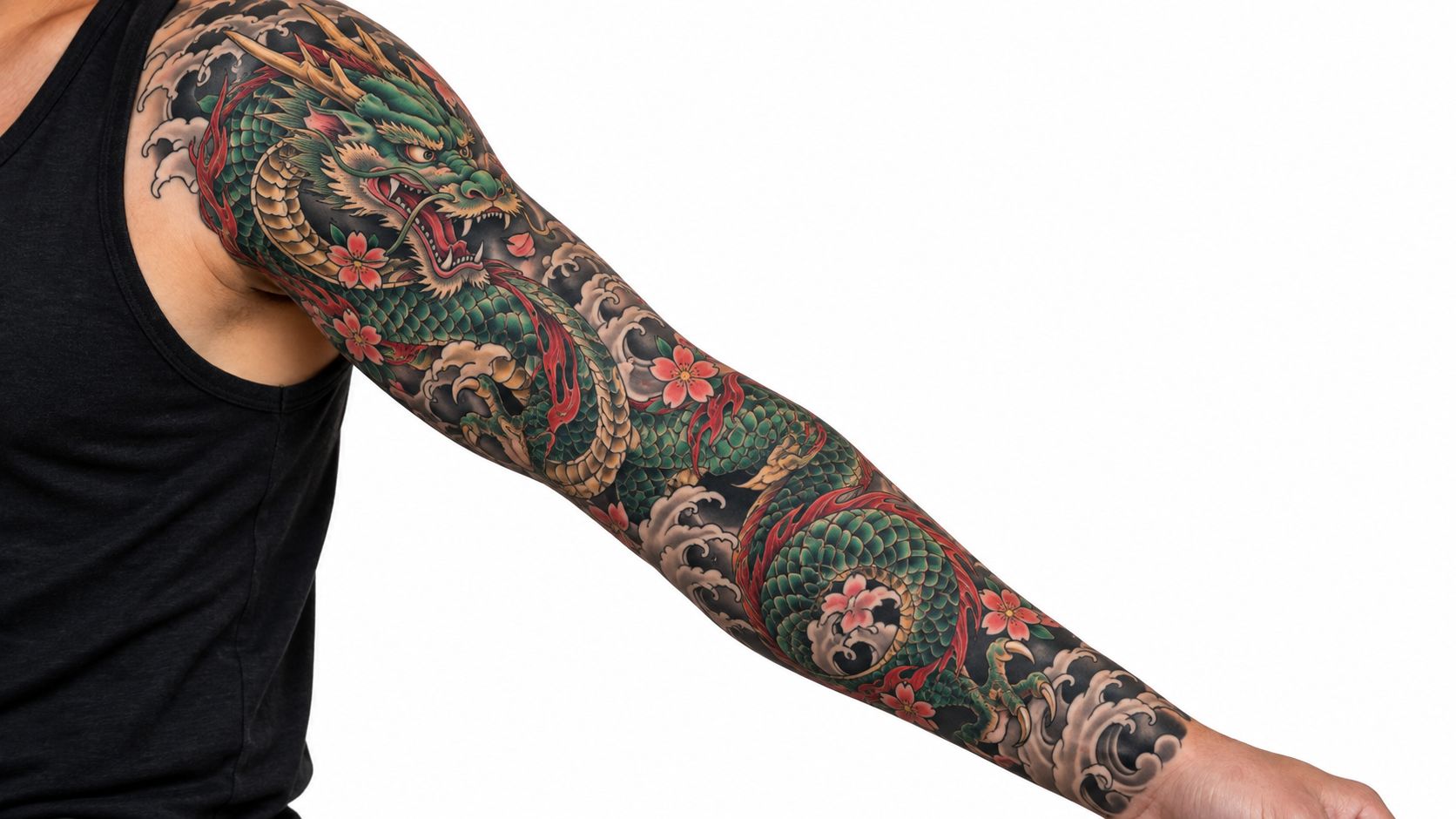
A Traditional Japanese dragon sleeve works because the dragon's body already knows how to wrap. The long torso, claws and whiskers can move around the bicep, forearm and elbow without looking forced, which is why this style has stayed so strong for full-arm work. Its visual language also carries history. British tattoo culture has documented dragon sleeves in elite body art since the late 19th century, including Prince Alfred's dragon tattoo in Tokyo in 1869 and later royal references to a dragon that could be completed in about three hours, while the first professional tattoo studio in London opened around 1881, helping move the style into the commercial market (Royal tattoo history and British dragon sleeve context).
Composition and artist fit
This style needs a specialist who understands how to build a sleeve as one living composition, not a pile of separate tattoos. Waves, clouds, cherry blossoms and bamboo should support the dragon, not fight it. If your artist cannot explain how the elbow will flow into the forearm taper, keep looking.
Timebomb's Japanese specialists are the right starting point for symbolism, background choices and placement planning. Bring references from ukiyo-e prints or temple artwork, not just random screenshots from social media. For a sleeve of this scale, plan the whole arm from the start and ask how many sessions they recommend before anyone draws the first line.
Practical rule: if the dragon's body doesn't guide the arm from shoulder to wrist, the sleeve will look crowded later.
This is also the style where a second arm matters. A balanced pair of sleeves reads better than one heavy arm and one blank arm, especially if you want the bodywork to feel intentional rather than unfinished.
Session demands and aftercare
Dragon sleeves in this tradition are a major commitment. A careful plan usually means multiple long appointments, and the healing window matters because the background and colour packing need space to settle. The aftercare should be strict, especially around friction, swimming and overworking the skin, because large Japanese-style pieces punish sloppy healing.
If you want the classic route, ask for a consultation, a full-arm plan and a clear timeline before you approve anything.
Timebomb's custom tattooing page is the right place to start if you want to compare Japanese sleeve options against other styles in the same studio.
2. Black & Grey Realism Dragon Sleeve
Could your dragon look physical without relying on colour? Black & grey realism suits that goal. Shading creates depth across scales, horns, smoke and skin texture, so choose an artist who understands contrast, anatomy and three-dimensional form. A strong design should make the dragon feel capable of moving around the arm.
The style works well for a dramatic sleeve without saturated ink. Monochrome places more pressure on line control, tonal grading and negative space. Review healed, large-scale realism sleeves rather than relying on fresh close-ups. An artist experienced with portraits and dragon anatomy may produce better results because the design depends on convincing structure, not surface detail alone.
What to ask for at consultation
- A detailed mockup: Request a digital preview or drawn plan showing how the dragon wraps around the arm and reads when the elbow bends.
- Large-scale realism examples: Review complete sleeves, not only small realism tattoos.
- Dragon-specific portfolio work: If the portfolio focuses on faces and roses, ask for evidence of strong dragon anatomy before booking.
- Healing plan: Confirm sun protection, recovery timing and how sessions will be spaced.
Timebomb's Colour Realism specialists can advise on black & grey variants during your free consultation, which is useful if you want the lifelike look of realism but prefer to stay in monochrome. Discuss contrast, skin tone and placement, including how the dragon will sit against the arm as it bends.
Plan the composition before approving detail. Keep the background controlled, use shadow to anchor the body and protect key features with negative space. Line weight should support the form without outlining every scale. Ask how many sessions the artist expects, which areas require the most concentrated shading and how they will preserve contrast during healing.
If the design already looks muddy on the mockup, reject it. A black & grey sleeve needs clear value separation from the start.
3. Neo-Traditional Dragon Sleeve
Neo-Traditional dragon sleeves sit in the sweet spot between classic tattoo boldness and modern detail. The outlines are stronger than realism, the colours are richer than old school, and the shading gives the dragon more depth than a flat traditional design. That combination makes the style ideal if you want impact first and technical polish second.
This is the easiest style to make visually punchy without sacrificing readability. Reds, greens, golds and blacks can all work, but the line weight has to stay disciplined or the sleeve loses its shape. If the artist can't explain how the background, horns and claws will support the main body of the dragon, the design will feel decorative instead of intentional.
How to judge the portfolio
Look for three things in the artist's work. First, clear outlines that still breathe. Second, saturated colour that doesn't crush the skin. Third, backgrounds that add movement without stealing focus from the dragon. If any of those are weak, the sleeve will age badly.
A good Neo-Traditional dragon sleeve also leaves room for future work. That matters if you want to pair it with another sleeve later, or extend the concept into a chest or shoulder panel. Timebomb's resident artists can help you choose a direction that still works if your plan grows over time.
Ask about colour priorities early. Ink choice, saturation and session sequencing all affect the final finish, especially on larger pieces. This is not the style for vague briefs. Bring direct references that show the line weight and palette you want, then let the artist refine the structure.
4. Minimalist Fine Line Dragon Sleeve
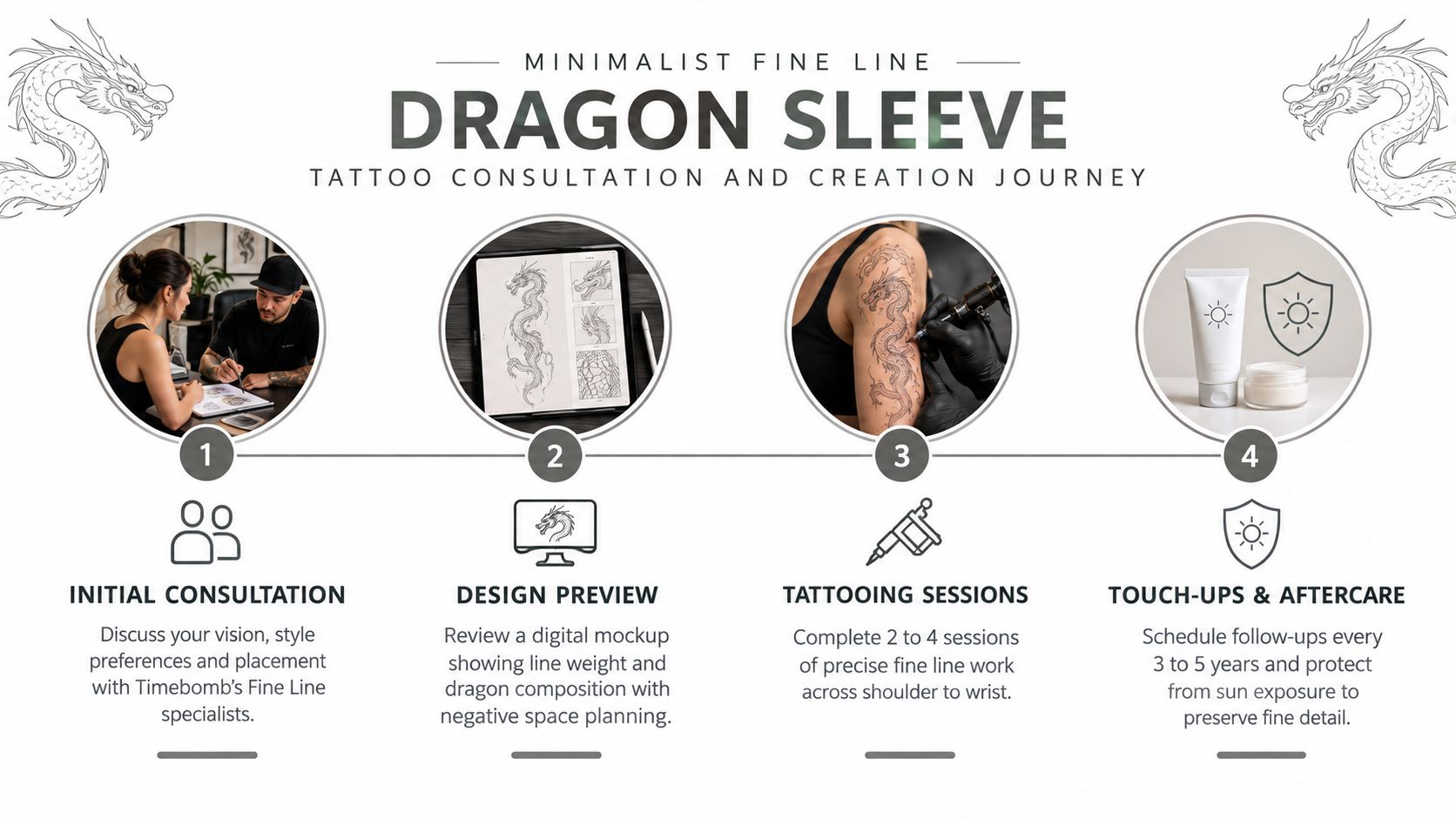
A Minimalist Fine Line dragon sleeve is for clients who want restraint, not spectacle. The dragon still has to read as a dragon, but the design depends on precision, white space and smart placement rather than heavy shading or dense fill. That makes the style feel elegant on the arm, especially when the wearer wants something discreet under clothing.
Fine line work gives you flexibility. You can build a sleeve gradually, keep the piece visually light, or use the dragon as a quiet structural element rather than a full visual assault. The trade-off is longevity, because thin lines are less forgiving over time and need an artist with serious technical control.
Direct advice: if the artist's fine line pieces look shaky in close-up, don't book them for a dragon sleeve.
A good fine line dragon sleeve should feel deliberate, not delicate for the sake of it. The body of the dragon still needs flow, and the line thickness should match the way the arm moves. Overly complex details will blur the idea, so keep the composition clean and let the skin do part of the work.
Timebomb's Fine Line specialists can discuss line thickness and longevity during your free consultation, which is the right moment to ask about visibility at work, future touch-ups and whether the design will sit above the elbow, wrap around the forearm, or stop short of the wrist. If you're not ready for a full sleeve, this is the easiest dragon concept to build in stages.
UV exposure matters here more than in bolder styles, so a good aftercare plan is essential. Choose this route if you want subtlety, not if you want instant maximum drama.
5. Colour Realism Dragon Sleeve with Environmental Background
Colour realism is the right choice when the sleeve needs to feel like a scene, not just a character. The dragon becomes one part of a full environment, whether that's clouds, water, mountains or a sunset palette that frames the entire arm. The result can be striking, but only if the artist can control colour balance across the whole composition.
This style asks more from the wearer too. You're not just choosing a dragon, you're choosing a narrative. That means you need a clear idea of mood, setting and visual temperature before the first appointment. If you want the sleeve to feel cinematic, the background needs as much thought as the dragon itself.
The planning stage should be detailed. A strong mood board helps the artist understand whether you want stormy blues, warm fire tones or a more natural environment. Timebomb's Colour Realism specialists can take that conversation and turn it into a workable sleeve plan during a free consultation, which is where you should settle the story, not after the outline has started.
Why this style needs patience
Color realism cannot be rushed. Large environmental sleeves need careful staging, and the skin has to recover between sessions so the layers stay crisp. If you want a finish that still looks rich later, you need a patient timeline and disciplined aftercare.
The dragon is only half the job. The space around it tells the real story.
This is the style for clients who want a major arm piece that reads like wearable art. If you're the kind of person who wants one large coherent project rather than a patchwork of smaller additions, colour realism is the strongest option.
Understanding healing timelines for tattoo work is useful here because larger, more detailed sleeves need more respect for recovery, not less.
6. Blackwork Dragon Sleeve with Geometric Integration
Blackwork dragon sleeves create impact through heavy black ink, sharp contrast and controlled structure. The design reads clearly from a distance and can remain visually strong as it ages. Geometric integration pushes the style towards a modern, architectural finish.
Choose this direction if you want a colour-free sleeve built around symmetry, sacred geometry or precise visual systems. Mandalas, triangular frameworks and geometric borders can frame the dragon, but they must support its movement. If the patterns dominate, the result becomes a geometry sleeve with a dragon added afterward.
The dragon is only half the job. The space around it carries the story.
Placement affects the entire composition. Curved organic forms need room to coil around the arm, while geometric borders require accurate alignment across joints and changing surfaces. Ask to see the design wrapped around a sleeve template before booking. A flat sketch can hide spacing problems at the elbow, wrist or inner arm.
Line weight also needs deliberate control. Solid black masses give the dragon authority, while finer geometric lines prevent the background from becoming heavy. Dense fill areas may require multiple sessions, especially when the design covers a large arm. Follow the artist's healing schedule and aftercare instructions so packed black sections settle cleanly.
Artist specialism matters more than the concept. Timebomb's Blackwork specialists can help assess whether your idea fits the intended sleeve size and whether their availability matches the project. Choose an artist with strong geometric stencil accuracy and a portfolio showing natural dragon anatomy. The best results stay bold, balanced and uncluttered, with enough open skin for every major shape to remain legible under imperfect lighting.
7. Portrait Dragon Sleeve with Human Integration
What should a portrait dragon sleeve communicate about you? This is the most personal direction here, and one of the hardest to execute well. The artist must make a realistic human face and dragon work together without weakening either subject. Build the design around a clear meaning, not a striking image alone.
The portrait may merge into the dragon, emerge from its body, or occupy shared space so both forms feel connected. Identity, memory and transformation suit this approach, but the concept fails quickly when the likeness is weak or the anatomy looks forced. Show the artist exactly what the portrait represents and how the dragon supports that message.
Before booking, confirm four things: Strong portrait realism credentials, with a portfolio of convincing faces; A clear symbolic brief, so the combined image has a defined purpose; High-quality reference images, because poor source material limits the result; and A digital preview, so you can assess the integration across the arm rather than judge a flat sketch.
Timebomb's portrait specialists can help shape the idea during a free consultation. Expect them to refine the concept for technical success. That process protects your design, especially where facial proportions, dragon anatomy and sleeve flow meet.
This sleeve also demands careful healing and session planning. Faces, scales and surrounding detail need room to settle, so choose this direction when meaning matters more than speed. If you want a simpler dragon, select a style with fewer competing subjects.
For a portrait-dragon hybrid within a larger bespoke project, custom ink tattoo planning can help you discuss the concept before committing to a standalone sleeve.
8. Old School Dragon Sleeve with Bold Simplicity
Old School dragon sleeves succeed through clarity. Choose this direction if you want a dragon that reads instantly, holds its shape across the arm and reflects classic tattoo culture without relying on fine detail or realism.
Start with the composition. A strong sleeve uses the dragon's body to guide the eye from shoulder to forearm, with the head, wings and tail spaced so the design does not bunch at the elbow. Keep the background restrained. Clouds, leaves or simple bursts can connect open areas, but too many filler elements weaken the graphic impact.
Line weight does most of the visual work. Ask for firm outer contours and controlled interior lines, then confirm how the artist will adapt them around joints and changing arm width. A skilled practitioner of classic American flash will understand this structure better than an artist who only copies a dragon outline.
Colour should stay selective. Red, green, yellow and black create the familiar palette, while solid fills keep the image sharp as it heals. Avoid excessive blending, muted gradients or a crowded colour scheme. The dragon can look fierce, playful or deliberately exaggerated, but every shape must remain readable.
Use these checkpoints during your consultation: Easy to read, with a silhouette that holds up from a distance; Forgiving to heal, because bold lines and solid colour are straightforward to maintain; Fast to recognise, with an immediate connection to tattoo history; and Flexible pairing, so later old school pieces can sit beside it without competing.
Placement still affects commitment. A full arm requires careful flow and repeated sessions, although this direction usually takes fewer appointments than realism or Japanese work. Keep the brief focused, and let the linework, colour blocks and spacing provide the finish.
Old School is a practical choice for a first sleeve or for anyone who values decisive design over hyper-detail. Book an artist whose portfolio proves control of classic proportions, bold outlines and clean colour packing.
8-Style Dragon Sleeve Comparison
| Style | Implementation Complexity 🔄 | Resource Requirements ⚡ | Expected Outcomes ⭐📊 | Ideal Use Cases 💡 | Key Advantages |
|---|---|---|---|---|---|
| Traditional Japanese Dragon Sleeve | High 🔄, multi-session, specialist techniques | High ⚡, experienced Japanese tattooist; 4–6 sessions | ⭐⭐⭐⭐, flowing, culturally authentic full-sleeve 📊 | Clients seeking traditional cultural artwork and long-term commitment | Timeless cultural respect, anatomical flow, rich symbolism |
| Black & Grey Realism Dragon Sleeve | Very high 🔄, advanced realism & shading skills | Very high ⚡, top realism artist; 5–8 sessions | ⭐⭐⭐⭐, photorealistic, three-dimensional impact 📊 | Perfectionists, art enthusiasts wanting lifelike detail | Highly lifelike, versatile with other realism pieces |
| Neo-Traditional Dragon Sleeve | Moderate–High 🔄, balances linework and shading | Moderate ⚡, skilled colour artist; 4–6 sessions | ⭐⭐⭐⭐, vibrant, dimensional, readable from distance 📊 | Clients wanting classic aesthetics with modern refinement | Bold colour, strong visual impact, forgiving of slight fade |
| Minimalist Fine Line Dragon Sleeve | Moderate 🔄, precision-focused, lower coverage | Low–Moderate ⚡, fine-line specialist; 2–4 sessions | ⭐⭐⭐, elegant, understated; best viewed up close 📊 | Professionals, those preferring subtlety or gradual sleeves | Low ink/pain, quick healing, easy future additions |
| Colour Realism Dragon Sleeve with Environmental Background | Extremely high 🔄, complex composition & colour mastery | Extremely high ⚡, award-level artists; 8–12+ sessions | ⭐⭐⭐⭐⭐, gallery-quality, narrative full-sleeve 📊 | Serious collectors, clients wanting major wearable art investments | Stunning realism, unique storytelling, high photographic impact |
| Blackwork Dragon Sleeve with Geometric Integration | Moderate 🔄, requires geometric precision | Moderate ⚡, blackwork specialist; 3–5 sessions | ⭐⭐⭐⭐, bold, high-contrast, long-lasting 📊 | Modern-art enthusiasts, fans of sacred geometry and bold design | Dramatic longevity, crisp geometric detail, strong contrast |
| Portrait Dragon Sleeve with Human Integration | Extremely high 🔄, combines portrait + dragon realism | Extremely high ⚡, elite portrait artists; 8–12+ sessions | ⭐⭐⭐⭐⭐, deeply personal, technically exceptional 📊 | Clients seeking symbolic, highly personal commissions | Unique storytelling, powerful symbolism, standout craftsmanship |
| Old School Dragon Sleeve with Bold Simplicity | Low–Moderate 🔄, straightforward line & colour blocking | Low ⚡, traditional artist; 2–4 sessions | ⭐⭐⭐⭐, iconic, highly readable, long-lasting 📊 | Those valuing classic tattoo heritage and low maintenance | Timeless aesthetic, quick healing, excellent readability |
Turn Your Favourite Dragon Into a Bookable Design
The right dragon sleeve starts with a clear decision. Choose the visual style first, then decide whether you want upper-arm coverage, a full-arm sleeve or a wraparound design that uses the forearm and elbow as part of the composition. After that, collect focused references, not a random folder of tattoos, and review artist portfolios for the exact technique you want.
Ask direct questions in the consultation. Find out how the artist handles composition, how many sessions they expect, how healing will affect the finished look and whether touch-ups are part of the plan. For a large piece, the best result comes from an artist who can explain the structure of the sleeve before they start sketching.
Timebomb Tattoo & Piercing is a practical place to begin if you want custom dragon sleeve planning, because the studio offers free consultations and matches clients with resident and guest artists across different styles. You can enquire at the Bournemouth or Croydon studio, and walk-ins may be possible when an artist has availability, but larger detailed work is best arranged by appointment. The artists also provide aftercare guidance, which matters when you're investing in a sleeve that has to heal cleanly as well as look strong on day one.
If you're ready to turn a dragon sleeve idea into something you can book, visit Timebomb Tattoo & Piercing to arrange a free consultation, ask about artist matching, and discuss your placement, style and timeline. You can contact the Bournemouth or Croydon studio by phone, email or the online form, and ask whether a walk-in slot is available if your design is small enough.