
You're probably looking at a gallery of tiny florals, delicate script or miniature portraits on your phone, wondering whether the fine line tattoo style will still look good once the skin has healed. You may also be asking whether thin lines hurt less, which placements are sensible, how long the result will last and whether a small design is easier to tattoo.
Those are practical questions, not signs that you're overthinking the decision. Fine line work depends on controlled technique, suitable scale, thoughtful placement, safe pigment handling and disciplined aftercare. It isn't a smaller version of a bold tattoo. This guide takes you from the visual basics through UK context, motif selection, the studio process, healing and booking.
Table of Contents
- You Want a Delicate Tattoo, But Where Do You Start
- What Fine Line Tattoo Style Actually Means
- How Fine Line Fits Into UK Tattoo History
- How Timebomb Artists Execute Fine Line Work
- Longevity, Healing, and Aftercare for Fine Line Tattoos
- Booking Your Fine Line Tattoo at Timebomb
- Why Fine Line Is a Choice, Not a Compromise
You Want a Delicate Tattoo, But Where Do You Start
A first tattoo often begins with a saved image and a mixture of excitement and caution. You might like a fine script phrase on the wrist, a botanical outline on the forearm or a tiny animal near the collarbone, but you can't tell whether the reference shows a fresh tattoo or a healed one. You may also be searching whether fine line tattoos fade, whether your skin is suitable and how much detail can fit into a small space.
Start by separating the design you like from the way it was photographed. Fresh tattoos usually look darker and sharper than healed work, while lighting, filters and camera distance can make delicate details appear more precise than they'll look in everyday life. A responsible artist will discuss the size, spacing, placement and likely ageing before taking a deposit.

A useful starting point: choose the feeling and subject first, then let the artist adapt the detail to your skin and placement.
You'll need to think about how often the area sees sunlight, whether clothing rubs against it, how much movement stretches the skin and whether the design needs to remain readable from a distance. The right fine line tattoo style is a collaboration between your idea and the limits of living skin.
What Fine Line Tattoo Style Actually Means
Fine line tattooing is a technical method defined by narrow needle groupings, delicate contours and restrained shading. An artist may use a single needle or a very small round-liner grouping to create a narrow mark, rather than the wider needle configurations used to pack in solid colour or heavy blackwork.
A simple analogy is the difference between a fine ink pen and a marker. The pen can describe the edge of a leaf, the curve of a face or the spacing between letters with subtle control. The marker makes a stronger, wider statement and can cover more area quickly. Neither tool is automatically better. They produce different visual results and demand different decisions from the artist.
Fine line pieces often include:
- Single-needle florals, where the artist relies on contour, negative space and selective detail.
- Fine script, which needs enough separation between letters to remain legible.
- Small animals and portraits, where a few carefully chosen marks suggest texture and form.
- Geometric linework, where clean intersections and consistent spacing matter.
- Minimalist symbols, which use proportion and placement rather than dense shading.
The style suits people who want body art that feels personal without dominating their appearance. A small constellation, a flower connected to a memory or an understated portrait can carry meaning while remaining visually quiet. That subtlety helps explain why fine line work fits the broader UK shift from tattooing as a marginal form of body modification towards mainstream personal expression.
The technique still requires accuracy. Fine-line pigment is placed in the dermis, which contains blood vessels and nerve endings, so too much pressure or repeated passes can traumatise the skin. Too little pigment implantation can leave a healed line weak or uneven. The finished look depends on the artist controlling depth, movement, machine response and design scale at the same time.
How Fine Line Fits Into UK Tattoo History
Fine line became easier to choose as tattooing became more accepted across the UK. A UK survey conducted in 2015 found tattoos on 13% of adults aged 18 to 24, 30% of those aged 25 to 39, 21% of people aged 40 to 59 and 9% of people aged 60 or older. The figures show that tattoo ownership varied by age, with the style becoming more familiar to younger and middle-aged adults during its wider normalisation. (UK tattoo prevalence summary)
That change widened the range of designs clients could request. Someone seeking a quiet botanical outline may not relate to older images of bold tattoos linked with sailors, soldiers or subcultures. Fine line offers another visual language, closer to jewellery, illustration or a handwritten note.
The generational shift appears in historical comparisons as well. One reported comparison places tattoo ownership at 7% among people born in the 1950s, rising to 42% among people born in the 1980s and 1990s. (UK tattoo history source)
For a first-time client, that history matters because fine line is a deliberate choice, not a weaker version of bold tattooing. The design has to suit the person's preferred level of visibility, the body area and the way that skin moves. A small geometric mark, for example, can look different on a curved surface than it does on paper.
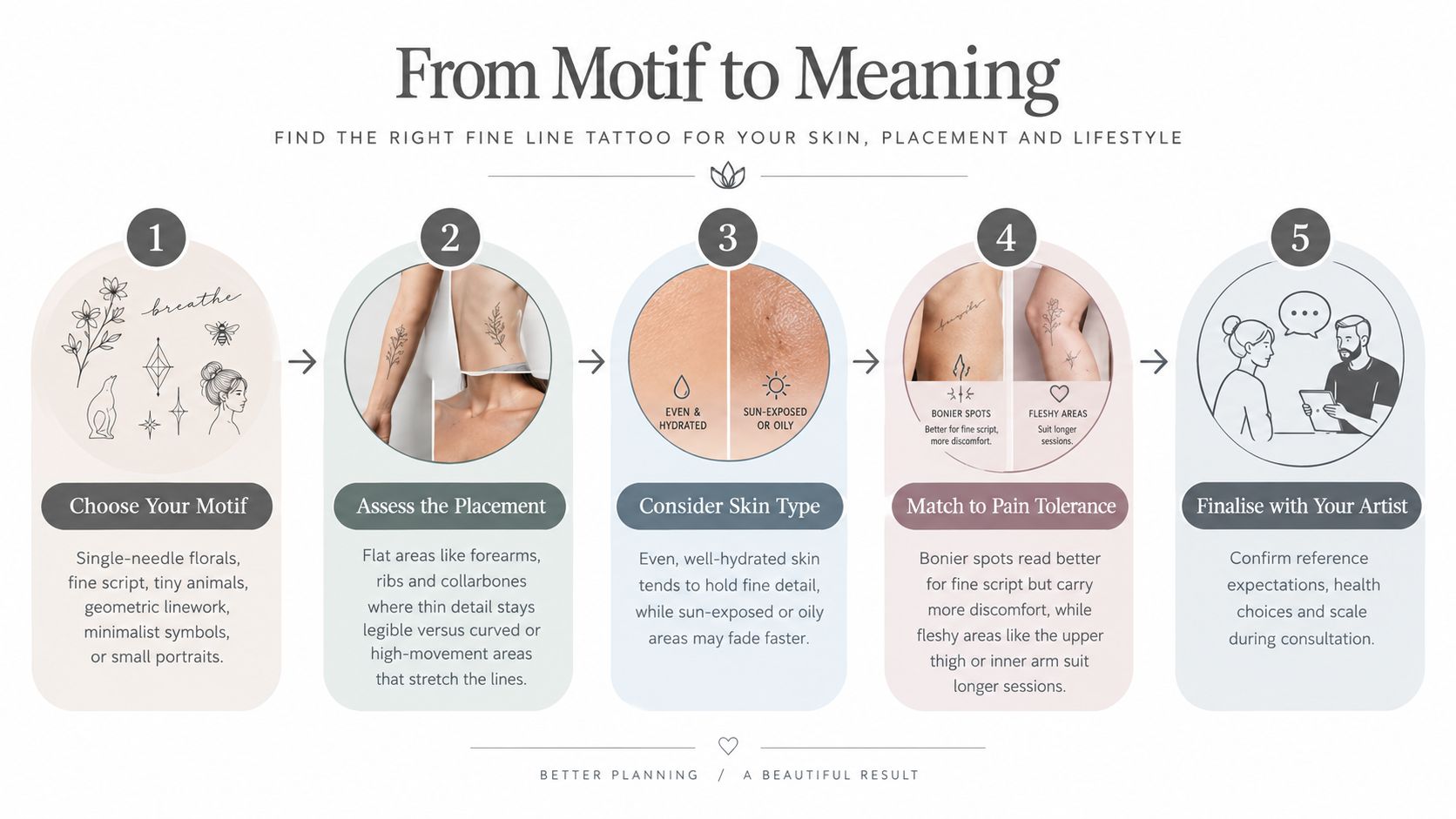
Placement also affects comfort and design decisions. Areas with less cushioning and more bone can feel sharper, while fleshier areas may make longer sessions easier to manage. Damaged, irritated or infected skin should not be tattooed, and skin exposed to regular friction may call for a simpler or more conservative design.
Fine line does not suit every idea. If a tattoo must remain highly legible over time, a stronger line or larger scale can provide more visual margin. A good artist may recommend simplification, wider spacing or a bolder treatment when those choices better match the client's intended result.
How Timebomb Artists Execute Fine Line Work
Fine line appointments reward preparation more than speed. A bold traditional design can use strong outlines and saturated fills to create visual impact. Fine line work depends on small decisions being correct from the beginning, because a heavy correction can change the character of the piece.
At Timebomb Tattoo & Piercing, clients can discuss ideas, size, placement and reference images during a free consultation before booking. The studios in Bournemouth and Croydon provide private curtained areas, while the Croydon location has multiple booths. Artists and guest artists cover several specialisms, so the initial conversation can help match a brief to the right experience.
The process behind a clean line
A typical consultation starts with the motif rather than a fixed template. You might bring a photograph of a flower, a handwritten word or a drawing that captures the mood. The artist considers which parts are essential, which details will disappear at a small scale and how the design should follow the body.
Next comes placement testing. A design that works on a flat forearm may need adjustment on a rib, ankle or collarbone because the surface curves and moves. The artist may recommend a slightly larger design, wider spacing or fewer internal details so the healed tattoo remains readable.
Needle choice follows the drawing. Narrow configurations support delicate contours, while limited shading can create depth without turning the piece into a dense block. Machine settings and hand speed must work together, and the artist needs to avoid excessive passes that irritate the skin.
Pigment handling is equally important. UK local-authority guidance says tattoo pigments should be sterile and inert, and recommends controls such as single-client pigment portions, suitable containers and appropriate sterilisation of reusable equipment. (Kent hygienic skin piercing code)
A professional appointment also includes preparation of the workstation, appropriate barrier protection, clean pigment portions and sterile or properly sterilised equipment. Those steps protect the client and make the artist's movements more consistent. Fine detail doesn't excuse casual hygiene. It requires greater discipline.
Longevity, Healing, and Aftercare for Fine Line Tattoos
“Will it fade?” is the right question, but “How long will it last?” doesn't have one universal answer. There's still limited long-term evidence specifically measuring fine line and single-needle tattoos over decades. Ultraviolet exposure is recognised as a major accelerator of fading, while placement, skin biology, design spacing and aftercare also influence how a tattoo changes. (Fine line longevity review)
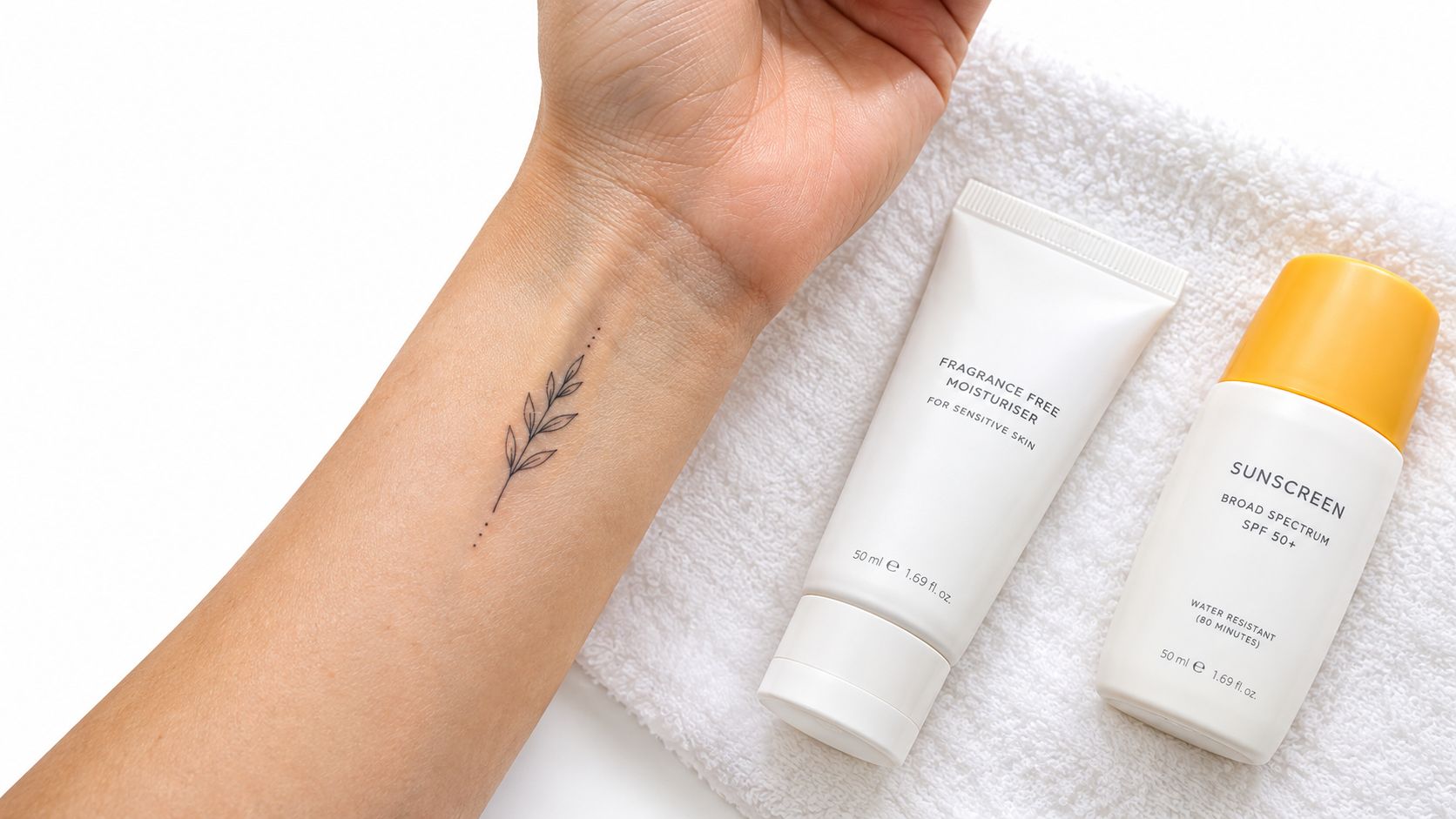
A covered upper arm and a routinely sun-exposed hand don't experience the same conditions. A design with generous spacing may remain easier to read as pigment softens than a tightly packed miniature drawing. Sunscreen and sensible sun avoidance can reduce ultraviolet damage, but they can't freeze the tattoo in its freshly completed state.
A practical healing routine
Follow the written instructions supplied by your artist, because dressings and products can vary. The basic principles are straightforward:
- Clean gently. Wash your hands before touching the tattoo, then use the recommended method to clean away surface residue without scrubbing.
- Moisturise sparingly. Apply the product and amount advised by your artist. Overloading a healing tattoo can leave the area overly wet and uncomfortable.
- Leave the skin alone. Don't pick flakes or scabs, and avoid unnecessary touching. Pulling at healing skin can remove pigment.
- Protect the area. Avoid avoidable friction and keep a healing tattoo away from direct sun. Don't put sunscreen on an open wound unless your artist or a healthcare professional advises it.
- Watch for problems. Increasing redness, spreading heat, worsening pain, discharge or feeling unwell warrants prompt medical advice.
Tattooing creates a controlled skin wound, and UK public-health guidance identifies tattooing as a potential exposure route for infections including hepatitis B, hepatitis C and HIV. It also states that sterile water should be used for diluting ink or flushing equipment, because non-sterile water can introduce microorganisms. (UK infection prevention guidance)
For a clearer healing timeline, see this guide to how long a tattoo takes to heal. A touch-up may be sensible once the tattoo has fully settled if a line healed unevenly or a small area lost pigment. That decision belongs after healing, not during the first irritated days.
Booking Your Fine Line Tattoo at Timebomb
A permanent tattoo has a clear legal threshold in the UK. Applying a tattoo to anyone under 18 is a criminal offence under the Tattooing of Minors Act 1969, and parental consent doesn't create an exception. A legitimate studio may request acceptable photographic identification before the appointment, regardless of the tattoo's size or price. (UK tattoo licensing guidance)
Registration provides another useful screening point. Local-authority systems commonly require both the practitioner and premises offering tattooing to be registered before trading. Council guidance also addresses pigment cleanliness, customer-specific containers and sterilisation of reusable equipment. (Local-authority tattoo registration guidance)
Questions worth asking before you book
- Who will tattoo the design? Look for healed examples and work that resembles your subject, scale and placement.
- How will the pigment be handled? Ask whether pigment cups are single-use and what happens to any leftover mixture.
- How is reusable equipment sterilised? The studio should be able to explain its process clearly.
- What aftercare will I receive? You should leave with practical written or verbal guidance.
- Can we discuss size and placement first? A consultation is valuable when you're unsure whether the reference will translate to skin.
You can arrange a free consultation with the Bournemouth or Croydon studio, ask about appointment availability or enquire about a walk-in for a small, simple piece when an artist has space. For style-specific planning, this guide to a fine line tattoo artist can help you prepare your references and questions.
Why Fine Line Is a Choice, Not a Compromise
Fine line isn't a watered-down traditional tattoo, and it isn't automatically an inexpensive shortcut because the finished piece looks small. It's a deliberate choice about visual volume, detail, restraint and personal visibility. The artist has less room to hide an uneven contour, crowded letter or poorly judged proportion, so the design needs careful planning before the machine touches skin.
The style also sits naturally within the UK's wider move towards personalised, professional tattooing. UK tattoo businesses numbered 3,342 in 2025, with an increase recorded from the previous year and average annual growth across the preceding period. (UK tattoo business market analysis) Local-authority registration and evolving ink controls place fine line work within a more accountable studio environment, where clients can assess both artistic suitability and hygiene practice.
Timebomb's custom-first approach includes style coverage from Traditional and Old School through Fine Line, Realism, Blackwork and Hyper-Realism. Its Croydon studio states that it doesn't tattoo the same piece twice, while the business has operated since 2003. Those details matter because a fine line tattoo should be designed for one person's body, intention and placement, not treated as a disposable image copied from a catalogue.
Fine Line vs Bolder Styles at a Glance
| Style | Line Weight | Shading Approach | Typical Size | Best Placement |
|---|---|---|---|---|
| Fine Line | Narrow, delicate contours | Restrained shading and open negative space | Small to medium, depending on detail | Flatter, lower-friction areas suited to the design |
| Bolder Traditional | Strong, highly visible outlines | Solid colour and confident shadow shapes | Medium to large | Areas where clear visual contrast is desired |
| Blackwork | Heavy black shapes or dense linework | High contrast with limited tonal softness | Small to large | Placements that support strong graphic forms |
| Realism | Variable, often controlled line and tonal detail | Layered shading and gradual transitions | Medium to large | Areas with enough surface for the subject to breathe |
The best choice is the one that matches your subject, lifestyle and expectations. If you want a botanical design with an airy, illustrative quality, fine line may express it more directly than heavy outlines. If your priority is maximum long-term boldness, a stronger treatment may suit you better.
Timebomb Tattoo & Piercing offers custom fine line tattoos, free consultations, professional piercing and appointment or walk-in enquiries at its Bournemouth and Croydon studios. Visit Timebomb Tattoo & Piercing to share your idea, request a consultation, contact the team by phone, email or online form, or ask about availability before booking.