
You've saved a delicate botanical sketch, a whisper-thin script idea, or a tiny symbol that feels personal, and now the question is simple, which fine line tattoo artist can pull it off well? A good design can still look wrong in the wrong hands. Fine line work is unforgiving, because the difference between crisp and fuzzy usually comes down to technique, placement, and how carefully the artist plans the tattoo with your skin in mind.
In the UK, that decision matters even more because tattooing isn't just about style, it's about visibility, workplace context, ageing, hygiene, and ink safety. A fine line piece can be exactly right for one person and completely wrong for another. The safest way to choose well is to understand what the style can do, how to read a portfolio, what to ask before booking, and when a design needs a specialist rather than a generalist.
Table of Contents
- Finding the Right Fine Line Tattoo Artist for You
- What Makes Fine Line Tattooing Different
- How to Judge a Fine Line Artist's Portfolio
- Design Ideas That Suit Fine Line Work Best
- How Fine Line Tattoos Age Over Time
- Ink Safety and the Questions to Ask Before Booking
- Booking a Fine Line Specialist at Timebomb
Finding the Right Fine Line Tattoo Artist for You
A lot of people start in the same place. They see a clean little rose, a single word in elegant script, or a tiny animal tucked behind the wrist, and they think the idea is the hard part. It isn't. The hard part is finding the person who can place that design on the body so it still looks intentional after healing, movement, and daily life.
A fine line tattoo artist is usually working with small, precise forms that leave very little room for error. That means the artist's hand, eye, and judgement matter as much as the sketch itself. A design that looks beautiful on Pinterest can fall apart fast if it's too detailed for the placement, too small for the skin, or drawn by someone who works better in heavier styles.
Start with the body, not just the idea
If you want a tiny flower on the wrist, the question isn't only “Do I like flowers?” It's also “Will this placement let the lines stay readable?” That's the kind of thinking a specialist brings into the consultation. For UK clients, this matters because tattoo visibility and placement shape how a design reads in daily life, at work, and over time, especially since 26% of British adults had at least one tattoo in the 2022 YouGov survey, with 11% reporting a visible tattoo on the head, face, neck, forearms, wrists, or hands (YouGov).
The right artist won't just agree with every idea. They'll help you size it properly, choose the best body area, and explain where fine lines will age better or worse. That's a good sign, not a rejection.
Practical rule: if the tattoo only works when it stays impossibly tiny, the design may need to be simplified before it goes on skin.
What Makes Fine Line Tattooing Different
Fine line artists use thinner needle groupings and fewer passes than bold-style artists. That choice shapes how the tattoo is planned, placed, and executed.
Fine line work relies on delicate outlines, subtle detail, and lighter visual weight. The aim is not to pack in as much ink as possible. The aim is to keep the design readable while preserving the softness that makes the style appealing.
Fine line versus heavier styles
Traditional and Blackwork tattoos are built to carry visual weight. They can handle thicker outlines, bolder fills, and stronger contrast. Fine line work depends on precision, clean spacing, and careful placement because the design has less ink and less visual margin to absorb movement or healing changes.
That is why fine line often suits script, small florals, minimalist symbols, and other placement-sensitive ideas. A heavy motif can look strained in this style because the technique is built around restraint. A specialist knows when to reduce detail, widen spacing, or suggest a bolder approach instead.
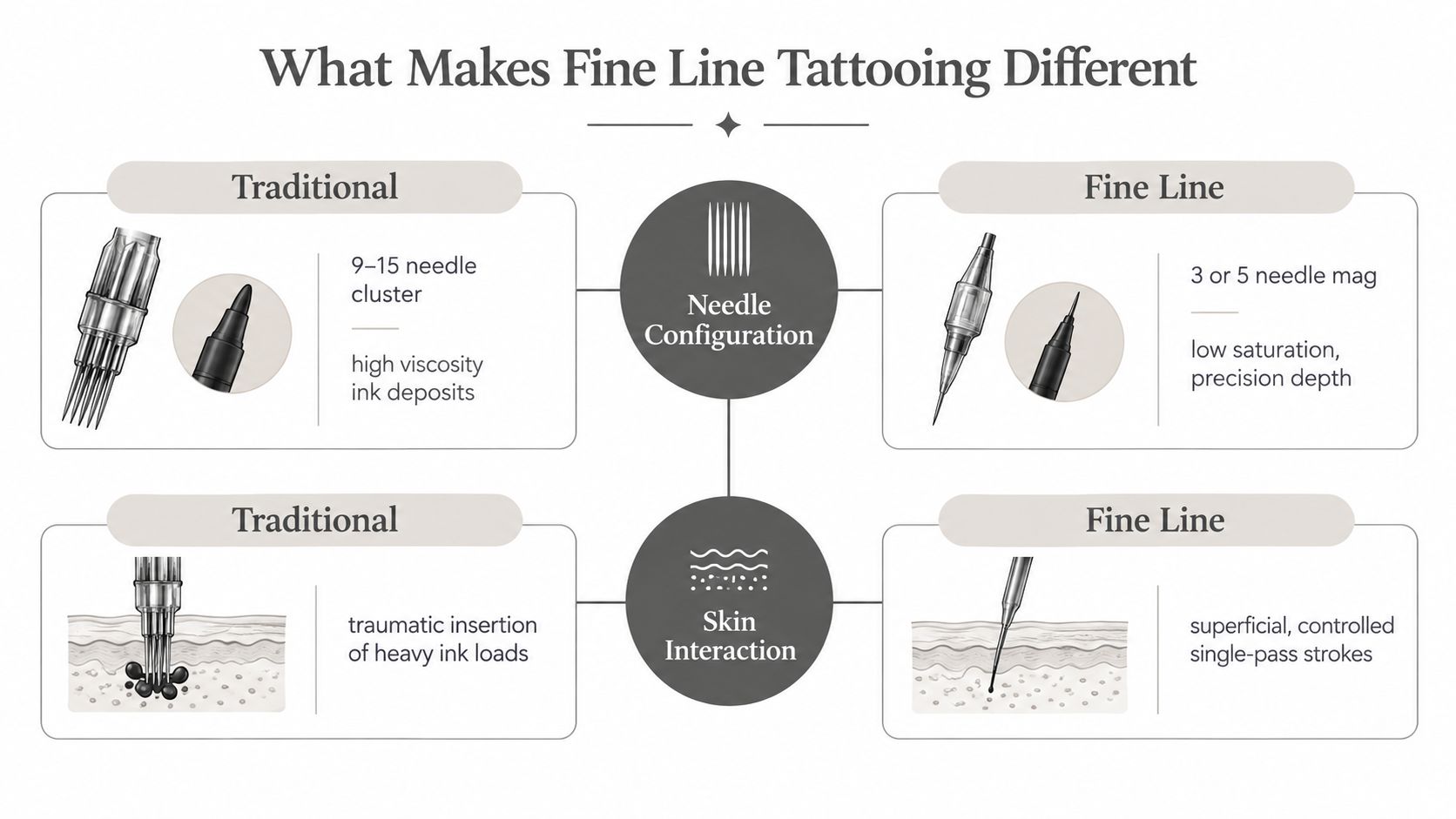
Body movement matters too. Skin on a wrist, forearm, ribcage, or ankle does not behave the same way, so the design has to suit the contour it sits on. The best results usually come from tattoos that are small enough to fit the body cleanly, but not so small that the lines blur into each other. In practice, fine line work is less forgiving of cramped spacing, so placement becomes part of the design, not an afterthought.
How to Judge a Fine Line Artist's Portfolio
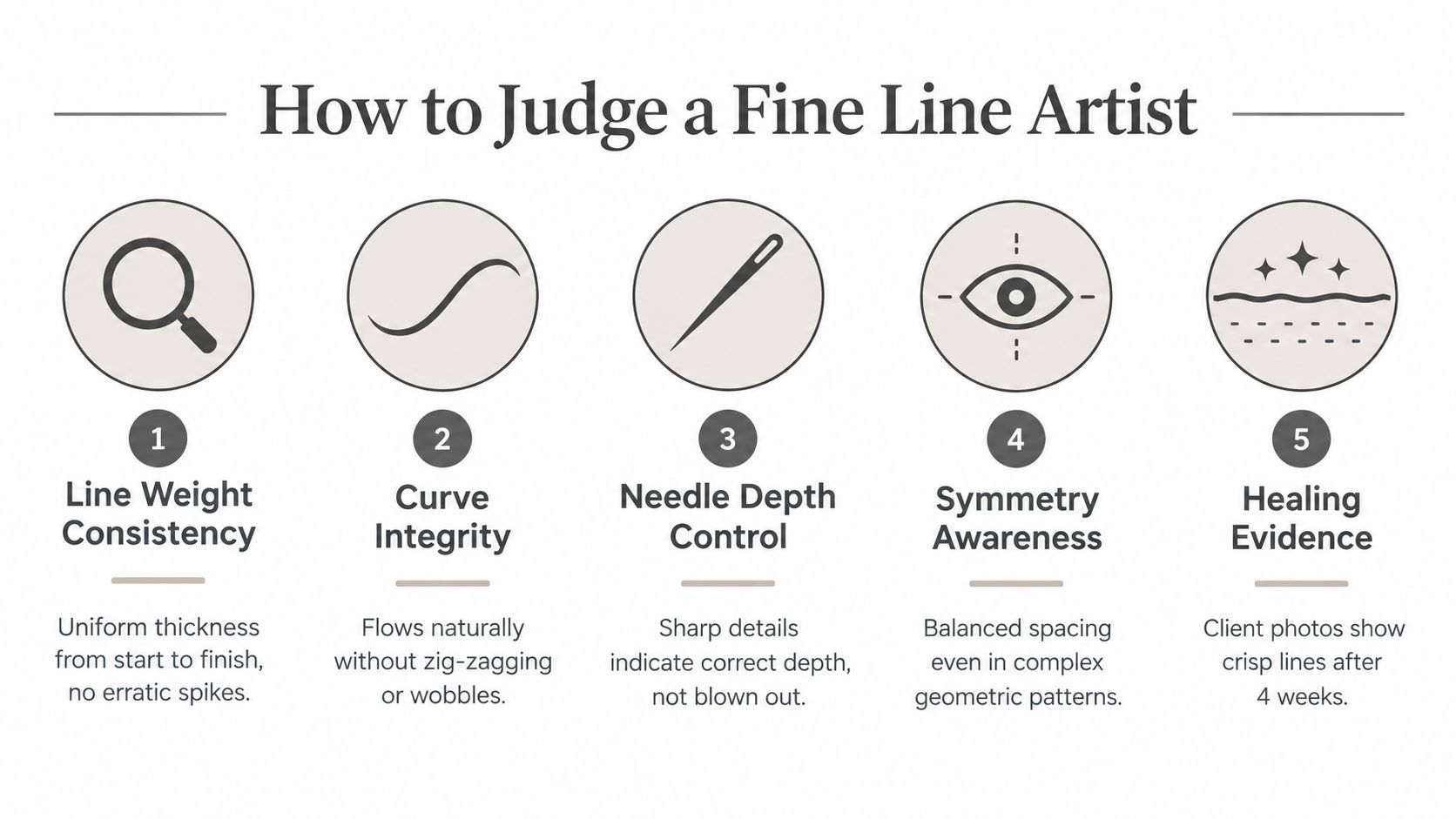
A portfolio should show more than attractive pictures. It should show how the artist handles line weight, spacing, and the way a tattoo settles on real skin after healing. Fresh photos can flatter the work. Healed photos show whether the lines stay readable.
Look for healed work, not just fresh work
Healed images tell you whether the artist can build a tattoo that lasts. Clean spacing, steady lines, and shapes that still read clearly matter more than a perfect photo taken moments after the session. If a portfolio only shows brand-new tattoos, you still do not know how the work will settle.
Body placement matters too. A fine line tattoo that follows the arm, collarbone, or wrist naturally usually reads better than one that feels dropped onto the skin without thought. Strong portfolios show range, but the same control runs through all of them.
Useful check: if every tattoo in the portfolio looks great only in one angle, under one light, and before healing, keep looking.
Check the studio systems too
Technique matters, and hygiene matters just as much. UK public-health guidance says tattooing can spread blood-borne viruses if it is done badly, so infection control should be visible in the studio's routine, not just assumed from the artwork (UK guidance). Ask how the studio handles single-use needles, hand hygiene, gloves, barrier protection, sharps disposal, cleaning, and aftercare.
A specialist portfolio also helps you see how an artist chooses subject matter. A realism tattoo artist's portfolio can be useful here because it shows how closely a studio matches style to skill. Fine line work needs that same match. A polished portfolio is only half the story, the other half is whether the artist uses safe, documented processes every day.
Design Ideas That Suit Fine Line Work Best
Fine line isn't the best fit for every concept, and that honesty saves people from regret. The style shines when the idea is light, clean, and dependent on elegant line quality rather than heavy shading. It struggles when the subject needs bold contrast to stay clear.
What usually works well
Script and lettering work because the style can keep words soft and refined, but the spacing has to be exact. Botanical pieces and small floral designs are natural fits because stems, petals, and leaves often benefit from delicate outlines. Micro tattoos and minimal symbols can also suit fine line work, as long as the placement gives the design enough space to breathe.
Delicate animals can work too, especially when the artist simplifies fur, feathers, or facial features into readable shapes. Geometric line art can look excellent when the lines are measured and the spacing is balanced. A first-time client often brings one of these ideas, because they feel personal without being overwhelming.
| Design Idea | Why It Suits Fine Line | Good Placements | Considerations |
|---|---|---|---|
| Script and lettering | Clean lines keep the text elegant and personal | Wrist, forearm, collarbone | Too-small lettering can blur over time |
| Botanical and floral pieces | Natural forms suit delicate outlines | Forearm, ankle, ribs | Petal detail needs enough breathing room |
| Micro tattoos | Minimal shape works well at small scale | Wrist, behind the ear, ankle | Very tiny tattoos can age quickly |
| Delicate animals | Simplified features look graceful in fine lines | Upper arm, forearm, calf | Over-detailing can make the design cluttered |
| Geometric line art | Precise spacing suits the style | Forearm, sternum, back of arm | Uneven symmetry stands out fast |
| Minimal symbols | Strong meaning with a light visual footprint | Wrist, finger side, ankle | High-friction areas can be less forgiving |
Some ideas read better in a bolder style. If you want a highly detailed portrait, a dense sleeve element, or something that must stay legible from across a room, fine line may be the wrong choice. A good artist will say that plainly.
Timebomb's styles overview is a sensible place to compare different approaches before you commit.
How Fine Line Tattoos Age Over Time
Fine line tattoos age differently because the lines are thinner and the visual margins are smaller. That doesn't mean they fail, it means they need more realistic expectations. A hair-thin line has less room to soften before it starts looking wider or less crisp, so placement, skin type, sunlight, and friction matter more.
What changes after healing
The biggest shift happens in the first healing phase, when the skin settles and the lines stop looking fresh and sharp in the same way they did on day one. After that, the main pressures are UV exposure, daily friction, and the natural behaviour of the skin itself. A forearm tattoo and a finger tattoo do not age under the same conditions, and clients should plan with that in mind.
The UK Health and Safety Executive's evidence review notes that tattoo-ink substances can act as skin sensitisers, irritants, or hazardous chemicals, and it estimates that about 1.8% of tattooed people develop an adverse reaction serious enough to require a doctor's consultation (HSE evidence review). That doesn't mean every tattoo causes a problem. It does mean clients need to know the difference between normal healing and a reaction that deserves medical attention.
What to expect and what to ask
No responsible artist should promise fixed fading timelines or guaranteed line-spread percentages. The healed result depends on placement, skin characteristics, technique, aftercare, and how much sun or friction the area gets. If the artist offers a touch-up policy, ask when they assess healed work and what counts as normal settling versus a correction.
A fine line tattoo can stay beautiful for years, but it should be chosen for the body you have, not the one you wish you had in a studio photo.
Ink Safety and the Questions to Ask Before Booking
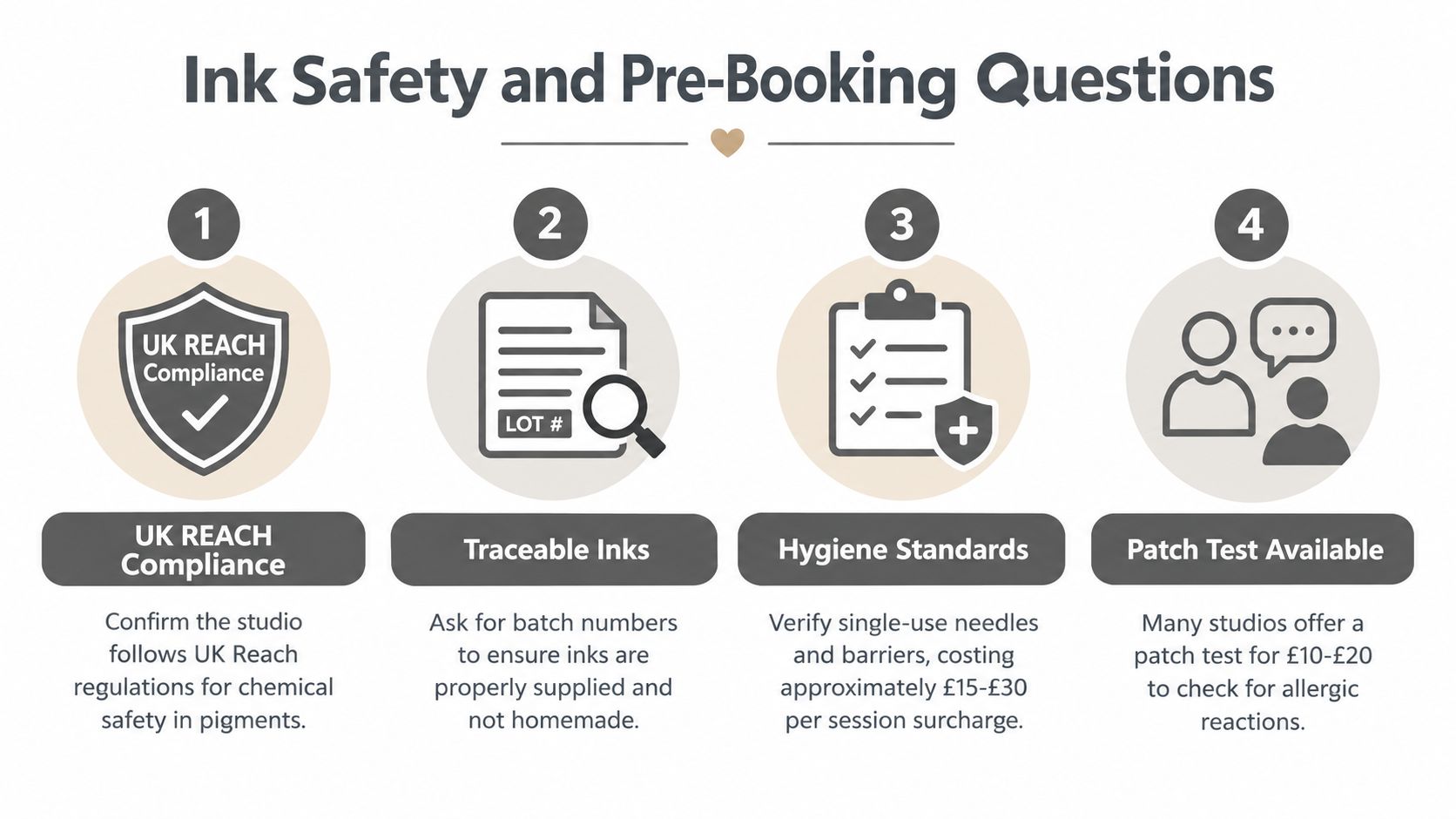
Which ink system does the artist use, and can they show batch information? That is a practical first question, because UK REACH controls cover tattoo pigments and the substances in them can include chemicals linked to sensitising, corrosive, irritant, mutagenic, reproductive-toxic, or carcinogenic risks (HSE REACH information). Traceable products and careful handling matter even more for fine line work, where a small change in ink or technique can show up in the healed line.
Questions worth asking every studio
Ask whether the ink is supplied for tattooing, and how the studio records batch details in case a concern ever comes up later. Ask what happens if you mention eczema, a metal allergy, a past reaction, or another skin condition that could affect healing.
Ask what their aftercare sheet covers, and which symptoms should prompt medical advice. England's public-health guidance says tattooing can transmit blood-borne viruses if done improperly, and England has no statutory professional-competence requirement or nationally recognised accredited tattoo-training pathway for tattooing (UK guidance). That means you judge the studio by its procedures, not by how confident the person sounds.
Age checks matter too. In England, tattooing anyone under 18 is an offence under the Tattooing of Minors Act 1969, and parental consent does not make it lawful. Local authority registration rules usually apply to both the practitioner and the premises, so registration checks belong in the booking conversation as well (local authority guidance).
Booking a Fine Line Specialist at Timebomb
A custom tattoo only works well when the artist matches the brief to the right hand. Timebomb Tattoo & Piercing does that by working with resident and guest artists across styles, including Fine Line, and by offering free consultations where size, placement, and reference images can be discussed before booking. That makes it easier to separate a nice idea from a tattoo that will actually suit your body.
The studio operates from 109 Old Christchurch Road, Bournemouth and 22 George Street, Croydon, with the Croydon location near East and West Croydon stations. If you want to compare options first, how to book a tattoo appointment is a useful starting point for understanding the process, and it helps to bring clear reference images, a rough size idea, and an honest conversation about placement.
For fine line work, the checklist is straightforward. Choose an artist who shows healed work, ask how they handle hygiene and ink traceability, and be willing to adjust the design if the body location calls for it. That's how you get a tattoo that looks considered on day one and still makes sense later.
If you're ready to book, Timebomb Tattoo & Piercing can help match you with a fine line specialist, talk through placement and sizing, and arrange a consultation in Bournemouth or Croydon. Visit Timebomb Tattoo & Piercing to get in touch, ask about tattoo or piercing availability, and book a time that suits you.