
You're probably here because the tattoo idea is real now, not just a saved photo on your phone. Maybe you've found an artist you like, maybe you're comparing studios, or maybe you just want to get the booking right so you don't waste time, money, or a good placement on a rushed decision. The smart move is to treat how to book a tattoo appointment as a short safety and consent process, not a calendar task.
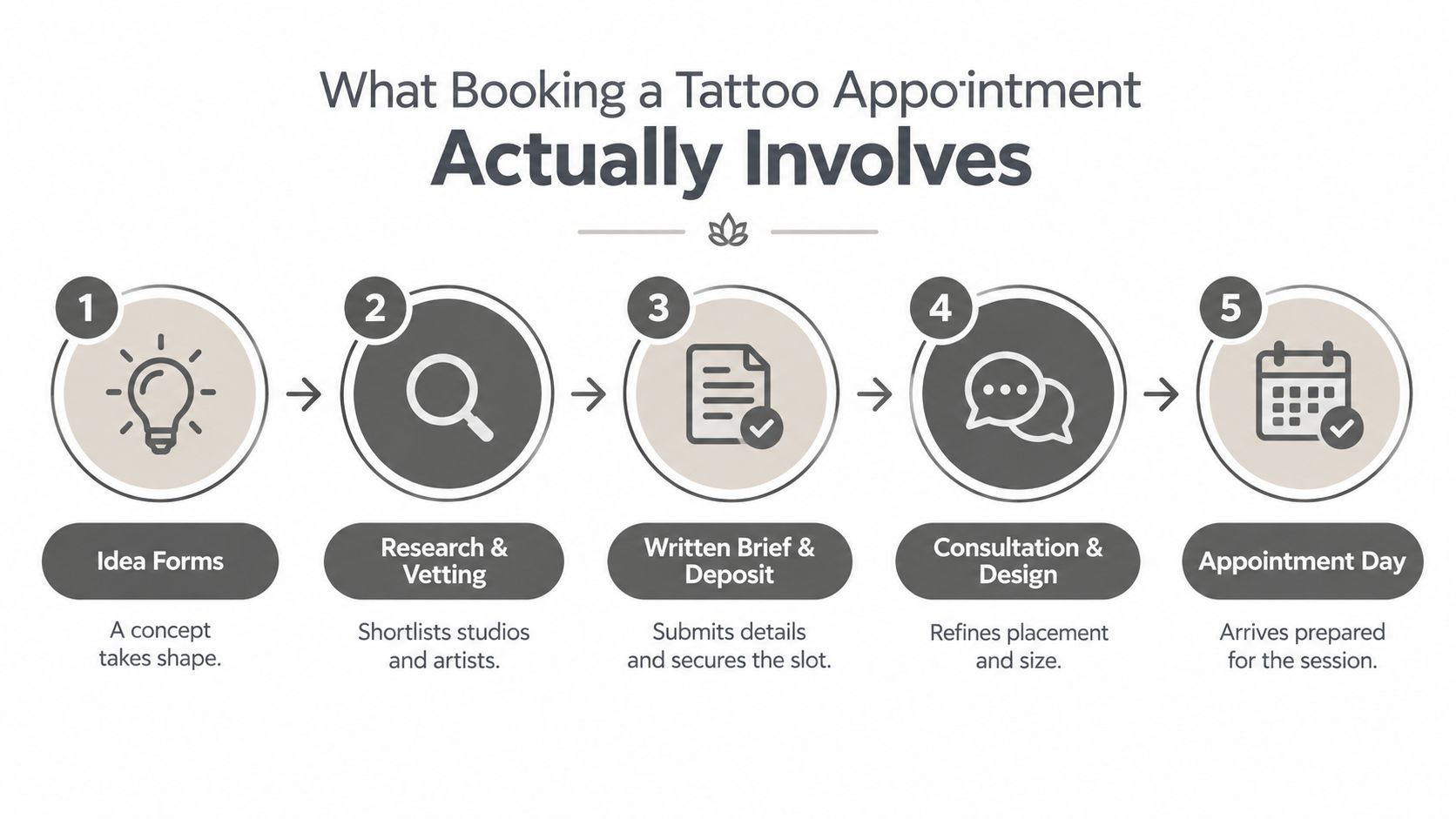
Table of Contents
- What Booking a Tattoo Appointment Involves
- Confirming You Meet the Age Requirement First
- Vetting the Studio and Artist Before You Book
- Submitting a Written Brief and Paying the Deposit
- Choosing Between Consultation, Walk-In and Online Booking
- Preparing for the Day of Your Appointment
- Your Booking Checklist and How to Get in Touch
What Booking a Tattoo Appointment Involves
Booking starts before anyone talks about a date. You need an idea worth tattooing, a studio that fits the work, a clear brief, and enough detail for the artist to judge whether the piece is ready to book or needs a consultation first. That order matters. Skip it, and you risk a bad design choice, the wrong timing, or a deposit tied to the wrong plan.
The short version of the process
Start by shortlisting an artist whose portfolio matches your style. Then send a proper brief. If all you give is “how much for a tattoo?”, you are asking the studio to guess. For custom, detailed, or style-specific work, book a consultation so the artist can assess size, placement, composition, and session length.
Then comes the deposit, which secures the slot and gets the work moving. On the day, arrive prepared, with ID if asked, the right clothing, and a clear idea of where the tattoo is going. Tattooing is permanent, time-sensitive, and bound to hygiene rules, so studios take the booking process seriously.
Practical rule: if the first message does not give enough detail to judge the job, it is an enquiry, not a booking.
The route in can still vary. Some people book by phone, some use an online form, some walk in, and some start with a free consultation. The method matters less than the quality of the information you give and how directly the studio answers.
Confirming You Meet the Age Requirement First
In England, Wales and Scotland, age is the first hard gate. Tattooing anyone under 18 has been illegal since the Tattooing of Minors Act 1969 (legislation.gov.uk). Parental permission does not override that. If you're under 18, the appointment itself can't be booked or carried out, except for a tattoo done for medical reasons by a qualified medical practitioner or someone working under that practitioner's direction.
Why studios ask for ID
Reputable studios ask for valid photo identification because the law includes a limited defence where the tattooist had reasonable cause to believe the customer was at least 18 and genuinely held that belief. That's not a loophole for casual guessing, it's a reason for studios to check properly. It protects the business, the artist, and you.
For online bookings, phone calls, and walk-ins, the rule is the same. If age is uncertain, the studio should confirm it before taking a deposit or allocating time. Acceptable ID is whatever the studio's policy names as valid photo identification, and you should bring it if requested rather than assuming your appearance is enough.
What first-timers get wrong
A lot of first-timers think a parent can sign off on the appointment. They can't. Others assume the booking desk will “sort it later”. That's backward. The age check comes first, because everything else depends on it.
If you're under 18, you can still talk through a future idea or ask about style and placement for later. You just can't move into the tattoo appointment itself until you're legally old enough.
Vetting the Studio and Artist Before You Book
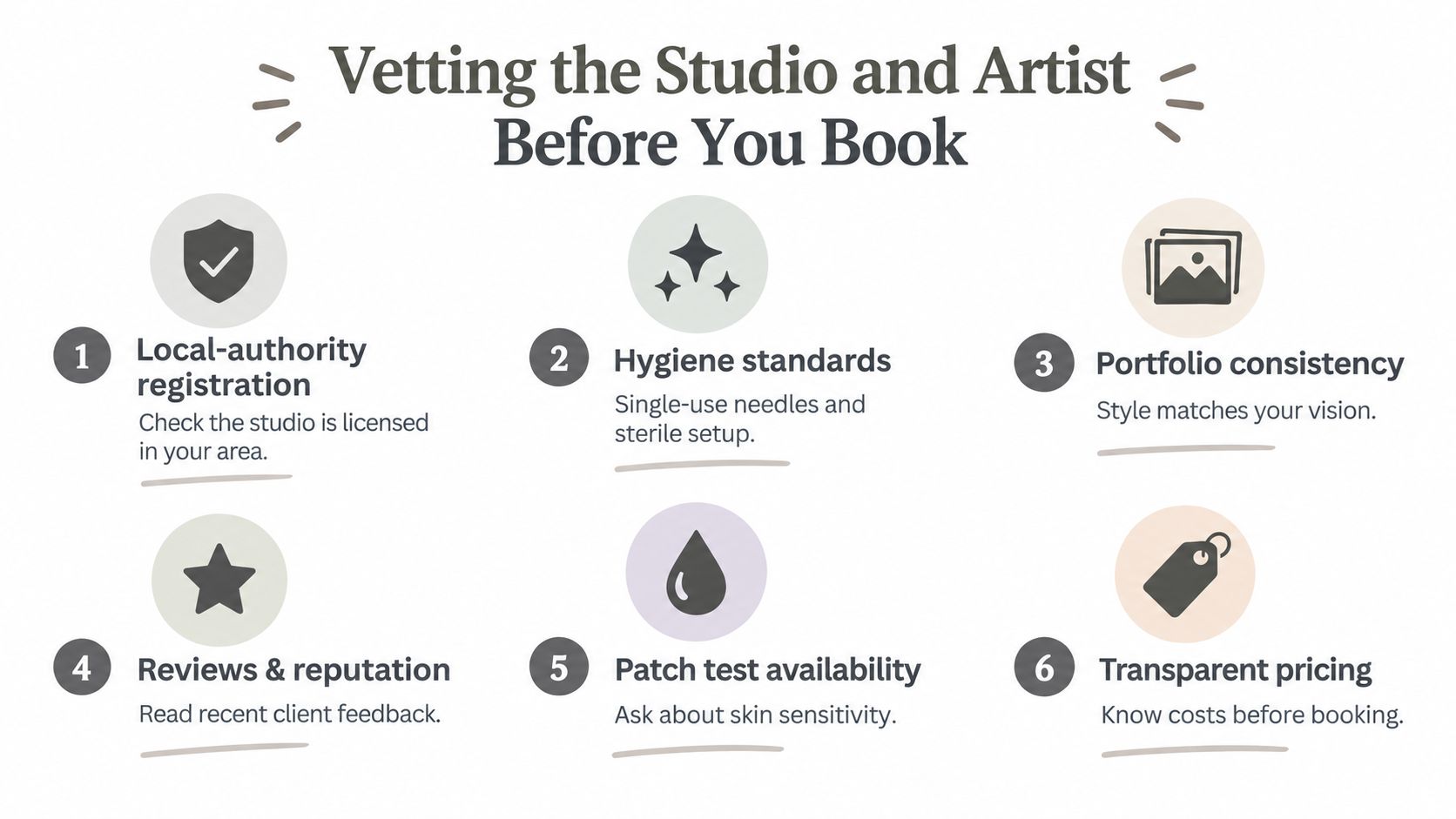
A smart booking starts with paperwork and hygiene, not a pretty Instagram feed. Check whether the premises and practitioner are registered with the relevant local authority, because UK rules differ by area and there is no single national inspection standard. Parliament records also note that operating without the required local registration, or breaching applicable byelaws, is an offence (UK Parliament briefing). Treat registration as part of the booking decision, not an extra detail.
Ask the right hygiene questions
Ask directly about single-use needles, glove changes, workstation disinfection, and how reusable equipment is sterilised. UK guidance describes controls such as disposable or sterilised needles, cleaning couches and furniture after each client, and training around blood-borne-virus risks (UK Government guidance). Local-authority guidance also covers handwashing, skin disinfection, decontamination, and autoclaves where appropriate (Cheshire East guidance).
If a studio gets defensive about hygiene questions, leave. A professional place answers clearly and without fuss.
Judge the artist by the work, not the promises
Look for healed results if they are shown, consistent style, clean lines, controlled shading, and evidence that the artist does your kind of tattoo. Fine line, realism, Japanese, blackwork, and cover-ups each demand different skills, and weak artists often hide behind polished language.
The government's guidance on tattooing training and accreditation says there are currently no nationally recognised accredited training courses for tattooing (UK Government guidance). So registration, visible hygiene, and a strong portfolio matter more than generic claims.
The questions worth asking before you pay
- Is the premises registered with the local authority?
- Who will tattoo me, and is that the artist I'm booking with?
- How are needles, gloves, and surfaces handled between clients?
- What happens if the skin isn't suitable on the day?
- Do you record consultation, consent, and aftercare details?
- What piercings use implant-grade jewellery, and what metal is supplied?
A useful next check is whether the artist's style matches your idea. A custom tattoo design brief shows why that match matters before you hand over a deposit.
Submitting a Written Brief and Paying the Deposit
A good booking message is specific. Say the style, the subject, the approximate size, the placement, whether you want colour or black and grey, what reference images you have, and whether there are previous tattoos or scars in the area. Give a realistic timeframe too. That's what lets an artist decide whether the work fits their lane.
What a strong brief looks like
Keep it simple and concrete. “Black and grey swallow on inner forearm, around palm-sized, existing tattoo near the wrist, ideally next month” is useful. “Want a cool bird, how much?” is not. The first message saves everyone time and usually gets a better response.
If the job is detailed or large, ask for a consultation before confirming anything. That gives the artist space to assess composition, likely number of sessions, and whether the reference material is technically workable. It also gives you a chance to ask about the deposit, redraw rules, and design approval before money changes hands.
Studio reality: a proper brief protects you as much as it protects the artist. Bad input creates bad bookings.
What the deposit actually does
The deposit secures the time slot and moves the design process forward. If the artist later tells you the concept needs changing, that conversation should happen before final approval. Good studios also spell out cancellation and rescheduling rules in writing, so there's no confusion about what happens if your plans change.
If the brief doesn't match the artist's specialism, don't force it. A professional studio should redirect the enquiry instead of pretending every artist can do every style. That saves you from paying for the wrong hand on the wrong job.
For a sense of how booking relates to budget, the page on how much a small tattoo costs is a useful companion read, because size and complexity drive the conversation from the beginning.
Choosing Between Consultation, Walk-In and Online Booking
Pick the route that matches the tattoo, not the route that feels fastest. A consultation is the right starting point for custom work, cover-ups, anything style-specific, or anything where placement and scale need discussion. Walk-ins suit small, simple pieces when the studio has a gap. Online or phone booking sits in the middle, which is ideal for straightforward requests, known designs, or locking in a preferred artist.
| Booking Route | Best For | Typical Lead Time | Good to Know |
|---|---|---|---|
| Free consultation | Custom work, larger pieces, style-specific tattoos | Usually planned in advance | Best when size, placement, and price need discussion |
| Walk-in | Small, simple tattoos, flash, quick pieces | Same day when space allows | Keep the design simple and stay flexible |
| Online booking | Clear brief, repeat clients, direct artist requests | Depends on studio availability | Good for structured enquiries and saved details |
| Phone booking | Fast questions, availability checks, short notices | Immediate conversation | Useful when you need a quick answer before deciding |
How to choose in real life
A first forearm piece? Start with a consultation. The placement is visible, the size matters, and you'll probably want to talk through the design before committing. A cover-up enquiry? Consultation again, without question. The artist needs time to assess what can be hidden.
A Saturday walk-in dolphin? That's a walk-in job if the tattoo is small and the artist has a gap. Don't try to force a large custom piece into a walk-in slot, because that creates pressure on both sides and usually ends badly. For booking a tattoo appointment online, structured forms make the most sense when you already know what you want and just need the slot confirmed.
Timebomb Tattoo & Piercing uses phone, email and online enquiries, plus free consultations, so it fits the booking path to the job rather than pushing everyone through one doorway. That's the right model for studios that handle both custom work and quicker pieces.
Preparing for the Day of Your Appointment
The best appointment starts before you leave the house. Sleep properly, eat well, stay hydrated, and don't turn up hungry, shaky, or hungover. Wear clothes that expose the placement without making the session awkward, and bring valid ID if the studio has asked for it.
What to disclose before you sit down
Tell the studio about allergies, medications, pregnancy, immune issues, and skin conditions. Local-authority guidance recommends disclosing relevant medical conditions, allergies, medications and skin conditions before tattooing, and postponing if the skin is broken, sunburnt or infected, because such conditions raise infection risk and affect healing (Barnet guidance). That isn't over-cautious. It's standard care.
Bring your reference images, even if you've already sent them online. That prevents confusion when the artist wants to check scale, angle, or line detail in person. If the studio suggests delaying the appointment, take that seriously. A professional postponement is better than a rushed session on skin that isn't ready.
The day-before checklist that actually helps
- Sleep well: You'll sit better, bleed less, and handle the session with a steadier head.
- Eat before you arrive: A proper meal beats trying to sit still on an empty stomach.
- Dress for access: Choose clothing that gives the artist room to work on the exact area.
- Bring your notes: Medical issues, references, and any design changes belong in the room, not in your memory.
- Respect the healing plan: The tattoo's aftercare starts the moment the session ends, not when you remember later.
If you want a practical follow-up on the recovery side, the guide on how long a tattoo takes to heal pairs well with this stage of the process.
Your Booking Checklist and How to Get in Touch
Keep this simple
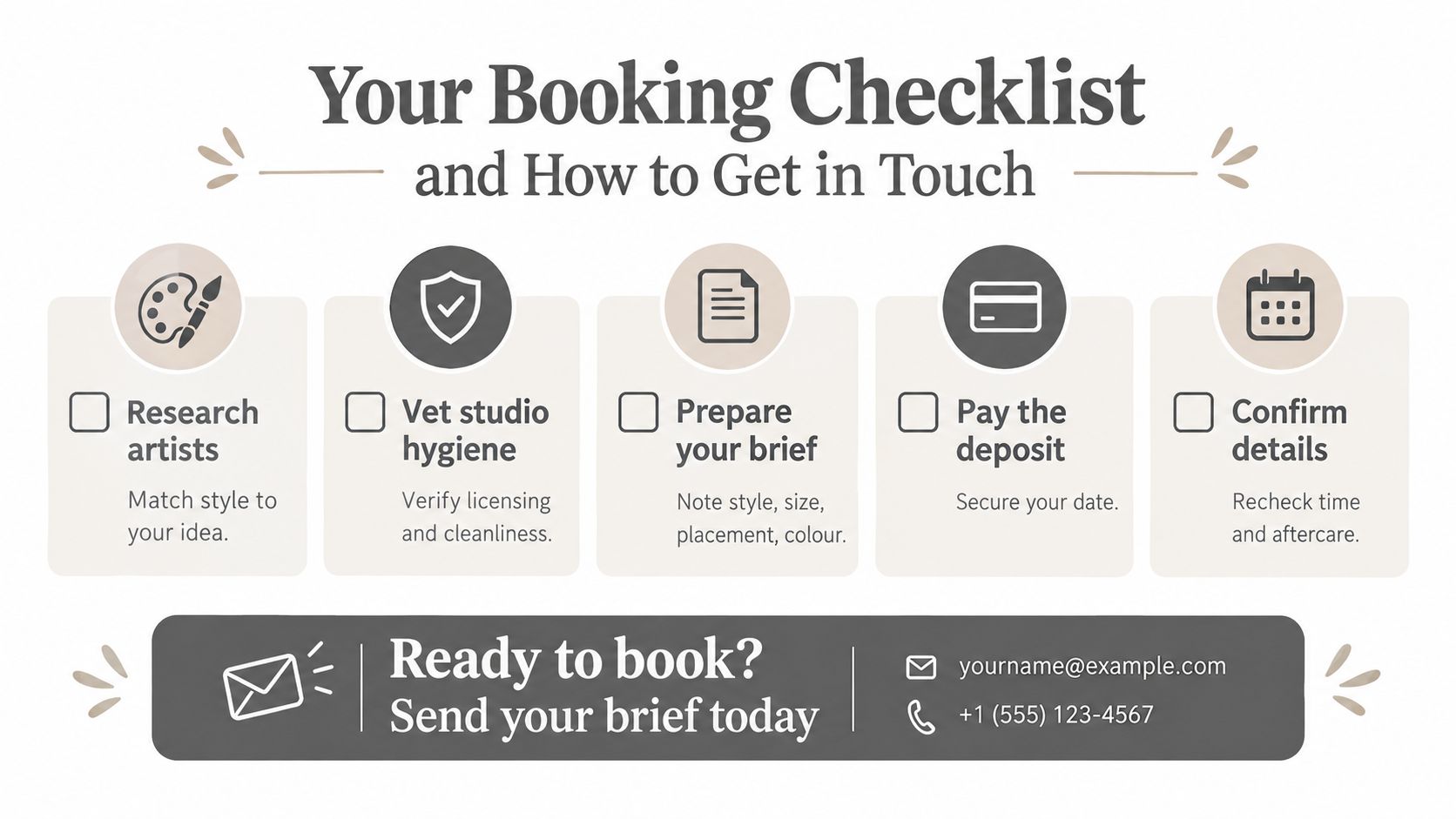
- Research artists: Match the style to the brief, not just the nearest chair.
- Vet studio hygiene: Check registration, cleanliness, and the way equipment is handled.
- Prepare your brief: Note style, size, placement, colour, references, and timeframe.
- Pay the deposit: Only after the booking details are clear in writing.
- Confirm details: Recheck time, arrival instructions, and aftercare before the day.
Use the route that suits your situation. Call if you want a fast answer, email if you've got images and details ready, fill in the online form if you prefer a structured booking, or drop in for a free consultation if you'd rather talk it through face to face. Both Bournemouth and Croydon are real options, and both work best when you arrive with a clear idea of what you want.
Book with confidence, not guesswork. Timebomb Tattoo & Piercing helps clients match ideas to the right artist, confirm the booking details properly, and move from enquiry to appointment without the usual confusion. If you're ready to talk through a tattoo or piercing, visit Timebomb Tattoo & Piercing, send your brief, or book a consultation and get the next step sorted today.