

You've got a Pinterest board full of koi, dragons and peonies, and perhaps a friend whose sleeve made you start thinking bigger. You can already picture the reveal. What's harder to picture is the months of planning, sitting and healing that come before it.
A Japanese back piece isn't a weekend decision. It's a long-term cultural and design commitment, shaped by your body, the artist's judgement and how carefully you plan each stage. Treat it as a lifecycle project: decide what the piece should say, choose an artist who can build a coherent composition, make room for the sessions and healing, and be honest about how difficult reversal can be.
Table of Contents
- Why a Japanese Back Piece Is a Different Kind of Decision
- How Traditional Japanese Composition Actually Works
- Choosing Motifs That Mean Something and Fit Together
- Sessions, Timeline and What Really Drives the Schedule
- Finding and Working with the Right UK Artist
- Aftercare That Actually Works Across a Full Back
- Cost, Payment and the Long-Term Financial Picture
- Your Next Step and How to Book
Why a Japanese Back Piece Is a Different Kind of Decision
A first-time client might arrive with a folder of screenshots and ask for a koi, a dragon and cherry blossoms, all somewhere on the back. Those references are a useful start, but they're not a finished design. They show what caught your eye, not how the pieces should work together across your body.
A full back is a substantial, planned project rather than a small, spontaneous design. UK tattooing provides a broad context for that kind of commitment: a nationally representative YouGov survey of adults in Great Britain found 26% had at least one tattoo, while 11% had a visible tattoo on areas such as the face, neck, forearms or hands. Tattoo ownership was highest among adults aged 25–54, at approximately 34–38% across the relevant age groups, according to the YouGov survey results. The figures don't tell us how many people choose Japanese imagery, but they do show that tattooing is familiar to a sizeable UK audience, while many people still choose placements covered by ordinary clothes. A back piece can offer detailed art without making it visible in everyday professional or social settings.
The back is the largest single canvas on the body, but it isn't a flat sheet of paper. The spine, shoulders, shoulder blades and lower-back curve affect how the image reads when you stand and move. A good artist will design for those landmarks, not force a pre-made picture onto them.
My advice: choose an artist as a collaborator, not a supplier. You're trusting them with a permanent design that will develop over multiple appointments, so the conversation matters as much as the first sketch.
The commitment also has a cultural dimension. Japanese tattooing has a history that reaches beyond contemporary studio trends, and its imagery deserves more care than a quick search for a motif's supposed meaning. The design process should leave you clear on what you want, why you want it, and how it will sit on your body.
How Traditional Japanese Composition Actually Works
A common consultation problem is a folder of striking but unrelated images. The fix is to stop treating each image as a separate purchase and start thinking in terms of composition.
A Japanese back piece usually has one central subject, supported by secondary figures and a background that carries the eye across the body. Water, wind, clouds, maple leaves, peonies and chrysanthemums can act as transitions between the upper back, flanks and lower back. They're not just filler. They help the main subject feel connected to the body rather than pasted into a space.
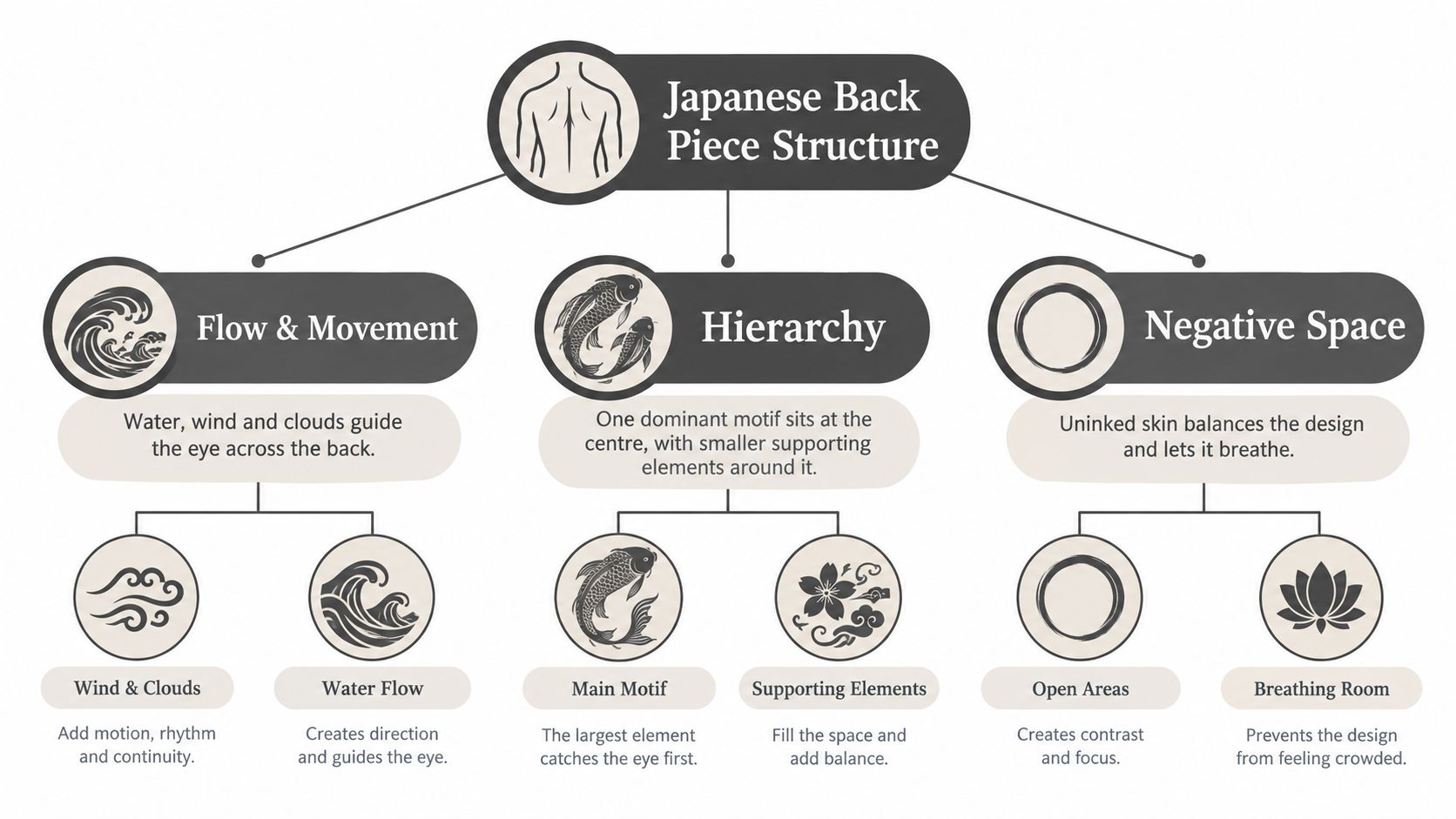
Think of the back as a mural on an uneven wall, not a sticker on a flat surface. The spine creates a central line, the scapulae shift as your arms move, the shoulders change the silhouette, and the lumbar curve affects how the lower composition sits. An experienced artist uses those working planes to guide placement and flow instead of pretending they aren't there.
Build a hierarchy, not a shopping list
Start with the hero subject. Then decide what supporting figures and background elements help the image move in a clear direction. Leave negative space where the design needs room to breathe. If every area is filled with an equally loud detail, the viewer's eye has nowhere to settle.
The visual hierarchy matters as the tattoo settles over time. Strong outlines, a saturated focal colour and controlled background contrast help the main image remain legible. Don't make the composition depend entirely on delicate grey transitions or pale details.
A useful starting point is to review examples of Japanese tattoo styles, then bring references to a consultation. The references should show what you respond to, not dictate a collage the artist must copy. Your artist's job is to build a framework around your body and preferences, then explain why certain elements belong where they do.
Choosing Motifs That Mean Something and Fit Together
The most common planning mistake is choosing every motif in isolation. A koi looks compelling in one image, a Hannya mask in another, and a peony in a third. That doesn't mean all three will make a coherent back piece together.
Koi, dragons, phoenixes, tigers, serpents, cherry blossom and peonies carry associations within Japanese tattoo traditions, but short online descriptions can flatten complex meanings into slogans. Ask your artist what a motif represents and how that reading fits the composition. Don't rely on a meme or a caption as your cultural research.
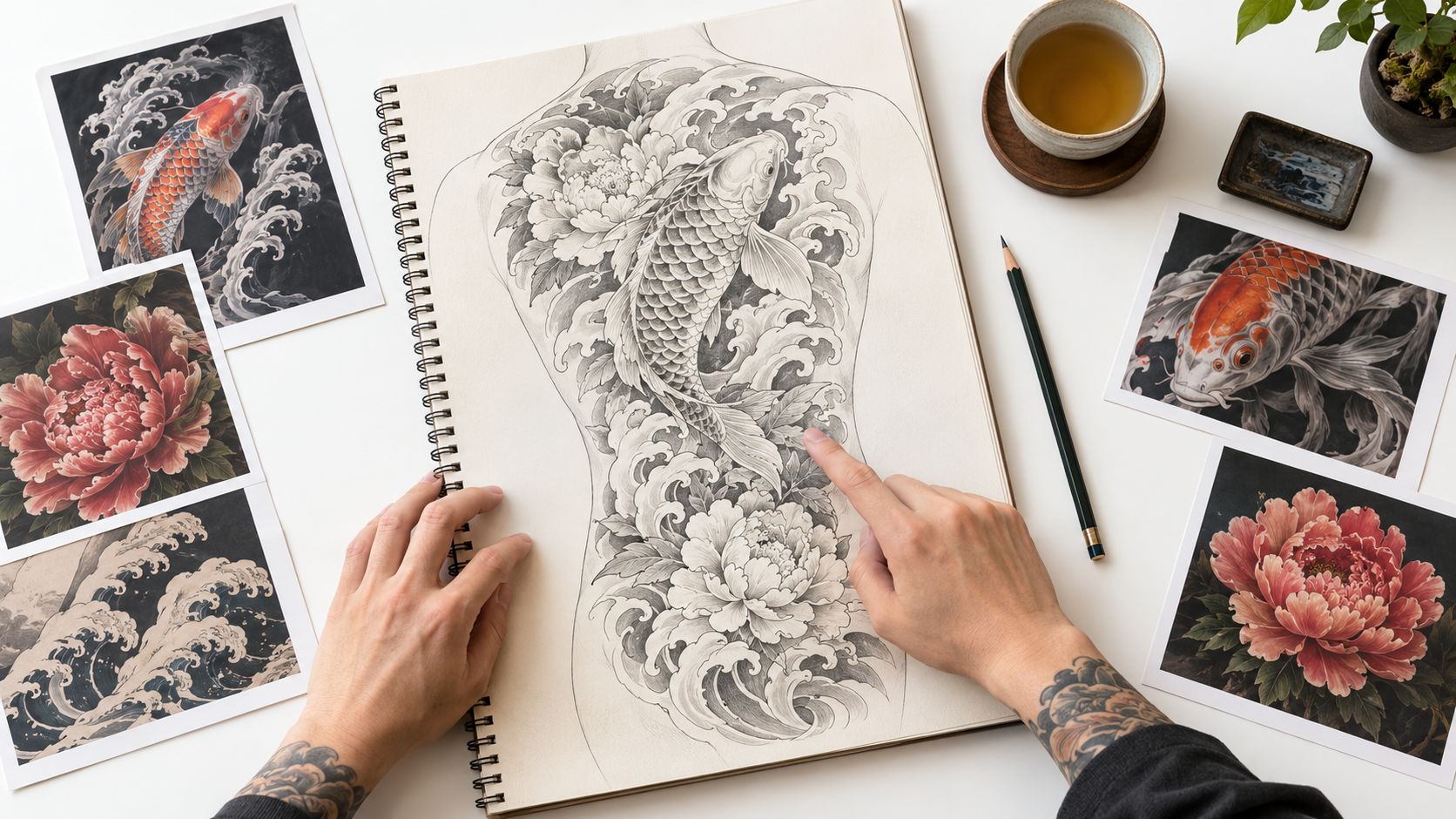
A strong piece isn't automatically the busiest one. One clear focal subject, well-placed supporting imagery and deliberate negative space usually produce a more readable result than a crowded collection of symbols. That restraint gives the artist room to create movement and lets each element contribute to the overall story.
Historical context matters, too. Irezumi has documented roots in Japan, and its social history includes periods of legal prohibition and stigma. The history of Japanese tattooing helps explain why traditional imagery shouldn't be treated as interchangeable with generic “Asian-style” design. If you're considering religious imagery such as Buddha or a specific deity, ask whether you understand its context and whether it belongs in your chosen composition. A thoughtful artist will raise concerns if a choice risks misrepresenting the source tradition.
Use these questions to make the consultation concrete:
- What does this motif mean? Ask for an explanation, then do your own reading rather than accepting a one-line label.
- Where is it traditionally placed? The answer can affect whether it belongs on your back and how it should face or move.
- Do my choices conflict? Ask the artist to explain how the subjects relate, not just whether they can draw them.
- Do I want historical grounding or a contemporary reinterpretation? Either can be a valid direction, but you should know which one you're choosing.
This short video can help you think about the difference between collecting images and planning a whole composition.
Your aim isn't to fit the most recognisable motifs into the available skin. It's to make one coherent story that respects the imagery and works with your anatomy.
Sessions, Timeline and What Really Drives the Schedule
A full back piece needs staged appointments. The exact schedule depends on the design, the artist's process, your availability and how your skin heals. Don't book as if the tattoo were one continuous procedure.
A practical sequence is to settle the composition first, then work through the main subject, shading, colour and finishing details. Some artists prefer to establish broad outlines early; others plan the work differently. Ask how your artist intends to build the piece rather than assuming a universal order or session length.
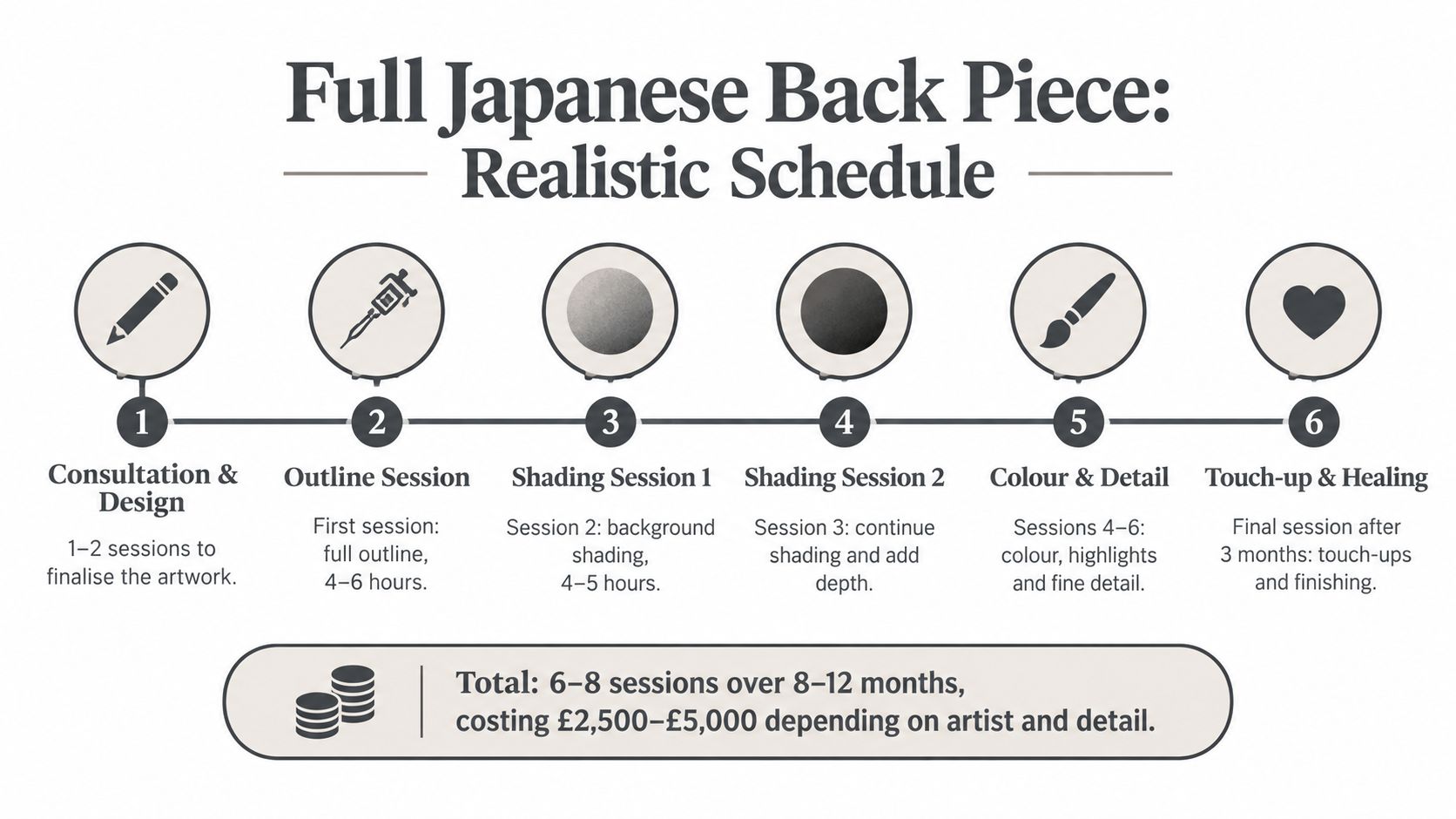
The key constraint is healing. A tattoo is a large wound, and adding new work over skin that hasn't healed properly can compromise the result. UK public-health guidance says scabbing commonly resolves after about two weeks, with complete healing taking a further 10–14 days. It also advises avoiding swimming, sunbeds and sun exposure until healing is complete. That supports spacing major sessions by roughly 3–4 weeks, subject to your artist's assessment and your own healing response. See the NHS aftercare advice for medical tattooing for the underlying healing guidance.
Plan for recovery, not just tattoo time. If your next appointment is booked before the skin is ready, reschedule. A gap in the calendar is cheaper than rushing work onto unhealed skin.
Your timeline needs room for more than the appointments. Work commitments, holidays, exercise routines and travel can all interfere with healing or make it harder to attend consistently. Talk through those pressures before booking, especially if your job involves heavy physical activity, friction against the back or extended time outdoors.
A useful planning sequence is consultation and design, first appointment, healing, the next appointment, then another round of healing and review. The actual number of sessions and total duration depend on the scale and detail of the design; ask the artist to give you a realistic working estimate and explain what might change it. Treat any timeline as a plan that must respect the skin, not a promise that every appointment will happen on a fixed date.
Finding and Working with the Right UK Artist
Don't choose an artist for a Japanese back piece by proximity or price alone. A portfolio full of fresh photographs may show technical confidence, but healed images tell you more about how the artist's work settles. Look for completed Japanese compositions, and ask whether the artist has experience designing full backs rather than only sleeves or smaller placements.
Before you commit, book a consultation and bring references that show what attracts you: line quality, colour, subject matter or background flow. Ask how the artist develops a custom design, what you'll see before the first appointment, how revisions work, what the deposit covers and how they handle cultural questions. Make sure you also discuss how they'll adapt the composition to your back.
Check registration and working practices
In England, Wales and Northern Ireland, local authorities regulate tattooing and body piercing primarily through the Local Government (Miscellaneous Provisions) Act 1982. Authorities can require both the practitioner and the premises to be registered. The House of Commons Library briefing on tattooing and body piercing sets out this regulatory framework.
Ask to see current registration, and ask the studio to explain its hygiene routine plainly. You should be comfortable with how staff handle sterile needles, clean work surfaces and manage pigments. If the studio won't answer questions about sterilisation or pigment safety, that's a reason to walk away, not a minor inconvenience.
Use this first-visit checklist:
- Review the portfolio: ask for healed photographs of substantial Japanese work.
- Discuss design: clarify what the artist will draw, how you'll review it and whether revisions are included.
- Agree expectations: ask about the deposit, payment timing, session planning and cancellation terms.
- Check hygiene: confirm the practitioner and premises are registered and ask how instruments and surfaces are prepared.
- Assess communication: notice whether the artist listens, explains decisions and can respectfully challenge a choice that won't work.
A local option for a consultation is Timebomb Tattoo & Piercing's Japanese tattoo artist information, which describes its custom tattoo work and artist matching. Compare any studio you consider using the same questions.
Aftercare That Actually Works Across a Full Back
Aftercare has to work across a large area, not just a small patch of skin. Follow the instructions your artist gives you, wash gently, pat dry rather than rub, and avoid picking at scabs. Wear clean, breathable clothing that won't catch on fresh work, and choose a sleeping position that avoids pressure or sticking against newly tattooed areas.
The awkward spots are often the ones that rub against chairs, seatbelts or backpack straps. Adjust what you carry and wear while those panels heal. Keep exercise light enough that it doesn't create repeated friction, stretch the skin excessively or leave sweat trapped against the tattoo. Ask your artist when it's sensible to return to your usual training, because the answer depends on the treated area and how it's healing.
For swimming, sunbeds and sun exposure, wait until the skin has completely healed. Chlorine and ultraviolet exposure can irritate healing skin and affect how pigment looks. Once the back is healed, protect it from excessive sun exposure rather than treating sun care as something that only matters during the first few days.
Ask about ink and know when to seek help
Before your appointment, ask which compliant, traceable pigments the studio uses and disclose known allergies. UK REACH decision materials identify restrictions on tattoo-ink substances associated with hazards including skin sensitisation and other health risks. Local-authority safe-practice guidance also notes that some colours may contain detectable copper or nickel, which can trigger reactions in susceptible people. For a large piece, pigment choice is part of the design discussion, not an afterthought.
If you have an MRI, tell the imaging staff that you're tattooed. MRI scans are generally possible, but NHS-linked MRI guidance records very rare cases of temporary superficial heating, with a suspected link to metal-containing compounds in some pigments. Report unusual heating or discomfort during a scan immediately.
Keep the tattoo healing guidance to hand, and seek medical advice if redness, heat, swelling or weeping worsens or persists. Don't try to diagnose an infection from a photograph or wait out symptoms that are getting worse.
Cost, Payment and the Long-Term Financial Picture
A full Japanese back piece is a substantial financial commitment, and the price depends on the artist, the design, the level of detail and how the work is scheduled. Don't ask for a finished quote before the artist has understood the composition. A rough figure without a design discussion isn't a meaningful budget.
You're paying for more than time under the needle. The price reflects design work, the artist's experience, sterile equipment, studio overheads and the planning needed to carry a coherent image across the back. Ask whether the studio charges by the session or estimates the project as a whole, what the deposit secures, and how payments are handled as the work progresses.
| Cost Driver | Why It Matters | What to Ask the Studio |
|---|---|---|
| Artist experience | Larger Japanese compositions demand careful planning and execution. | Have you completed full-back work in this style? |
| Design complexity | Multiple subjects, colour and detailed backgrounds affect the work involved. | Which elements are included in the estimate? |
| Session planning | The project is completed in stages, with healing time between appointments. | How do you charge for each appointment? |
| Aftercare and travel | Repeated visits and suitable aftercare add to the overall commitment. | What aftercare guidance do you provide? |
| Future revision | A settled tattoo may need assessment or a planned touch-up. | Is a follow-up review included? |
Build room in your budget for travel, aftercare products and a possible touch-up once the tattoo has settled. Don't commit to a design you can only afford if every stage goes exactly to plan.
The harder truth is that removal isn't a clean fallback. An NHS Scotland evidence summary on tattoo removal cites 71% clearance after approximately four sessions in one retrospective case series. The same summary lists circumstances that can make removal unsuitable, and NHS policy indicates that tattoo removal isn't routinely commissioned except in limited medical or coercion-related cases. A large, saturated, multicolour back piece should be planned on the assumption that it's permanent.
Your Next Step and How to Book
A good Japanese back piece comes from a clear design conversation, an artist you trust, realistic scheduling and disciplined aftercare. It doesn't come from rushing to secure the first available appointment or emailing a folder of images and asking someone to make them fit.
Start with a small, useful preparation list:
- Gather references: choose examples that show what you like about the style, such as linework, flow, colour or subject matter. Don't present them as designs to copy.
- Book a consultation: discuss meaning, placement, composition and practical constraints before committing to the work.
- Plan the calendar: make room for appointments and healing, and tell the artist about travel, work and exercise commitments.
- Ask about aftercare: understand what guidance and follow-up support the studio provides before the first session.
If you're in Bournemouth, the studio is at 109 Old Christchurch Road, Bournemouth, BH1 1EP. In Croydon, visit 22 George Street, Croydon, CR0 1PA. The studios offer free consultations to discuss ideas, size, placement and reference images; you can enquire by phone, email or online form through the website.
Don't book the tattoo just because you're excited about a motif. Book the conversation that will tell you whether the motif, composition, artist and timeline make sense together. That's the simplest responsible first step.
Timebomb Tattoo & Piercing offers custom Japanese tattoo consultations at its Bournemouth and Croydon studios, with ideas, placement and references discussed before booking. To talk through your back piece and arrange a consultation, visit Timebomb Tattoo & Piercing.